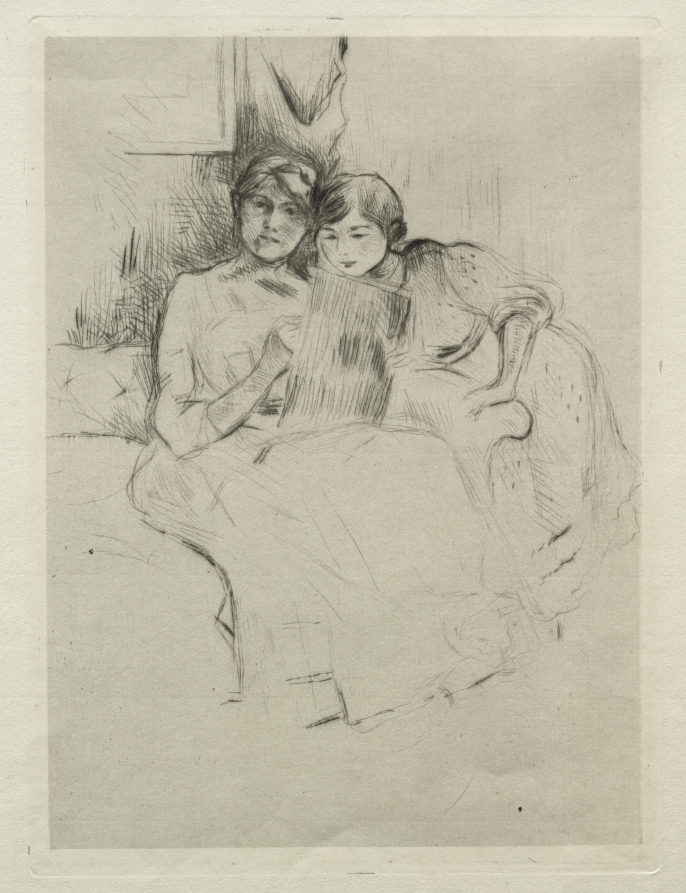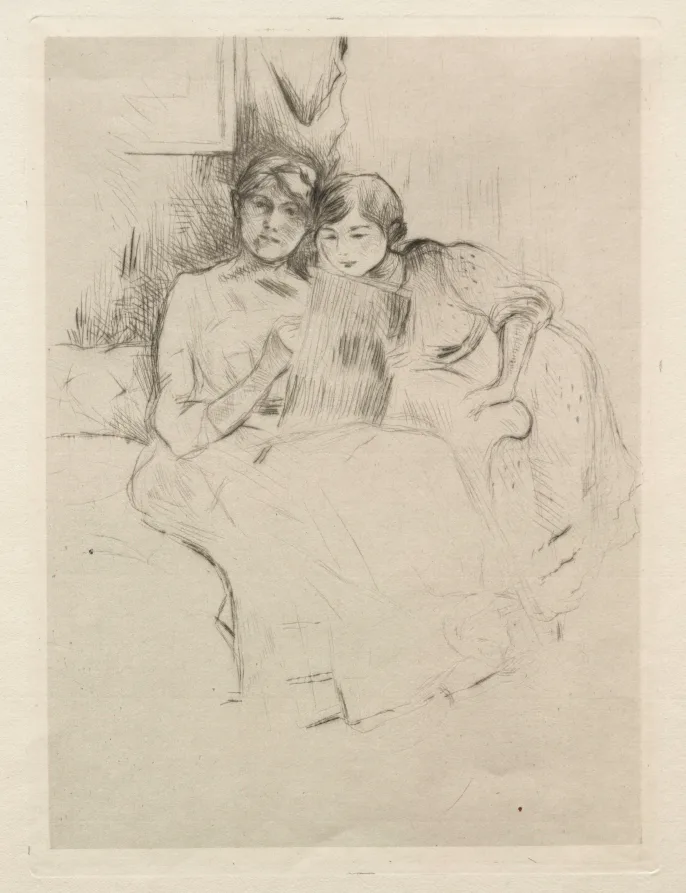
The artist looks toward us as her daughter leans in, making a picture about looking also a picture about learning.
The two heads are close, but their gazes do different work. Morisot looks outward, while her daughter Julie leans toward the activity between them. A drawing support rises from their laps, giving us a clue that this is not simply a double portrait. The museum describes the adult as appearing to draw our portrait, a reading that makes the viewer part of the pictured lesson without proving precisely who or what was actually being drawn.
This is a drypoint: lines were scratched directly into a metal plate and then printed. Morisot explored the medium during the late 1880s, encouraged by Mary Cassatt and Stéphane Mallarmé. Dense marks gather around the heads and the room behind them, while clothing remains more lightly traced. The contrast keeps attention on the shared activity. Artistic instruction appears within a domestic relationship, joining professional practice and family life instead of treating them as completely separate subjects.
The suggestion that Morisot draws the viewer is the museum’s interpretation of her gaze. The print identifies an artistic encounter, but it does not preserve the image on the drawing support clearly enough to identify its subject.
What links the figures through a shared activity?
Practise looking at The Drawing Lesson (Berthe Morisot Drawing with Her Daughter) →