Read the
Picture
An open collection
Iran, Seljuq period (1037–1194) · Ceramic

Luster Dish with Polo Player

Unknown maker · 1170–1200

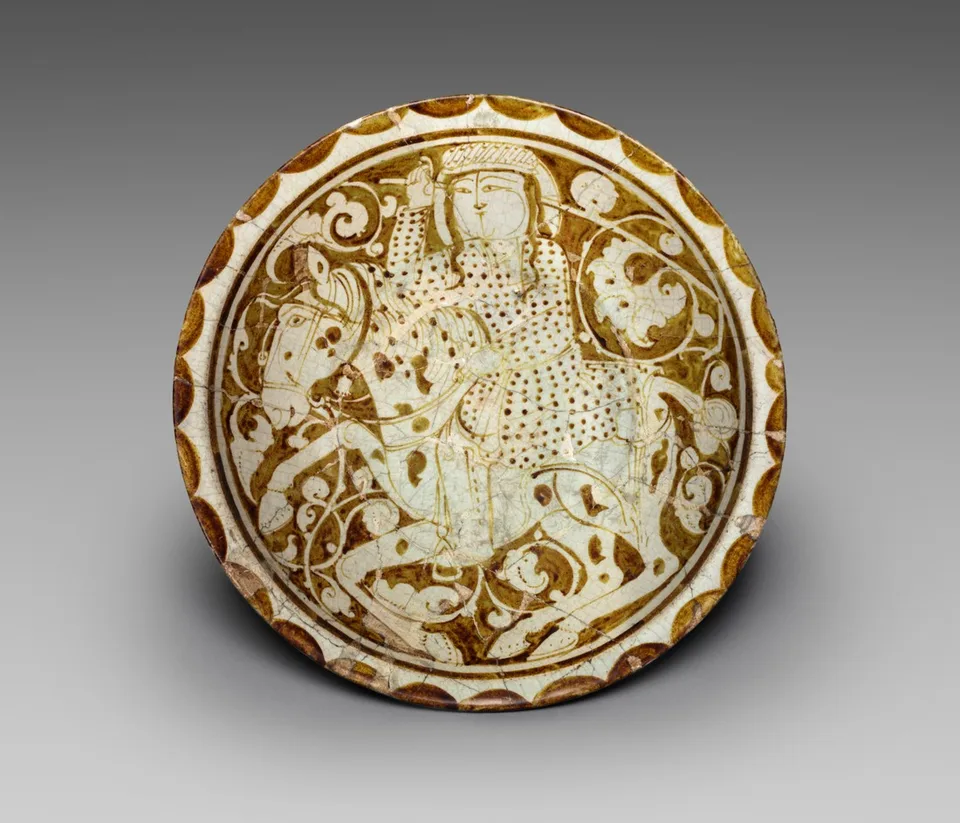
A shallow circular dish bears a pale horse and rider against a brown-gold patterned ground. The rider has a rounded face, long dark strands of hair and a spotted garment. One arm is raised beside the head, while the horse’s legs bend through the lower half. Cracks and joins cross the surface inside a decorated rim.
100%

Drag to move · Pinch or +/− to zoom · Arrow keys to pan · 0 to reset

The Cleveland Museum of Art · 1944.74 · Image: CC0Museum image ↗
A little context

Find the rider’s lifted arm within a circle crowded with curling plants.

A rider and horse nearly fill the centre of this dish, but they do not stand in an open landscape. Curving stems and leaves occupy the remaining spaces, and the circular border holds everything together. The horse’s bent legs suggest movement while its body becomes another patterned area. The rider’s dotted clothing, round face and carefully drawn features are as prominent as the action. The museum identifies the subject as a polo player and connects the face with an Iranian ideal of beauty.

The design is painted in luster on fritware, a ceramic body identified in the museum record. Instead of a wide range of colours, the maker builds the scene through pale reserves, fine lines and a brown metallic-looking ground. The record places the work in late-twelfth-century Iran and discusses Kashan as a major centre for luster pottery during this period. This establishes a useful context without identifying an individual potter. Looking around the rim also reveals the object’s later material history: visible joins and cracks interrupt the painted continuity, reminding us that the image and its support have survived together.

A careful reading

The museum identifies a polo player, but this photograph does not establish a particular match, person or narrative. Visible repairs also interrupt some of the original painted lines.
Try your eye

What most clearly makes the scene a dense decorative field?

Where this reading begins

  • Luster Dish with Polo Player — The Cleveland Museum of Art. Individual museum record supplies the qualified identification, material, date and historical context; observations refer to the inspected museum print photograph. Museum record updated 2026-11-10 12:42:49.559000; accessed 2026-11-14.

Our observations describe the supplied museum photograph. Historical identifications and context follow the cited collection record; interpretive limits are stated above. This is an independent guide, not a museum endorsement.

Image rights & attribution

Luster Dish with Polo Player, 1170–1200. Iran, Seljuq period (1037–1194). Fritware with luster-painted design; overall: 7.2 x 35.5 cm (2 13/16 x 14 in.). The Cleveland Museum of Art, Purchase from the J. H. Wade Fund, 1944.74

Individual API record marked CC0; checked 2026-11-14. CC0 1.0 dedication. Record date: 2026-11-10 12:42:49.559000. Complete museum print photograph resized and recompressed for local overview and WebP derivatives; numbered details are a separate overlay. No cropping or generated replacement.