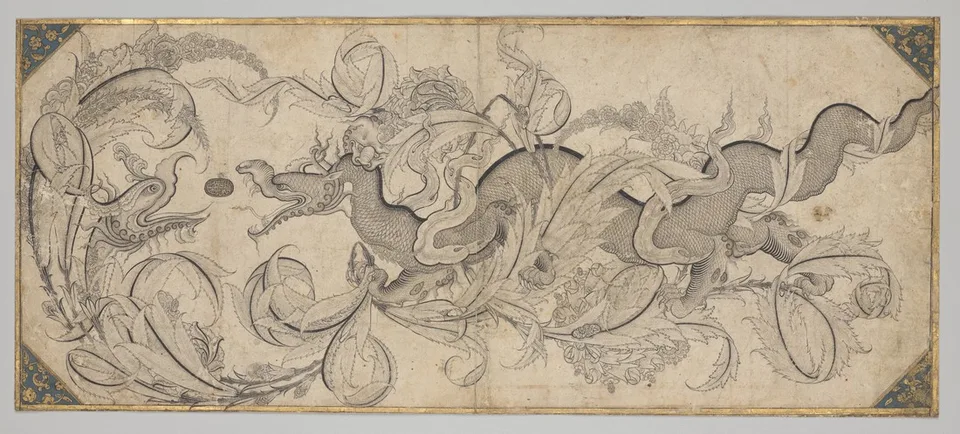
Trace the dragon’s body until leaves, flowers and other creatures interrupt its outline.
Begin with the dragon’s tail at the right and follow its scaled body toward the open mouth. The route is repeatedly interrupted by large leaves and smaller creatures. A flowering stem does not remain a plant for long: it can seem to become a head or a rival animal. The drawing invites this uncertainty between botanical growth and living bodies. Fine outlines keep the forms distinct enough to discover, while their shared curves bind the whole surface into a continuous tangle.
The museum attributes the work to Sahkulu, an artist active in the Ottoman imperial workshop in Istanbul during the sixteenth century. It identifies the small oval before the dragon as a pearl-like seal bearing a Qur’anic verse expressing trust in God. A phoenix competes for it, while a lion produced by the flowering branches bites the dragon’s neck. Those identifications turn apparent ornament into a scene of pursuit and conflict. The attribution remains qualified, and the drawing’s many visual connections need not resolve into a single moral message. Looking can begin with the lines before deciding how the fantastic encounter should be interpreted.
The attribution to Sahkulu is qualified. The small inscription and the creatures’ identities follow the museum record; visual resemblance alone does not establish a single intended allegory.
What makes the dragon’s outline difficult but rewarding to follow?
Practise looking at Dragon in foliage with lion and phoenix heads →