Creatures between pattern and action
A creature may be a useful shape, a courtly subject, a component of writing or an unstable hybrid with foliage. Compare how recognition works on curved metal, ceramic and paper. The objects share imaginative animals, but their functions and source traditions remain distinct.
Begin the journey ↓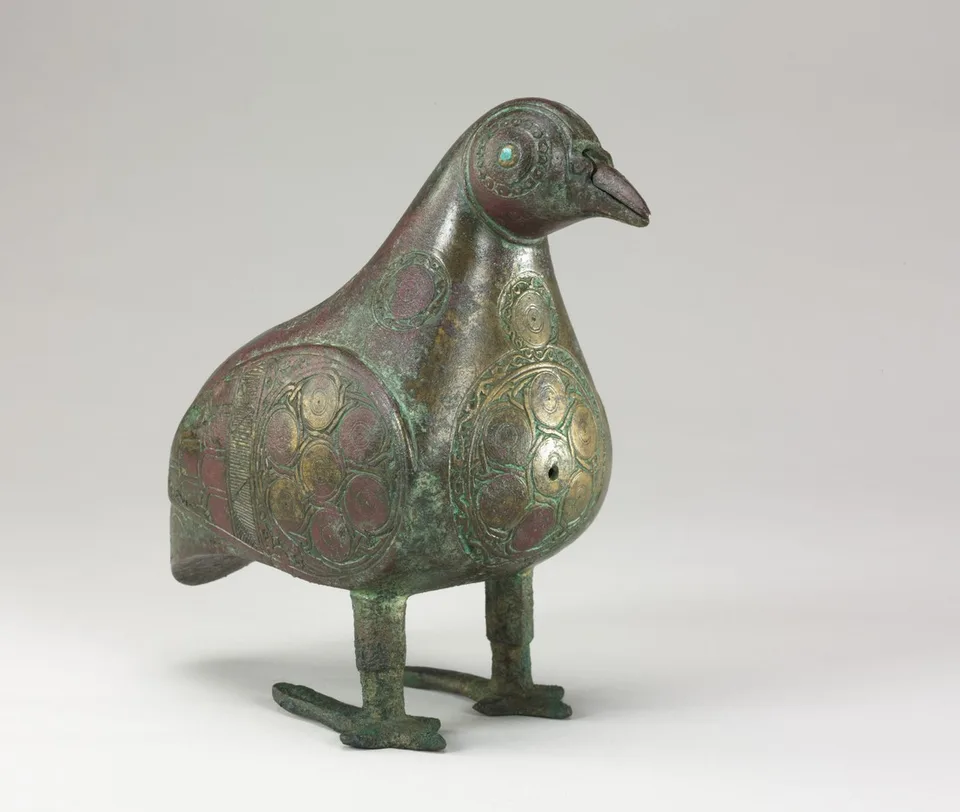
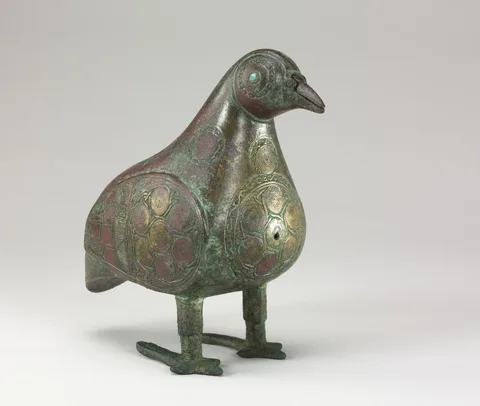
Give a beak a possible mechanism
The hinged beak supports the museum’s proposed water-pouring function. The bird’s outline therefore offers a practical hypothesis, while its original use and protective meanings remain qualified.
Carry this question: What would the beak do if the vessel held water?
Open the artwork ↗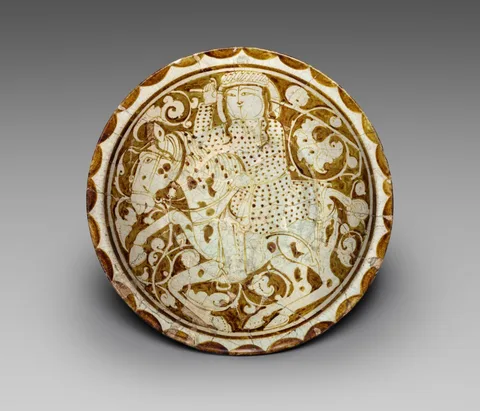
Set a player inside ornament
The raised arm helps establish action within a densely patterned circular field. The museum’s polo identification supplies a specific sport, while the face belongs to an ideal rather than a named player.
Carry this question: How does the raised arm remain legible among the surrounding curls?
Open the artwork ↗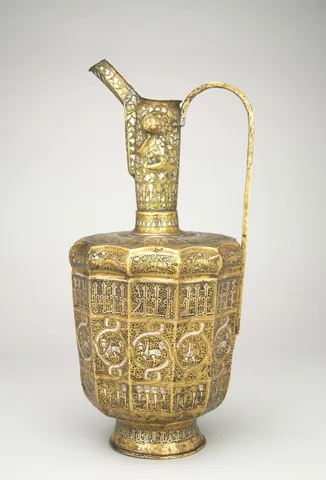
Find faces inside writing
Human heads enter the inscription’s letter forms. This deliberately animated script prevents a simple division between text and picture on an otherwise carefully banded vessel.
Carry this question: Where does the writing begin to behave like a procession of figures?
Open the artwork ↗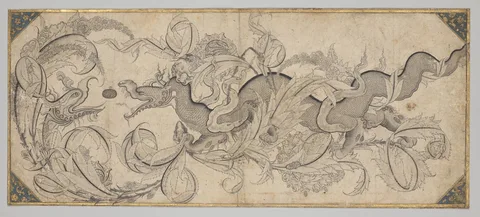
Follow a shifting boundary
A lion’s head emerges from flowering branches to bite the dragon. Similar curves let plant and animal overlap, while the attribution to Sahkulu remains explicitly qualified.
Carry this question: At what point does a branch become part of an animal?
Open the artwork ↗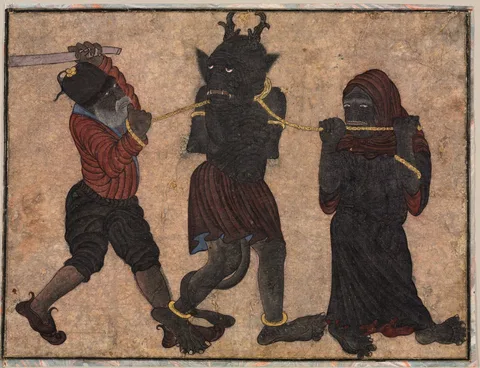
Read a relationship before a story
The bright chain connects the captive div with the surrounding figures. It makes coercion visible, even though the museum does not identify one specific episode or name every participant.
Carry this question: What can the chain tell you without an invented before-and-after story?
Open the artwork ↗Look at a pair more closely
- When foliage becomes a creature
A Khmer lintel and an Ottoman drawing
- Birds and the pouring of water
A surviving vessel and a proposed machine
Read with the sources
Historical context follows the individual museum records linked on each artwork page. These routes make original comparisons of visible form; resemblance alone is not evidence of shared meaning or direct influence.
- Bird-shaped Vessel — museum collection record
- Luster Dish with Polo Player — museum collection record
- Twelve-sided Ewer with Sphinxes and Human-Headed Inscriptions — museum collection record
- Dragon in foliage with lion and phoenix heads — museum collection record
- Demon in chains — museum collection record