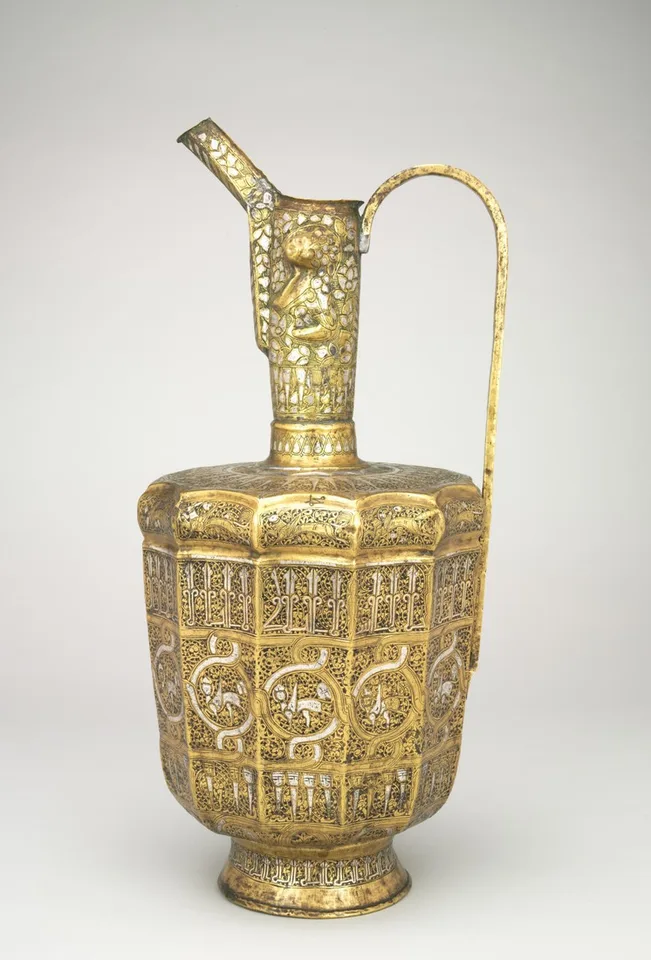
Follow animal bodies and human heads as they move through the vessel’s decoration.
The sharply divided body of this ewer gives its decoration a series of narrow stages. Some bands repeat upright forms; others hold animals within rounded compartments. Above them, the neck carries a lion in relief. The viewer must move between the vessel’s large silhouette and the small inhabitants of its surface. Its high arching handle and projecting spout retain a practical purpose, but nearly every available area becomes an opportunity for detailed ornament.
The museum dates the ewer to the early fourteenth century in Khurasan, Iran, during the Ilkhanid period. Hammered brass forms the body and silver inlay supplies much of the lighter design. Its catalogue identifies sphinxes, winged hare-like creatures and inscriptions furnished with human heads. These are specific identifications within a varied programme, not interchangeable examples of animal symbolism. The record places comparable elaborate vessels in elite households and court banquets. This photograph supports looking closely at one side, while leaving much of the encircling design beyond view; turning the object would reveal relationships that a frontal image cannot reproduce.
The photograph shows only part of a design that encircles the vessel. Identifications of the small composite creatures and inscriptions follow the museum; their complete texts are not supplied here.
Which detail combines the forms of writing and human figures?
Practise looking at Twelve-sided Ewer with Sphinxes and Human-Headed Inscriptions →