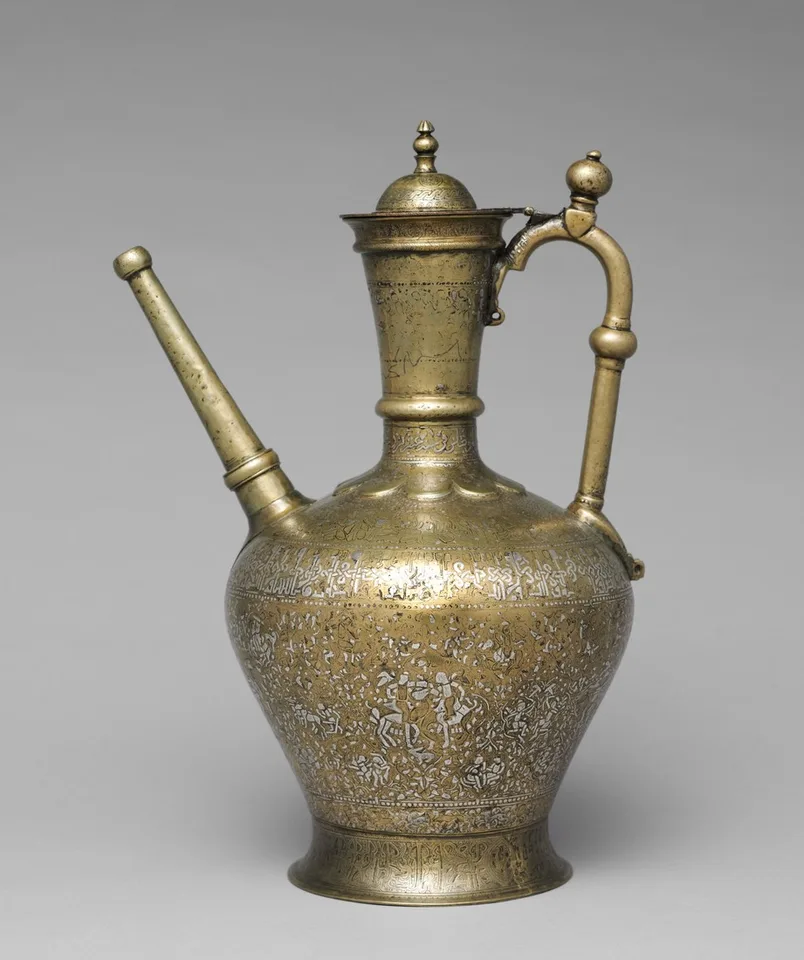
Look past the tall spout to find small courtly scenes in silver.
At first the long spout and high handle make this ewer look like a study in pouring. Moving closer reveals another scale of activity: tiny figures occupy shaped compartments across its body. The museum identifies scenes of courtly and daily life, including hunting, falconry, dancing and music. Silver inlay distinguishes these scenes from the brass beneath them, while interlacing plant forms fill the surrounding spaces. The curved vessel offers only part of this decorative programme in any one view.
The object is dated 1223, and its inscriptions name Ahmad al-Dhaki al-Mawsili. The record associates it with Iraq, possibly Mosul, while retaining uncertainty about that place of manufacture. A band around the shoulder extends wishes for the owner’s prosperity and well-being. Those words make luxury explicit: the ewer offered admiration and good fortune along with practical service. Its present silhouette also includes later interventions. Both the lid and base are recorded as additions, so the apparently coherent shape should not be assumed to have emerged from one workshop at one time.
The lid and base were added later, and Mosul is only a possible place of manufacture. The curved body hides scenes that this single photograph cannot show.
Which feature should be read as a later addition?
Practise looking at Luxury Ewer Extending Good Fortune to the Owner →