Marks that do different jobs
Visible marks can bless an owner, organise a courtly scene, explain a mechanism or remain undeciphered. These works ask for different kinds of reading. Follow what the marks visibly connect, then notice when the museum supplies a translation, a technical interpretation or an explicit limit.
Begin the journey ↓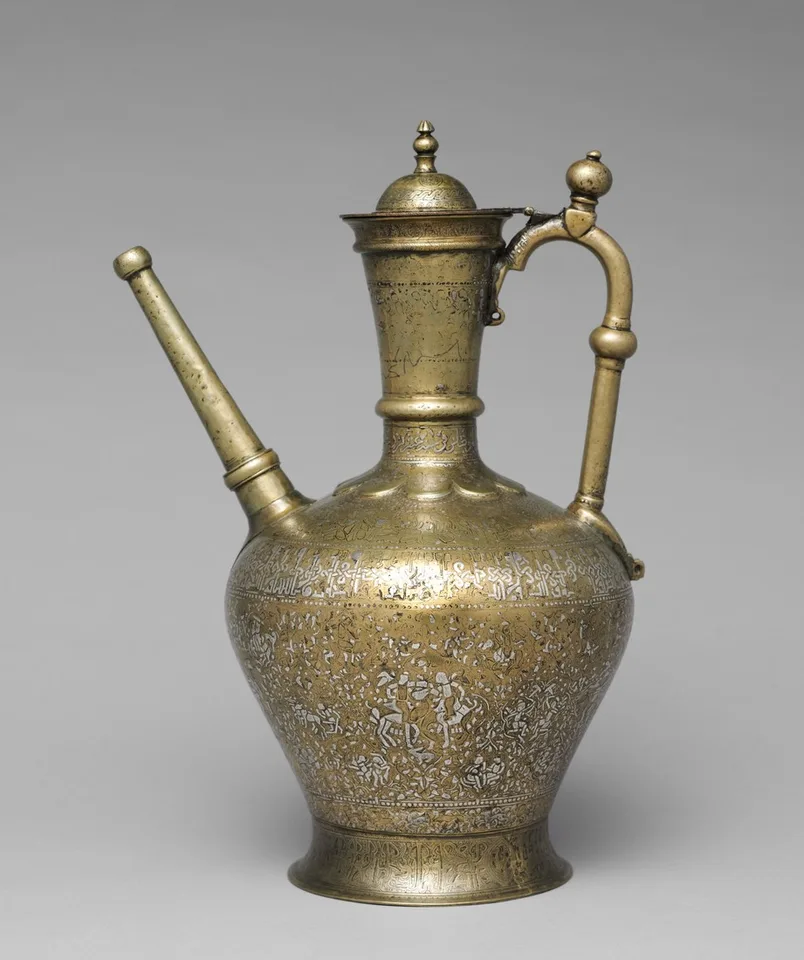
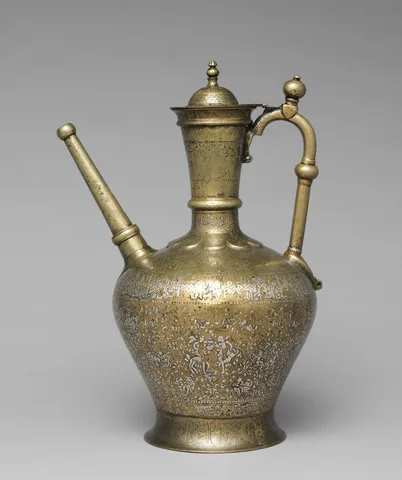
Place good wishes above courtly life
An inscription circles the shoulder above miniature scenes. The museum’s translation supplies wishes for the owner, while the later lid reminds us that the complete-looking vessel has undergone alteration.
Carry this question: How do writing and pictured pleasures support one another here?
Open the artwork ↗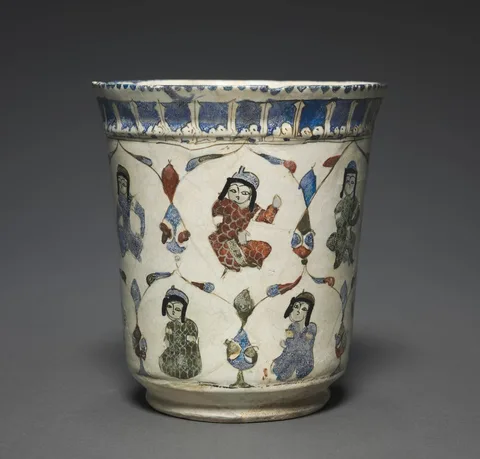
Use colour to separate figures
Blue, red, green and black distinguish small seated figures on a curved surface. The enamel technique makes variety possible, but the repeated setting does not describe a securely identified court gathering.
Carry this question: Which colour helps you separate one figure from the next?
Open the artwork ↗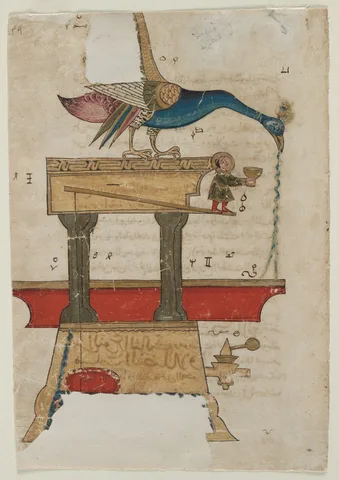
Read a design as a proposal
The drawn housing exposes a mechanism around a peacock-shaped outlet. It explains an intended handwashing device, yet the museum does not know that this exact machine was ever constructed.
Carry this question: What is the difference between drawing an operation and proving it was built?
Open the artwork ↗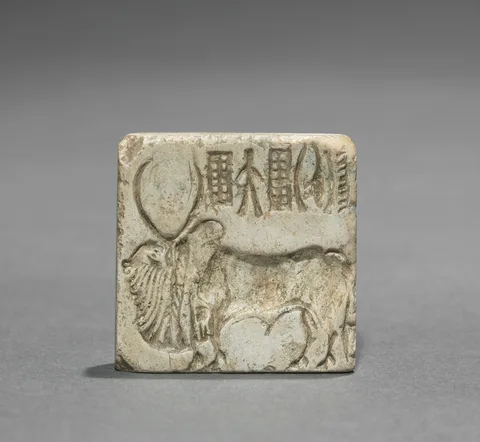
Describe signs without translating them
The bull is recognisable while the adjacent script remains undeciphered. This contrast makes a useful discipline: careful description can be informative even when reading the inscription is not possible.
Carry this question: Which features can you describe without claiming to know what the signs say?
Open the artwork ↗Look at a pair more closely
- Two ways to colour a small scene
Blue outlines and enamel scenes in China and Iran
- Birds and the pouring of water
A surviving vessel and a proposed machine
- Images beside readable and unread signs
An Indus seal and a Korean sacred opening
Read with the sources
Historical context follows the individual museum records linked on each artwork page. These routes make original comparisons of visible form; resemblance alone is not evidence of shared meaning or direct influence.
- Luxury Ewer Extending Good Fortune to the Owner — museum collection record
- Mina'i Beaker with Seated Princes — museum collection record
- Peacock-shaped Hand Washing Device: Illustration from The Book of Knowledge of Ingenious Mechanical Devices (Automata) of Ibn al-Razza al-Jazari (recto) — museum collection record
- Seal with Two-Horned Bull and Inscription — museum collection record