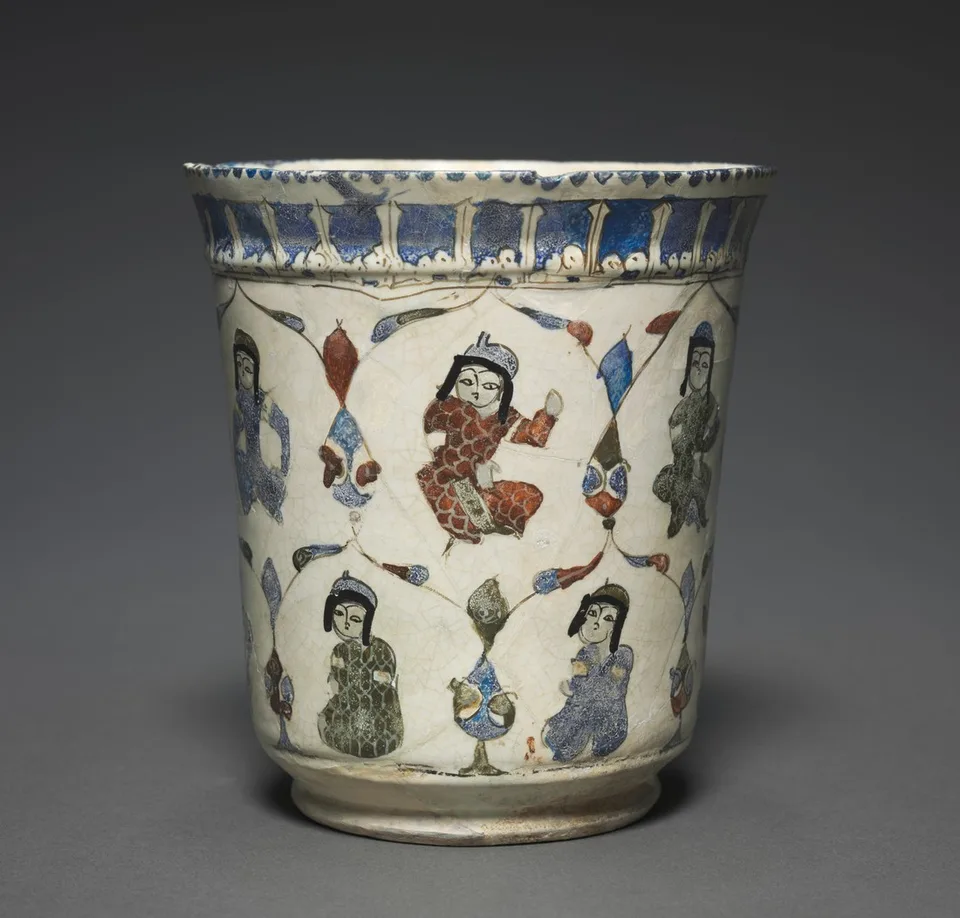
Compare the seated figures and the coloured loops that hold them together.
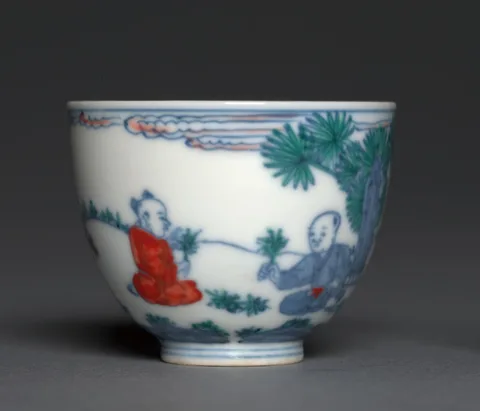
The figures on this beaker are small enough to become part of a repeating pattern, yet their faces and gestures invite individual attention. A red-clad figure near the centre raises a hand, while seated figures below balance it on either side of a stem. Curving lines link the surrounding coloured forms. The decoration therefore works both as a group of people and as a network wrapping around a useful object. Looking from one fixed viewpoint reveals only a portion of that network.
The museum identifies the object as mina’i ware from Kashan in Iran. Its name relates to enamel, and its overglaze decoration allows several colours to share the ceramic surface. The record connects this luxurious pottery with courtly imagery, including seated princes and scenes reminiscent of book illustration. Here those painted figures inhabit a vessel rather than a flat page. Their arrangement should not be converted into a claim that a specific ruler is portrayed: the title identifies a princely subject, while the photograph lets us examine how colour, outlines and repetition make that subject decorative.
The princely subject does not identify a particular ruler or event. The vessel curves away from the camera, so the visible arrangement is only part of its complete decoration.