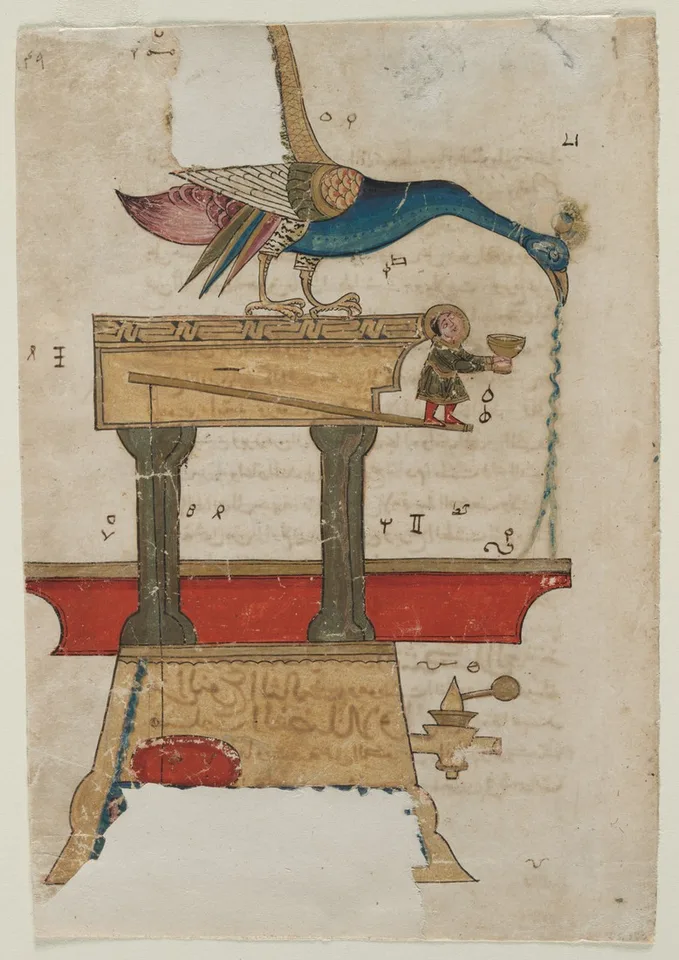
Trace the painted stream from a peacock’s beak into a mechanical diagram.
This peacock performs a technical task. Its neck bends down so that water can emerge from the beak, while a small figure holding a bowl occupies the structure below. The illustration combines an attractive animal form with a diagram of a washing device. Rather than placing the bird in a natural landscape, the artist gives attention to supports, chambers, a basin and scattered labels. Following the blue stream provides a simple route into an image that otherwise contains many unfamiliar parts.
The leaf comes from a Syrian manuscript dated 1315, copying al-Jazari’s book of mechanical devices completed in 1206. The museum describes the design as an automaton for handwashing and places it within a longer tradition of engineered vessels and machines. That context matters because the image is evidence of technical imagination and communication, not merely decoration. It is not, however, proof that this particular mechanism was built. Nor does a single detached illustration provide enough information to reconstruct every moving part. The page invites us to consider how a drawing can make an engineered action intelligible without being the machine itself.
The museum states that construction of this particular device is uncertain. A detached illustrated leaf is not a complete working plan, and the small labels are not translated here.