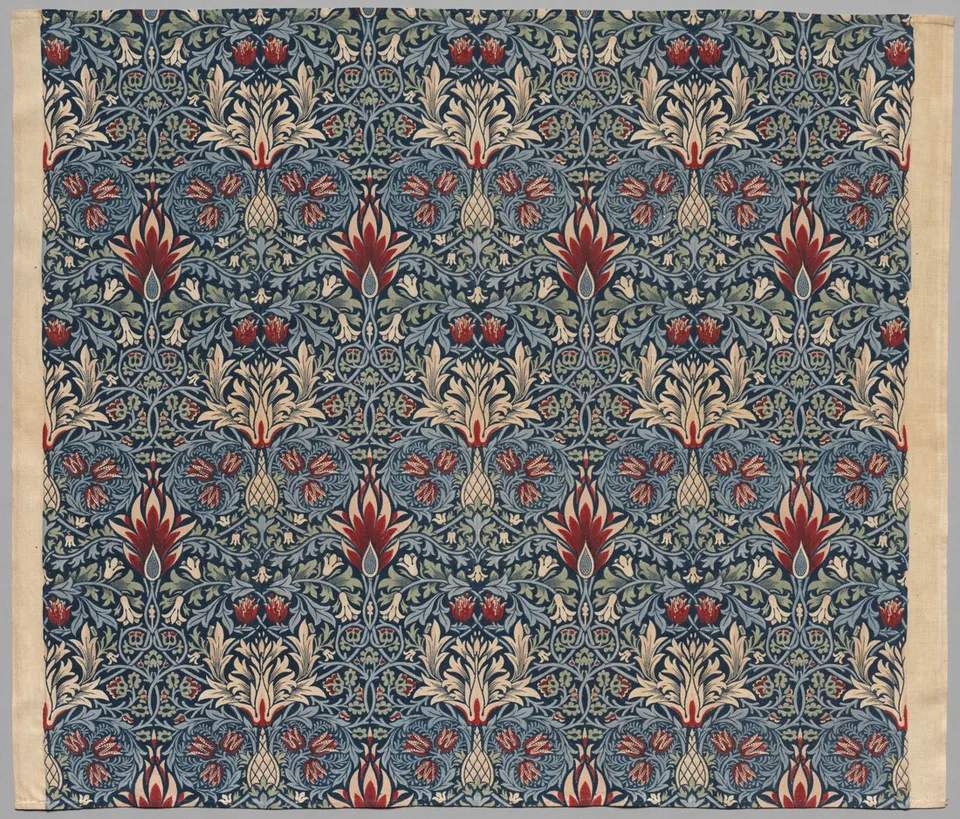
Red flowers repeat across a dark field, but this particular cloth belongs to a later imitation of an earlier design.
The pattern rewards two distances of looking. From farther away, the pale branching shapes and red points create a steady rhythm. Closer in, curling stems and small leaves fill the gaps, so the ground rarely becomes empty. The offset rows keep the repeat from reading as a rigid grid, even though the motifs recur with evident regularity.
The museum dates this cloth to the early twentieth century and credits it as designed in imitation of William Morris. That wording matters: Morris’s original Snakeshead design dates to 1877, but this is a later object. The record connects its strong palette with Indian silks imported from British India and fashionable in Britain while identifying the fritillary as an English wildflower Morris remembered near Oxford. The fabric therefore combines several histories of taste and recollection. Its printed repetition makes those sources available as a surface for an interior, rather than as a single framed botanical specimen.
The textile is a later imitation, not securely an original Morris-period printing. Indian silk influence concerns fashion and color here; it does not make the English floral pattern an Indian design.