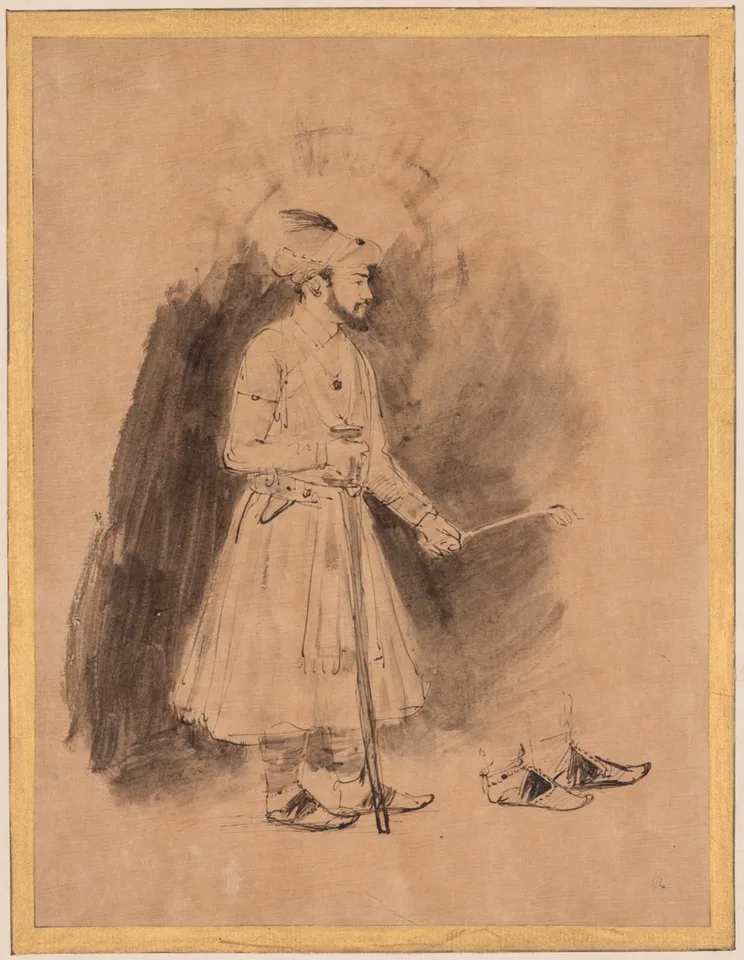
Fine lines, dark washes, and a scratched halo transform a Mughal ruler’s image as it travels into a Dutch drawing.
The ruler’s face is drawn with a precision that contrasts sharply with the loose washes behind him. His long robe remains mostly the color of the paper, articulated by fine lines and small marks. Near his head, a lighter arc interrupts the surrounding ink. The separately drawn shoes at the lower right make the sheet feel exploratory even as the standing figure retains formal dignity.
Rembrandt made this image after a Mughal miniature, one of twenty-three such drawings known to the museum. It represents Shah Jahan, emperor from 1628 to 1658; it does not document a meeting between artist and sitter. The model probably reached Rembrandt through an album in Holland and is now in Vienna. His use of costly Japanese paper and careful work suggest particular attention to these sources. The museum explains that he scratched away ink and paper around the head, adapting an existing convention through a physically different process.
This is a European artist’s interpretation of another image, not a portrait drawn from Shah Jahan’s presence. Its formal differences should not be ranked as proof that one tradition was more truthful.