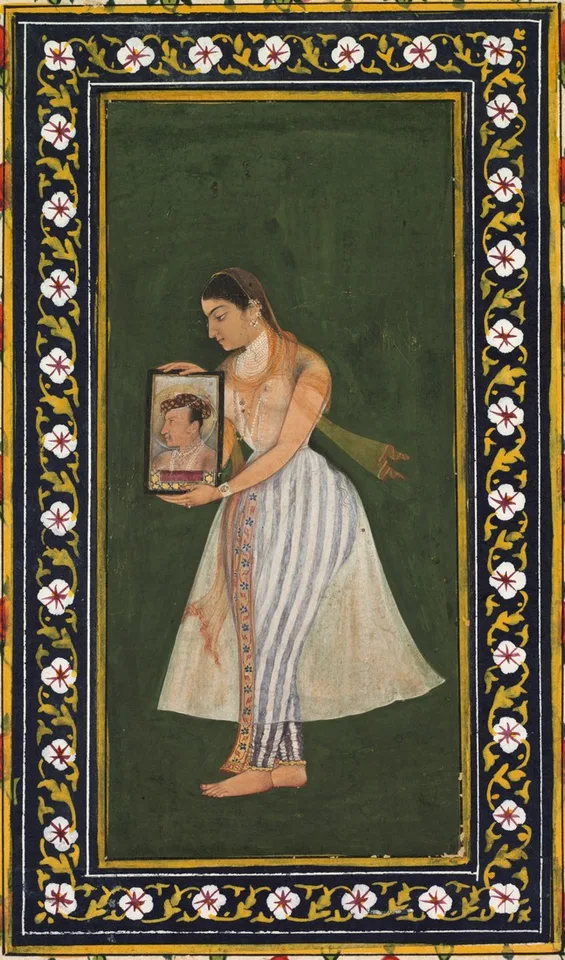
Nur Jahan holds an emperor’s image, making a portrait within a portrait carry a possible claim to continuing authority.
The smaller portrait is the key object. The woman holds it carefully before her body, presenting the emperor’s face while her own turns toward it. A dark green ground isolates the exchange, and the floral border gives the image a formal, precious setting. Her youthful face and delicate clothing create an idealised presence rather than a straightforward record of age.
The museum identifies her as Nur Jahan, Jahangir’s wife, who conducted much of the business of government. The emperor appears older in the held portrait, while she is shown young despite being about fifty at his death in 1627. The record suggests a connection with images of Jahangir holding his deceased father’s portrait to assert succession. Nur Jahan’s image may similarly express a desire to retain power. That political reading is persuasive context, but remains an interpretation rather than a declaration visibly written into the scene.
The political analogy is proposed by the museum, and Nur Jahan’s youthful appearance is idealised. The painting should not be treated as a literal record of her age or a documented ceremony. The museum records an attribution to Bishandas without naming an artist in its caption.
Which feature makes the relationship to imperial authority visible?
Practise looking at Nur Jahan holding a portrait of Emperor Jahangir →