Read the
Picture
An open collection
Northern India, Pahari kingdoms · Other

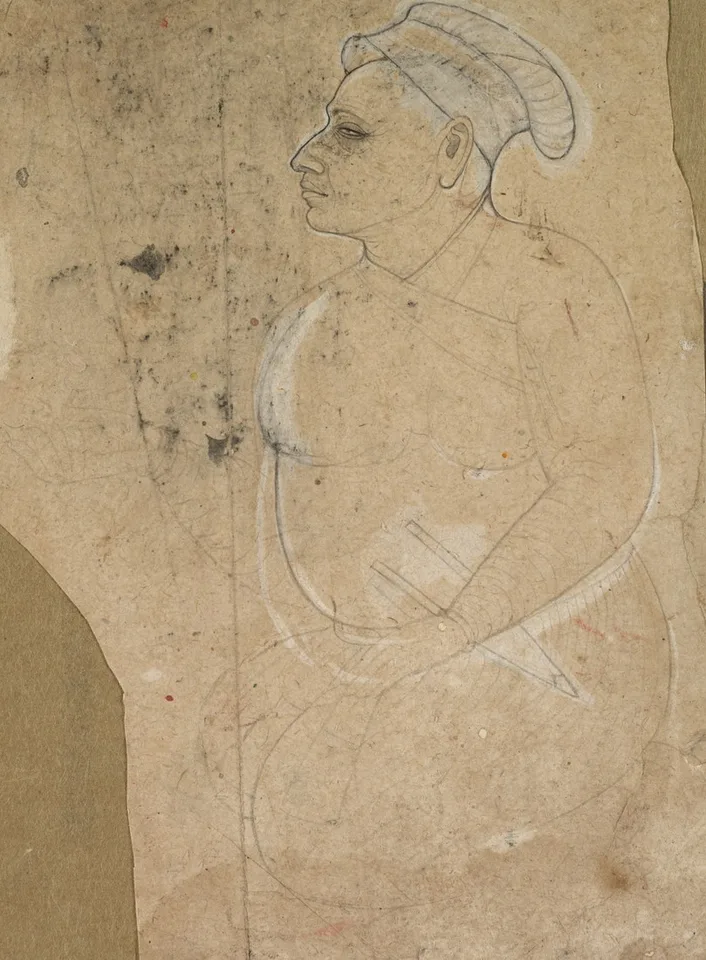
Portrait of a blind man

Unknown artist · c. 1750

A fragmentary drawing on worn tan paper shows a seated man in profile facing left. He wears a folded head covering and a tunic, with a dagger tucked diagonally at his waist. His face is more strongly outlined than the faint raised hand and lower body. White strokes alter parts of the shoulder and torso, and an irregular missing area cuts into the lower left.
100%

Drag to move · Pinch or +/− to zoom · Arrow keys to pan · 0 to reset

The Cleveland Museum of Art · 1968.41 · Image: CC0Museum image ↗
A little context

Follow the white revisions around a lightly drawn figure on a damaged sheet.

The strongest lines belong to the face. A projecting nose, slightly parted lips and a narrow eye give the profile concentration, while much of the body remains faint. White strokes around the shoulder and torso reveal adjustments rather than a finished field of colour. The museum describes the sheet as a surviving fragment of a study for a larger painting. What looks sparse or interrupted therefore reflects both a working process and the incomplete survival of the paper.

The title identifies the sitter as a blind man. The museum reads his tunic and the katar dagger at his sash as signs of noble status, and suggests that he was probably Hindu on the basis of the tunic’s fastening. It also proposes that this might be a posthumous portrait of Sital Dev of Mankot, who died decades before the drawing was made. Neither that identity nor the interpretation of his faint raised hand as making a request is certain. The revised contours are visible evidence of the artist’s working process; the sitter’s biography remains a historical question.

A careful reading

The museum proposes Sital Dev of Mankot as a possible posthumous subject. His identity, religious affiliation and requesting gesture remain qualified interpretations, and the larger painting is not supplied.
Try your eye

Which detail most directly reveals the artist revising the drawing?

Where this reading begins

  • Portrait of a blind man — The Cleveland Museum of Art. Individual museum record supplies the qualified identification, material, date and historical context; observations refer to the inspected museum print photograph. Museum record updated 2026-09-04 20:15:38.482000; accessed 2026-11-14.

Our observations describe the supplied museum photograph. Historical identifications and context follow the cited collection record; interpretive limits are stated above. This is an independent guide, not a museum endorsement.

Image rights & attribution

Portrait of a blind man, c. 1750. Northern India, Pahari kingdoms. Gum tempera on paper; overall: 18 x 13.3 cm (7 1/16 x 5 1/4 in.). The Cleveland Museum of Art, Cornelia Blakemore Warner Fund, 1968.41

Individual API record marked CC0; checked 2026-11-14. CC0 1.0 dedication. Record date: 2026-09-04 20:15:38.482000. Complete museum print photograph resized and recompressed for local overview and WebP derivatives; numbered details are a separate overlay. No cropping or generated replacement.