Read the
Picture
An open collection
Japan, Kamakura period (1185–1333) · Sculpture

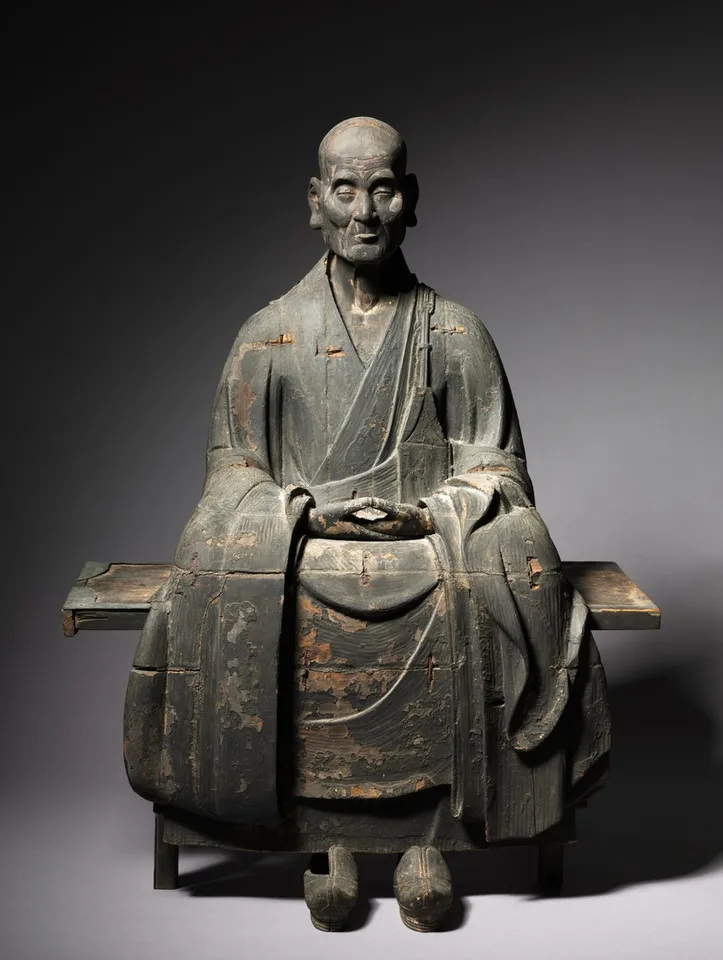
Portrait of Hottō Enmyō Kokushi

Maker unrecorded · c. 1295–1315

A dark seated wooden monk faces forward on a low chair. His shaved head has strongly modelled brows, cheeks and a closed mouth. Broad layered robes cover the body and arms; the hands meet at the centre. Two shoes rest below, and worn patches reveal changes in the surface.
100%

Drag to move · Pinch or +/− to zoom · Arrow keys to pan · 0 to reset

The Cleveland Museum of Art · 1970.67 · Image: CC0Museum image ↗
A little context

A monk’s particular face emerges from broad, quiet folds, making the difference between bodily detail and personal presence unusually clear.

The face receives a different degree of attention from the robe. Individual contours around the brows, cheeks and mouth stand out above large, comparatively simplified folds. The hands rest together at the centre, and the seated posture establishes stability. Looking from head to lower body reveals how a sculptor can suggest a particular person without describing every part equally.

The portrait represents the Zen monk Shinchi Kakushin, known by the posthumous title Hottō Enmyō Kokushi, bestowed by Emperor Go-Daigo. The museum associates this emphasis on the face with Kamakura realism. The honorific records religious and institutional recognition, but it should not make us confuse the sculpture with an unmediated encounter with the living monk. Its date spans the years around his death, and the present worn surface and museum setting differ from its earlier place within a temple collection.

A careful reading

A detailed face is still a constructed portrait, not an unfiltered likeness. The posthumous title and present surface should be distinguished from the monk’s living appearance.
Try your eye

Where does the sculptor concentrate the strongest sense of individual likeness?

Where this reading begins

  • Portrait of Hottō Enmyō Kokushi — collection record — The Cleveland Museum of Art. Supports dating, materials, attribution, provenance and the contextual reading; observations describe the individually inspected museum photograph. Museum record updated 2026-08-22; accessed 2026-11-14.

Our observations describe the supplied museum photograph. Historical identifications and context follow the cited collection record; interpretive limits are stated above. This is an independent guide, not a museum endorsement.

Image rights & attribution

Portrait of Hottō Enmyō Kokushi (法燈円明国師像), c. 1295–1315. Japan, Kamakura period (1185–1333). Hinoki cypress wood with lacquer, metal staples and fittings; overall: 91.4 cm (36 in.). The Cleveland Museum of Art, Leonard C. Hanna Jr. Fund, 1970.67

Individual API record marked CC0; checked 2026-11-14. CC0 1.0 dedication. Record date: 2026-08-22 11:53:15.600000. Museum print JPEG downloaded unchanged and retained; complete overview resized and recompressed as JPEG; responsive WebP and zoom derivatives resized and recompressed; numbered annotation overlay separate from image.