Portraits, roles and revisions
A face alone rarely tells the whole story. Compare a woman holding an imperial portrait, an unfinished noble study, a princess hunting, Krishna in festival play and a sculpted monk. Each uses different evidence to establish identity, and none provides direct access to a subject’s private character.
Begin the journey ↓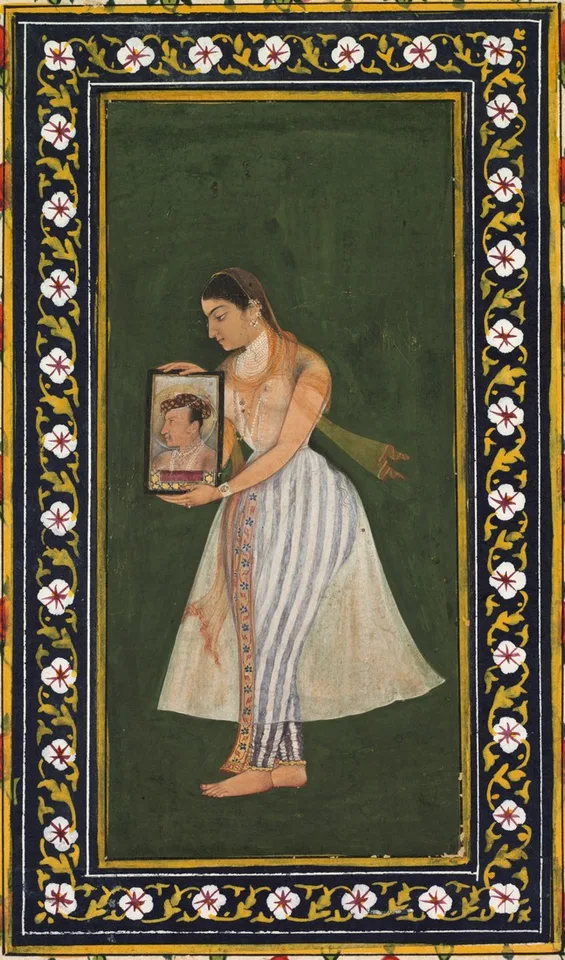
Present authority through an image
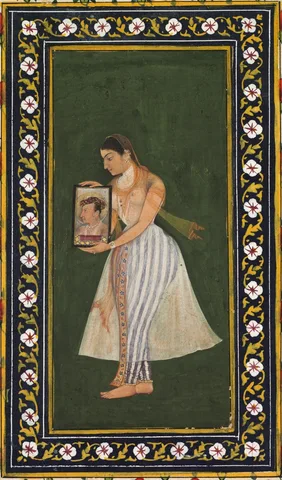
The smaller portrait of Jahangir becomes the central object in Nur Jahan’s representation. It supports a possible claim to political continuity while her youthful appearance remains deliberately idealised.
Carry this question: What would the portrait lose if the held image were removed?
Open the artwork ↗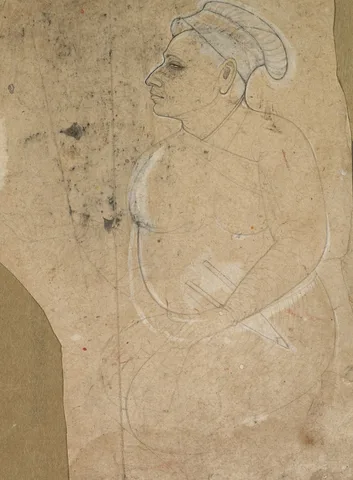
Notice the artist changing course
White revisions reveal a study in progress around a more firmly drawn profile. Clothing and a dagger suggest status, while the proposed personal identification remains uncertain.
Carry this question: Which marks record making rather than the sitter’s appearance?
Open the artwork ↗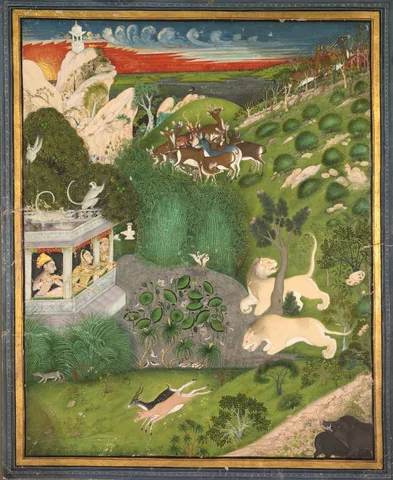
Follow an action from shelter
The musket extends from the pavilion toward the lions. The painting gives royal women an active role in the hunt, while the animals’ alertness links separate areas of the landscape.
Carry this question: How does the gun connect the enclosed pavilion with the open terrain?
Open the artwork ↗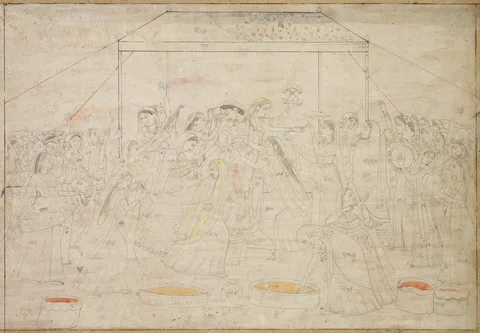
Read a changing appearance
The lifted crown helps show a playful alteration of Krishna’s usual identity during Holi. Colour notes and unfinished areas also reveal the division of labour within a painting workshop.
Carry this question: What can an unfinished picture reveal that a fully coloured one might hide?
Open the artwork ↗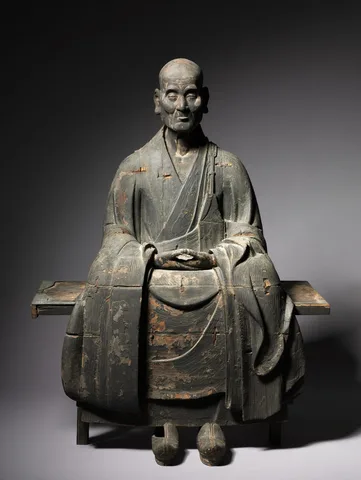
Concentrate likeness in the face
The monk’s face receives greater specificity than the broad robe folds. That selective realism creates personal presence while the posthumous title and religious setting shape how the portrait is understood.
Carry this question: Why does equal detail everywhere seem unnecessary here?
Open the artwork ↗Look at a pair more closely
- Two monastic portraits
Specific teachers within different sculptural conventions
Read with the sources
Historical context follows the individual museum records linked on each artwork page. These routes make original comparisons of visible form; resemblance alone is not evidence of shared meaning or direct influence.
- Nur Jahan holding a portrait of Emperor Jahangir — museum collection record
- Portrait of a blind man — museum collection record
- Royal women shooting from a pavilion — museum collection record
- Krishna being dressed in women’s clothes for the spring festival Holi — museum collection record
- Portrait of Hottō Enmyō Kokushi — museum collection record