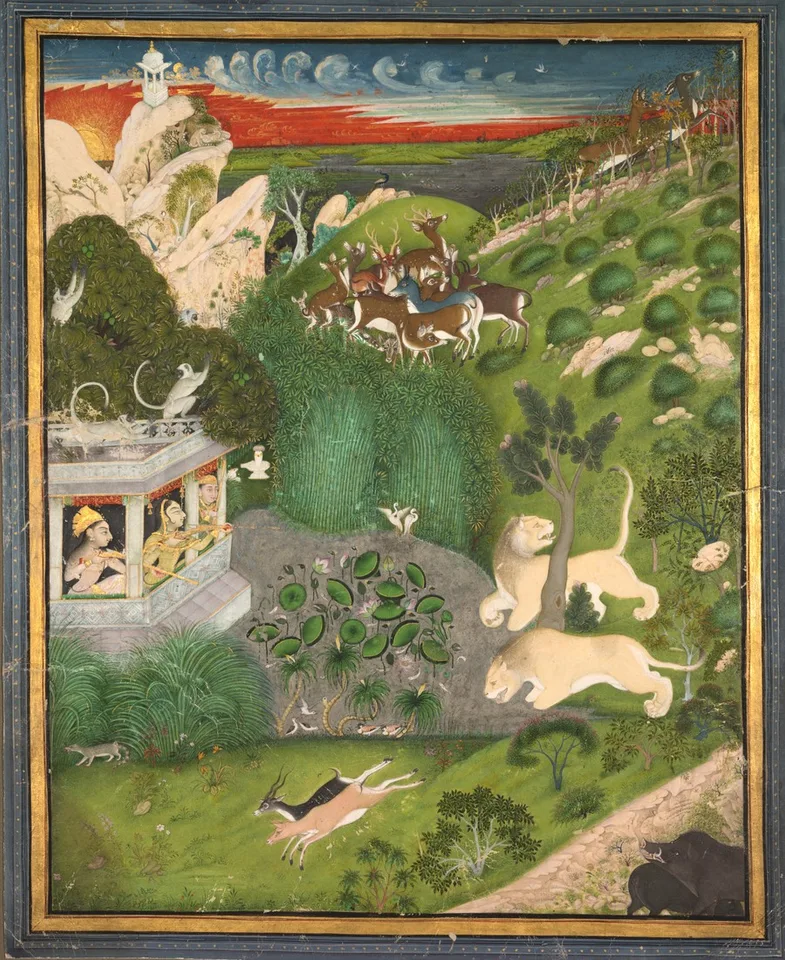
Follow the musket’s direction from a sheltered pavilion toward the lions by the water.
The pavilion gives the painting a concentrated point of action. A woman aims a musket outward, while her companions look into a landscape crowded with animals. Two lions occupy the ground beside the pond; above them, deer bunch together among green slopes and pale rocks. The eye can travel along the gun’s direction, then branch into many smaller incidents. Dense vegetation and changing scales keep the landscape active without organizing it as a single uninterrupted view from a fixed position.
The museum locates the painting in the Rajput kingdom of Kota around 1810 and identifies the shooter as a princess. Its account also draws attention to a small Shiva linga and the bull Nandi on the far bank, connecting the abundance of the landscape with devotion. That interpretation belongs to this particular picture and source; it should not turn every tree or animal into a fixed symbol. The painting brings royal leisure, danger and a sacred presence into one setting. It does not supply the names of the women or prove that a documented hunt occurred exactly as represented.
The women are not individually named here, and a painted hunt is not proof of a specific event. The small shrine’s identification follows the museum record rather than scale alone.