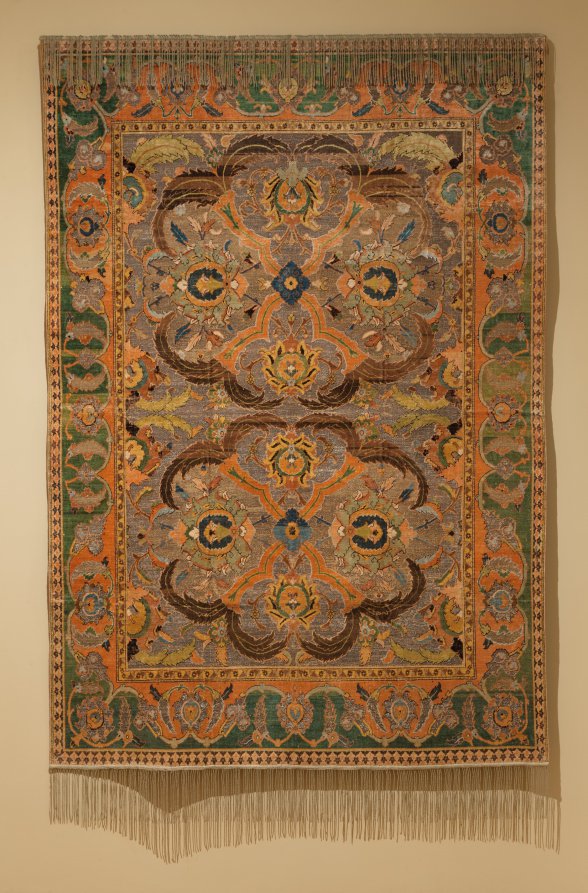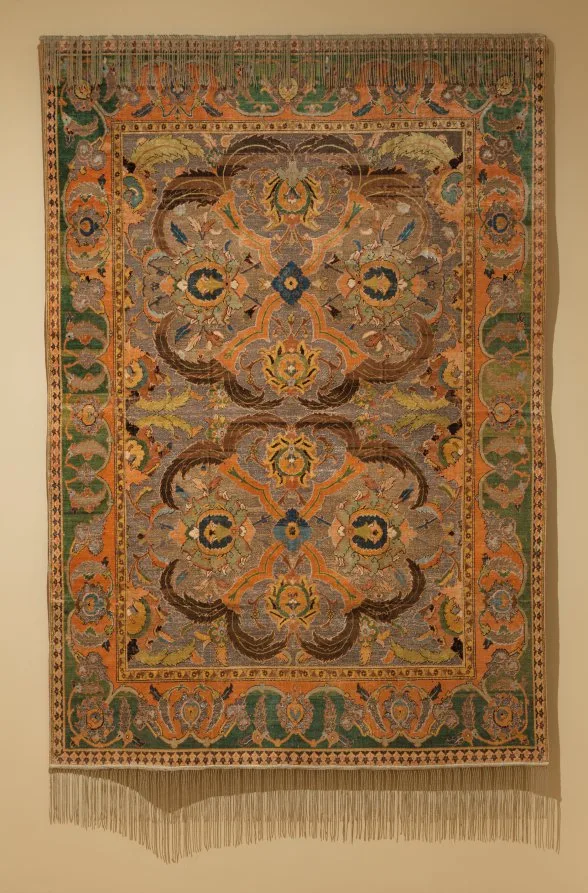
Mirrored plant forms organise a luxurious woven surface whose silk and metal thread were made to shape an interior.
The broad border establishes an edge before the curling forms inside begin to unfold. Two large arrangements occupy the field, balancing across the carpet’s long axis without becoming separate framed pictures. Floral shapes branch and return, directing the eye through a repeated structure. The museum identifies production in Safavid Isfahan and records silk pile alongside brocaded gilt- and silver-metal thread. Pattern and costly materials contribute together to the object’s character.
The museum places such textiles in royal workshops supplying courtly interiors, while also noting exports to European aristocratic consumers. This carpet therefore belongs to histories of furnishing and exchange as well as the close study of ornament. Its present vertical display makes the whole design easy to compare, but cannot reproduce an earlier room, changing light, or the surface’s original condition. The museum also warns against an old “Polish” label applied to Iranian carpets of this kind, a reminder that later collecting categories can mislead about where an object was made.
The photograph does not establish the exact room or person for whom this carpet was first made. The historical “Polish” classification refers to later collecting history and should not replace the museum’s Iranian production attribution.
Why should an old “Polish” label be treated cautiously for carpets of this kind?
Practise looking at Royal Carpet with Silk and Metal Thread →