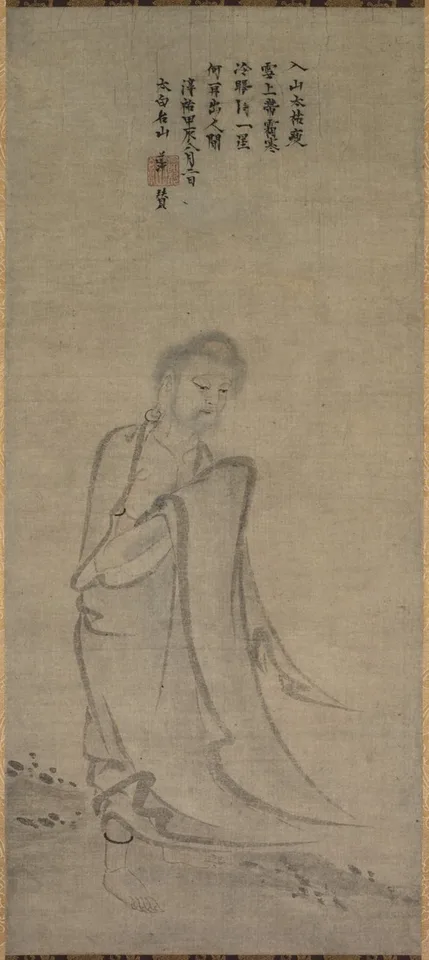
A spare, lightly drawn figure returns to the world beneath a poem that makes his destination a question.
The body is drawn with comparatively little ink. A bowed head, narrow chest and loose robe establish the figure before the ground receives much detail. Long sleeves and trailing folds extend his downward movement. Above, a compact inscription occupies a space almost as important as the figure itself, inviting the image to be read in relation to words.
The museum identifies Shakyamuni emerging from the mountains after ascetic practice, but allows another reading: he may already have achieved enlightenment and returned to teach in the human world. The inscription by Chijue Daochong mentions his indifferent glance toward the morning star, connecting the scene with nonattachment. Those possibilities should remain visible in the interpretation. We can describe the thin figure and restrained setting directly while recognising that the exact stage of his spiritual story is not settled by posture alone.
The museum offers more than one interpretation of this moment in Shakyamuni’s life. The bowed figure alone cannot decide whether enlightenment precedes or follows the depicted return.
Why should the scene’s exact place in the Buddha’s life remain open?
Practise looking at Shakyamuni Emerging from the Mountains →