Teaching through images and texts
A sacred image can illustrate a journey, participate in a set, honour a teacher or make copying itself devotional. Follow the visible arrangement before applying the museum’s contextual account. These works do not present one undifferentiated Buddhist message; each establishes a particular relation between image and teaching.
Begin the journey ↓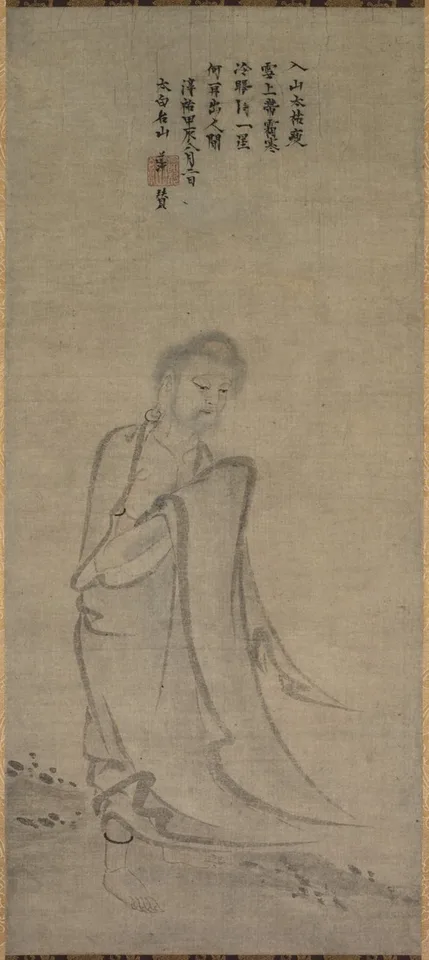
Leave a moment open
The inscription complicates the thin figure’s return from the mountains. The museum allows more than one place in the Buddha’s story, showing how words can widen rather than close interpretation.
Carry this question: Does the inscription resolve the moment or make it more complex?
Open the artwork ↗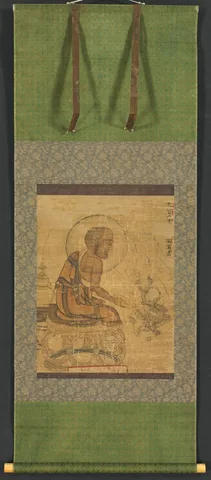
Imagine an absent ensemble
The dragon encounter gives this arhat a particular action, but the scroll once belonged to five hundred images. Reading one surviving member cannot reproduce the scale or arrangement of that ensemble.
Carry this question: What can this single scene tell you, and what remains missing?
Open the artwork ↗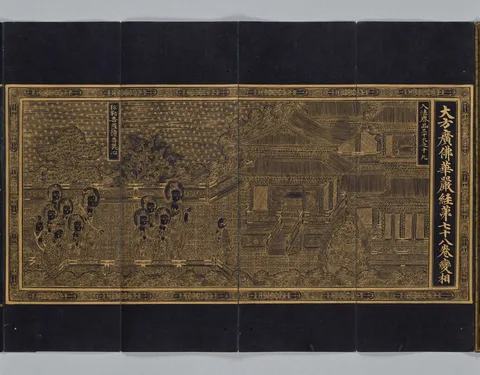
Consider the labour of devotion
Fine gold lines create a sacred encounter on indigo paper. The selected opening makes workmanship legible while preserving the distinction between one photographed section and the much longer manuscript.
Carry this question: How does the precious medium affect your sense of copying as an act?
Open the artwork ↗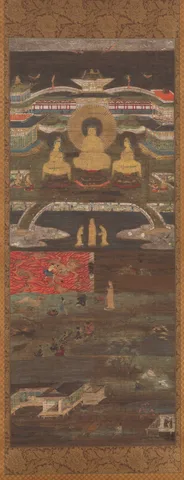
Follow a spiritual route
The narrow path links dangerous fire and water with Amida’s Pure Land. Its spatial clarity supports a teaching, but the image is not a physical map that a traveller could follow.
Carry this question: What does the route explain without becoming literal geography?
Open the artwork ↗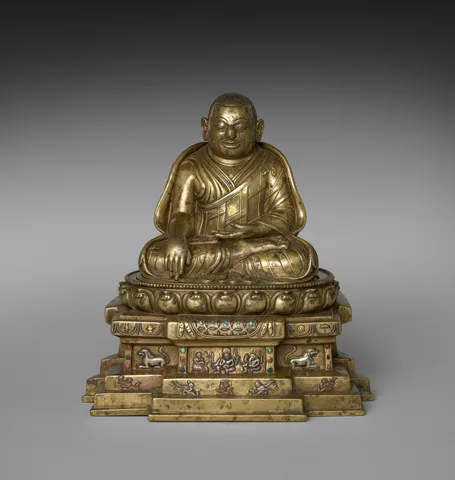
Recognise a named teacher
A lotus and lion throne lend sacred authority to a historical Kagyu leader. Shared conventions with Buddha images do not erase the sitter’s particular identity or institutional setting.
Carry this question: How can a familiar throne honour someone without changing who he is?
Open the artwork ↗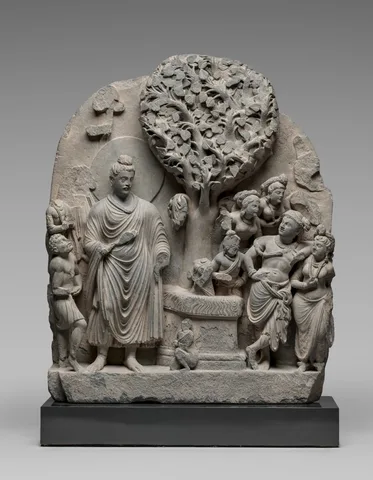
Let a place carry the story
The tree and altar gather the Buddha, nature divinity and earth goddess around one sacred site. The setting participates in the narrative rather than merely filling space behind the figures.
Carry this question: What makes the tree an active part of the encounter?
Open the artwork ↗Look at a pair more closely
- Two monastic portraits
Specific teachers within different sculptural conventions
- Images beside readable and unread signs
An Indus seal and a Korean sacred opening
Read with the sources
Historical context follows the individual museum records linked on each artwork page. These routes make original comparisons of visible form; resemblance alone is not evidence of shared meaning or direct influence.
- Shakyamuni Emerging from the Mountains — museum collection record
- Arhat — museum collection record
- Avatamsaka Sutra No. 78 — museum collection record
- The White Path Between Two Rivers — museum collection record
- Portrait of Phagmo Drupa Dorje Gyalpo (1110–1170) — museum collection record
- Siddhartha at the Bodhi Tree — museum collection record