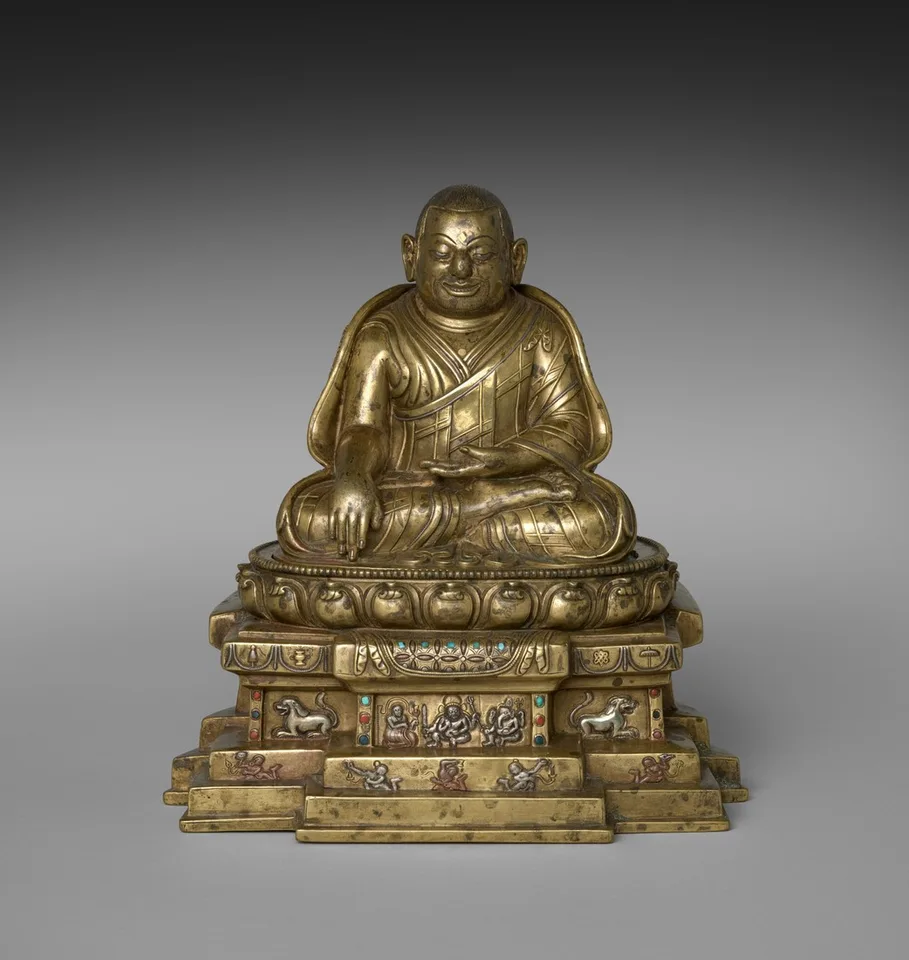
A monk’s portrait borrows a lotus and lion throne, making his teaching authority visible through forms associated with the Buddha.
The face and wrapped robe establish a human teacher, but the support expands his status. A lotus cushion rises above a tiered throne with small lions and other figures. The seated body remains calm despite the dense architecture below it. One hand reaches downward while the other rests closer to the lap, creating a clear relationship between gesture and stable posture.
The museum identifies Phagmo Drupa Dorje Gyalpo, the first monastic leader of Densatil and an influential early teacher in the Kagyu order of Tibetan Buddhism. It explains the lotus and lion throne as forms associated with a Buddha, while the hand positions communicate the relationship between meditation and enlightenment. The image honours a historical religious leader through established sacred conventions. It should not be mistaken for a generic Buddha, nor should the carefully constructed portrait be treated as a complete record of his living appearance or personality.
Shared throne and gesture conventions do not make the sitter a generic Buddha. The historical identification comes from the museum, and the portrait cannot establish private character from facial expression.
Which visible features most directly give the teacher a throne associated with Buddha images?
Practise looking at Portrait of Phagmo Drupa Dorje Gyalpo (1110–1170) →