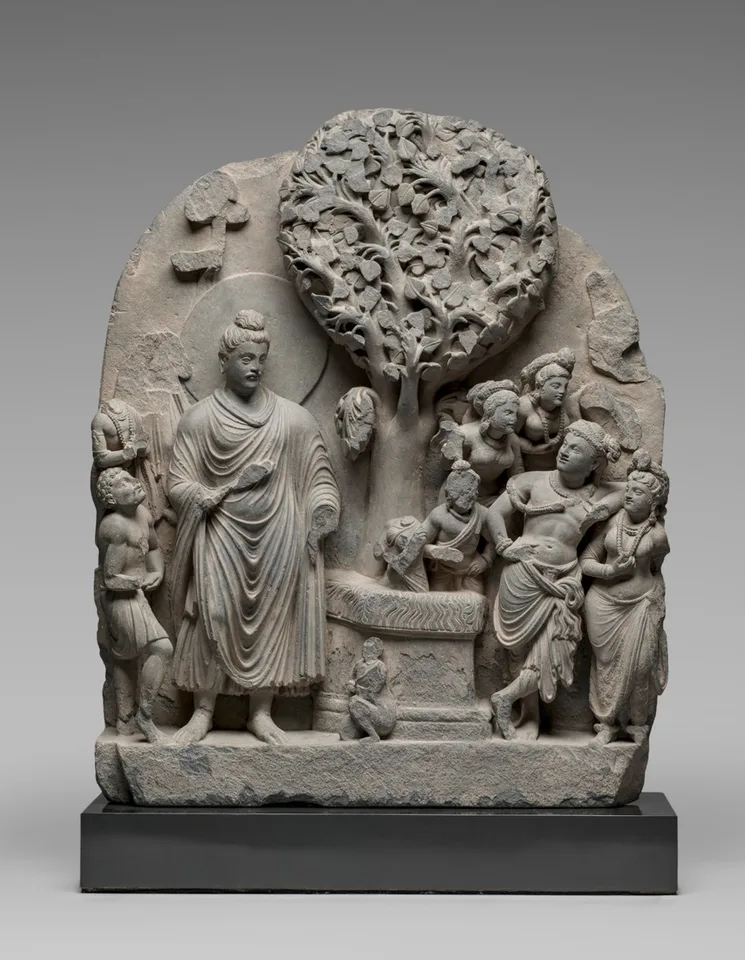
A tree occupies the centre of this relief, gathering the Buddha, a nature divinity and the earth goddess around one sacred place.
The tree, rather than a person, anchors the centre. Its thick trunk rises from an altar into a crowded canopy, while the standing Buddha occupies the left. Smaller figures approach from the right and gather near the base. The arrangement makes the site itself important: bodies, altar and vegetation all direct attention toward the place of awakening.
The museum explains that the tree had been revered locally as the dwelling of a nature divinity, who emerges here to praise the Buddha. An earth goddess rises near the altar’s base in reverence, and the altar is covered with kusha grass associated with offerings. The relief therefore brings several forms of sacred presence into one scene. We can follow the relationships between figures and tree without assuming that the carving records an observed historical ceremony. Its compact composition translates a religious account into a layered stone setting.
The small divinities are identified through the museum’s interpretation, not appearance alone. This religious narrative should not be treated as an eyewitness record of the historical Buddha’s awakening.