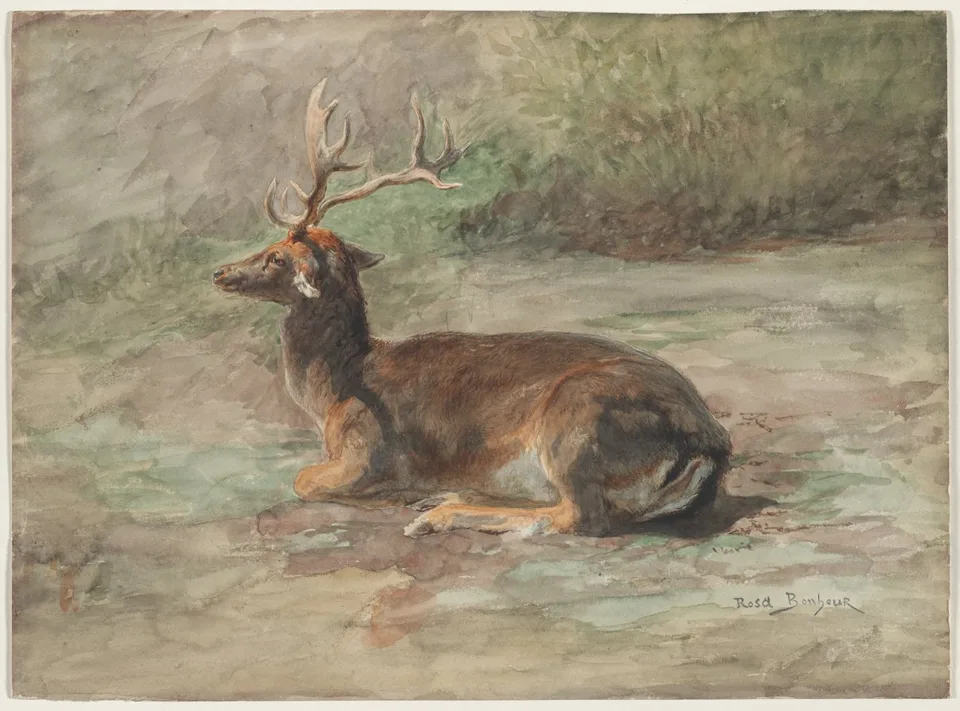
 France · c. 1875–85
Stag Lying Down
Rosa Bonheur (French, 1822–1899)
watercolor and gouache over graphite on cream wove paper
An animal can stand out against a restrained setting or become partly concealed by a crowded one. Compare how each environment shapes recognition, and how documented observation differs from an invented jungle assembled through books and botanical gardens.
France · c. 1875–85Rosa Bonheur (French, 1822–1899)
watercolor and gouache over graphite on cream wove paper
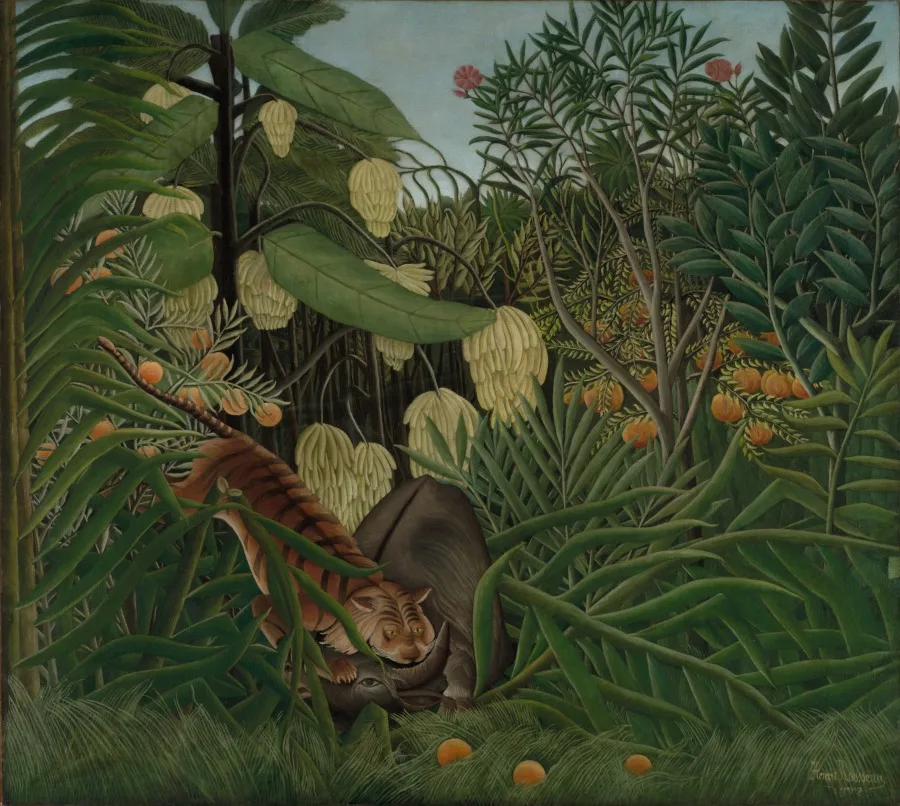 France, late 19th-early 20th Century · 1908
Henri Rousseau (French, 1844–1910)
oil on fabric
Bonheur gives the antlers open space, clarifying their branching outline. Rousseau lets leaves cross the tiger and buffalo, making the struggle something to discover. The surrounding surface controls recognition in opposite ways without making either arrangement accidental.
The stag’s flank is rounded through warm and pale marks. Rousseau’s hanging fruit is sharply outlined and botanically implausible in its setting. The museum connects Bonheur with outdoor observation and Rousseau with imaginative assembly, so visual conviction does not always depend on the same relation to nature.
Bonheur’s broad washes leave the ground relatively unresolved and keep the stag dominant. Rousseau’s enlarged leaves form an insistent barrier across the foreground. One environment supports an animal through restraint; the other competes with and intensifies the animal action through abundance.
Neither work is a complete scientific record. Bonheur’s observation is selective, and Rousseau’s imagined plants and animal encounter should not be treated as ecological documentation.
The comparison of visible choices is our own reading. Follow either artwork page for its full context, uncertainty note and image-rights record.
A stag, a jungle, a mountain and a textile take different routes from nature into art.
Movement can be implied by a lifted hoof, drapery or an unnoticed prank.