Nature observed and arranged
Plants and animals can come from direct study, remembered places, books, cultivated specimens or the needs of a repeating design. This route follows several of those possibilities without making naturalism the only standard of success. Compare what each work selects, enlarges or simplifies, and let the record distinguish an observed setting from an imagined one.
Begin the journey ↓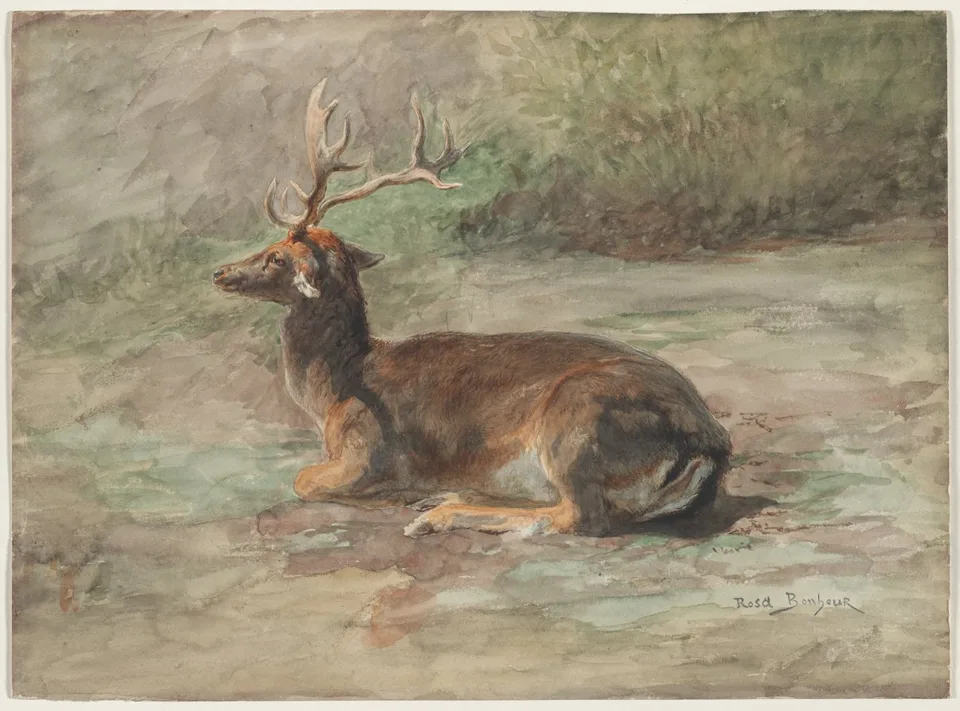
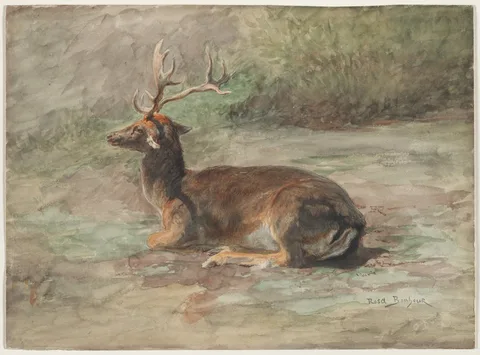
Selective attention clarifies an animal
The stag remains comparatively definite while its setting dissolves. Less detail around the body can increase the force of observation. The source provides context for outdoor study but does not securely identify this animal as Bonheur’s particular pet.
Carry this question: What becomes more noticeable because the setting remains open?
Open the artwork ↗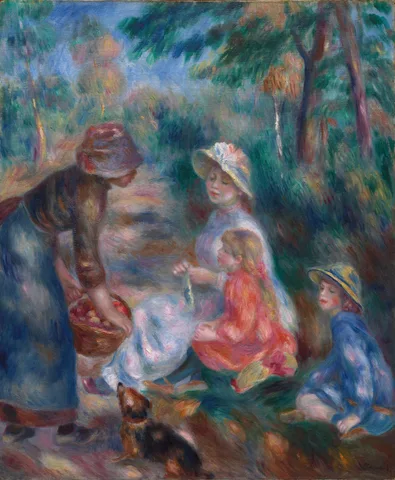
Light links people and vegetation
Small touches of light cross figures and foliage, creating continuity across a social scene. The basket and dog supply particular actions within it. The pleasant setting should not stand in for a complete description of rural working conditions.
Carry this question: Where do similar touches join clothing with the surrounding landscape?
Open the artwork ↗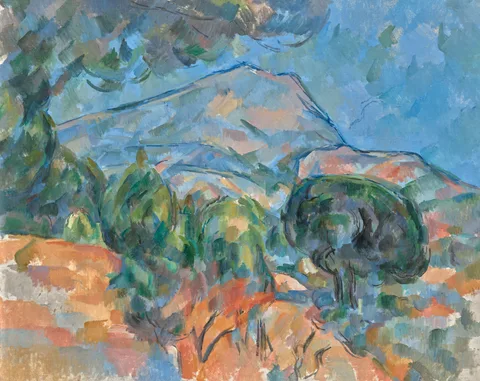
A tree anchors distance
The rounded foreground pine contrasts with the mountain’s angular ridge. Its scale and position establish depth, while recurring colours hold the surface together. Observation is organised through relationships between forms rather than a neutral inventory of everything at the site.
Carry this question: How does the near pine change the apparent distance of the mountain?
Open the artwork ↗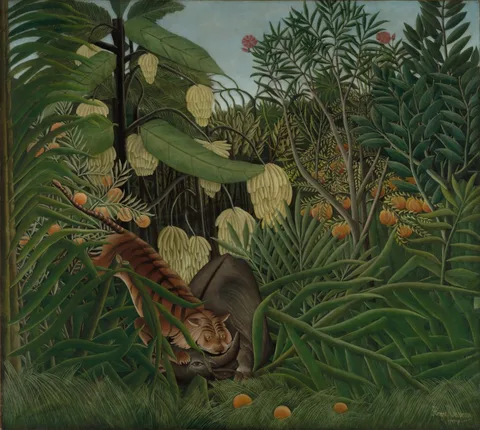
Abundance does not prove accuracy
Pale fruit stands out within Rousseau’s imagined vegetation. The museum notes botanical implausibility and sources in books and a botanical garden. A compelling invented jungle can therefore be assessed as a constructed image without mistaking it for field observation.
Carry this question: Which details make the plants vivid even when their arrangement is implausible?
Open the artwork ↗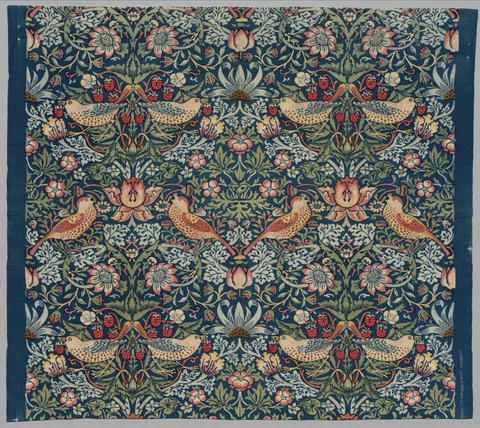
An observed bird enters a repeat
Mirrored birds turn a garden-related motif into a pattern that can continue across cloth. The image must now answer the needs of repetition and manufacture. Compare that ordered extension with Rousseau’s dense imagined environment and Bonheur’s selective study.
Carry this question: What changes when an animal must belong to a repeating pattern?
Open the artwork ↗Look at a pair more closely
- Animals and their surroundings
Bonheur’s resting stag and Rousseau’s jungle struggle
- A mountain and the work of painting
Cézanne’s Sainte-Victoire and Courbet’s Alpine panorama
- Nature becomes a repeat
Strawberry Thief and Peacock and Dragon
Read with the sources
Historical context follows the individual museum records linked on each artwork page. These routes make original comparisons of visible form; resemblance alone is not evidence of shared meaning or direct influence.