Bodies at rest and in motion
Still images make action understandable through balance, contact, overlap and contrast. This route moves between observed animals, a classical dancer and carved narratives. Compare the visible devices that suggest energy or rest while keeping the subjects distinct: similar bodily arrangements do not make a horse study, mythological joke and historical representation equivalent.
Begin the journey ↓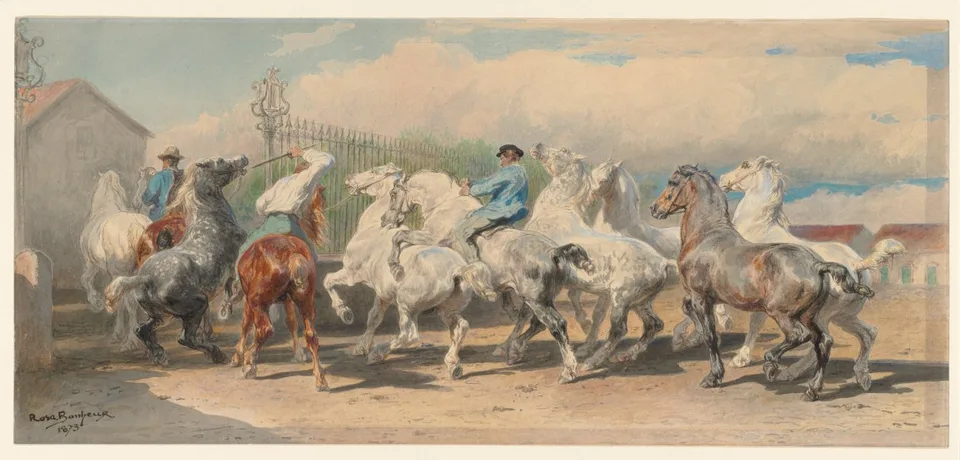
A hoof interrupts the procession
One horse’s lifted movement breaks the broad horizontal sequence. Trace its bent legs against the surrounding bodies. Anatomical description creates energy, while the riders and fence place the animals within a managed setting rather than untouched wilderness.
Carry this question: Which change of posture first interrupts the procession?
Open the artwork ↗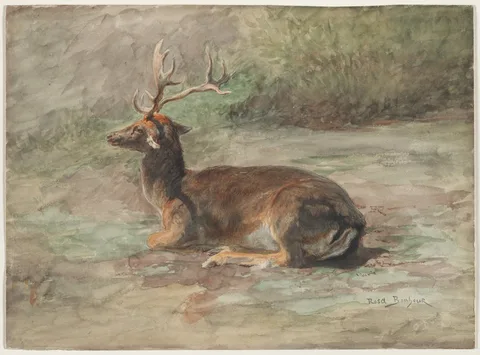
Rest still has weight
The stag’s resting body depends on small tonal shifts rather than dramatic movement. Compare its rounded form with the loosely treated ground. A quieter pose can make structure especially clear because fewer competing actions pull the eye away.
Carry this question: Where does light make the resting body feel rounded?
Open the artwork ↗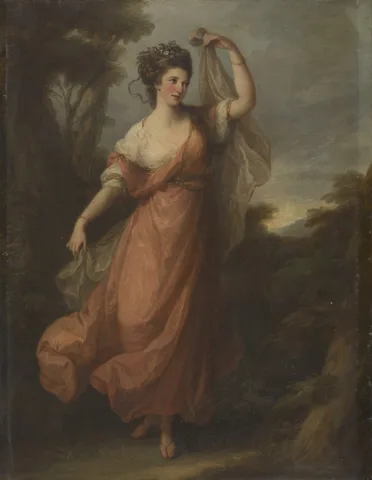
Cloth enlarges a gesture
Lifted drapery carries movement beyond the dancer’s solid outline. Follow its curve toward the feet before consulting the classical identity. The museum supplies the association with Terpsichore and ancient models; the pose alone does not name the subject.
Carry this question: How far does the gesture extend beyond the body itself?
Open the artwork ↗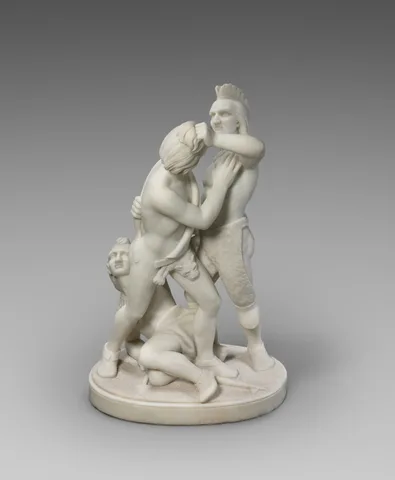
Opposing arms lock together
Interlocking arms draw several carved bodies into one spiralling group. A single photograph only partly reveals that structure. Read the sculpture’s historical subject with care: its title does not document a particular battle or represent every Indigenous community.
Carry this question: Which overlaps make the bodies seem difficult to separate?
Open the artwork ↗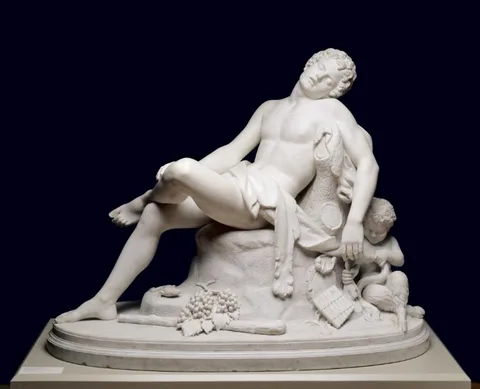
A small action changes the story
The sleeper seems to dominate until the smaller satyr’s action becomes clear. The museum identifies a prank involving the animal skin and stump. Rest is now part of a narrative: one figure acts while the other remains unaware.
Carry this question: How does discovering the prank change the sleeping pose?
Open the artwork ↗Look at a pair more closely
- Animals and their surroundings
Bonheur’s resting stag and Rousseau’s jungle struggle
Read with the sources
Historical context follows the individual museum records linked on each artwork page. These routes make original comparisons of visible form; resemblance alone is not evidence of shared meaning or direct influence.