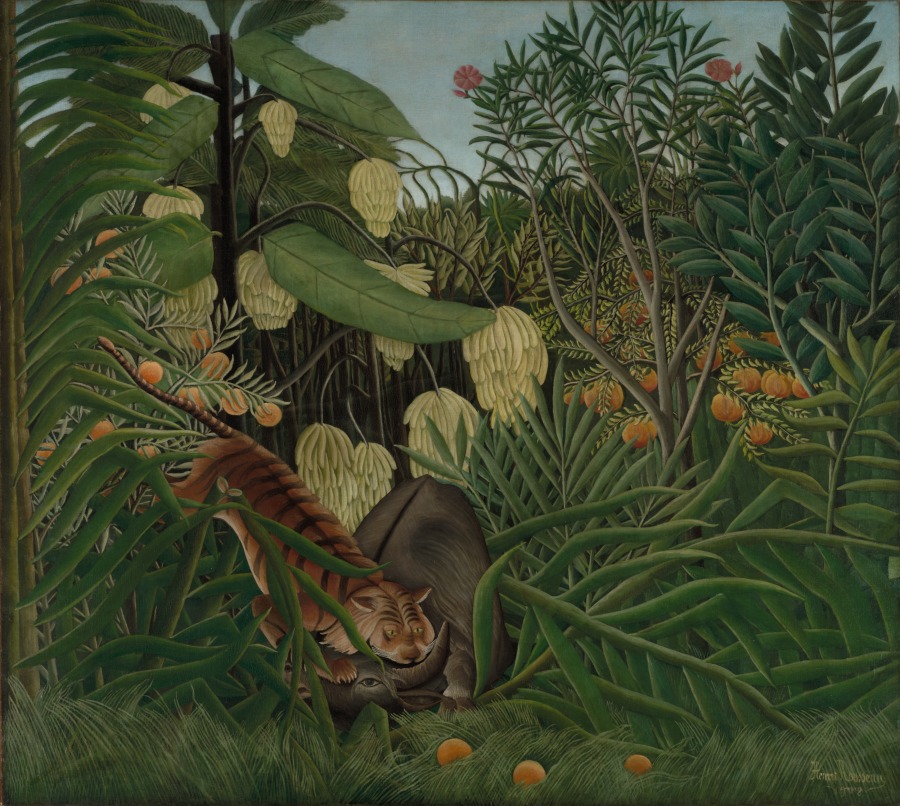
The jungle almost swallows the animal fight, but its impossible abundance was assembled from sources available in France.
At first the plants seem to be the main event. Large leaves overlap, thin branches interlace, and pale fruit hangs above orange clusters. The tiger and buffalo occupy a relatively small opening low in the composition. Finding the struggle requires looking through the vegetation, so the environment becomes an active part of the scene’s tension.
Rousseau never traveled outside France. The museum explains that he developed his imagined jungles through travel books and visits to the Paris botanical garden. It also points to botanically implausible details, including the orientation of the bananas. These are reasons to read the painting as a constructed fantasy rather than a field report. Strong outlines and enlarged plants give the invented setting its conviction. Compare the crowded foliage with the animals’ compressed bodies: both belong to a deliberately organized surface in which clarity of individual shape coexists with uncertainty about how deep the space really extends.
This is an imagined jungle, not an eyewitness record of a specific ecosystem. The animals and plants should not be used as evidence of a natural encounter, and the artist’s lack of formal training does not mean the arrangement was accidental.