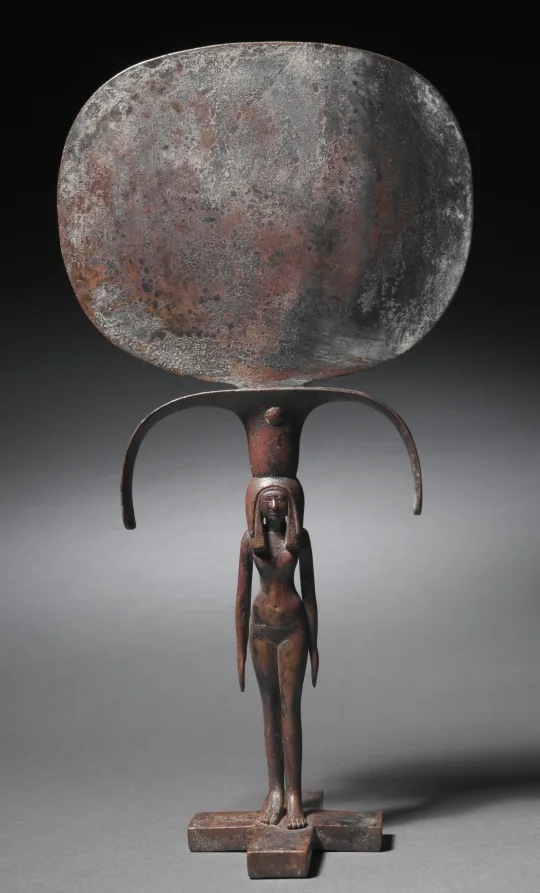
 Egypt, New Kingdom (1540–1069 BCE), Dynasty 18 · c. 1540–1296 BCE
Caryatid Mirror
Maker unrecorded
bronze with black copper inlay?
Both bronzes place a human figure below a mirror, combining an image of a body with an object used by another body. Compare stance, attachment and survival. The Egyptian mirror retains its disk; the Greek support makes the loss of its separately made reflecting surface visible.
Egypt, New Kingdom (1540–1069 BCE), Dynasty 18 · c. 1540–1296 BCEMaker unrecorded
bronze with black copper inlay?
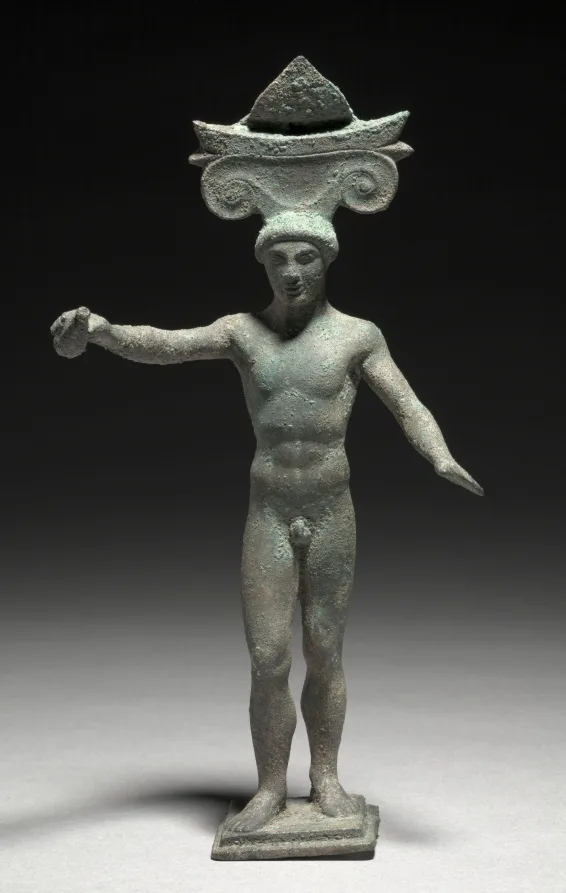 South Italy, Locri (?), Greek · 460–450 BCE
Maker unrecorded
bronze
The Egyptian woman stands with lowered arms above a small base. The Greek athlete advances one leg while remaining sufficiently upright to support a disk. Both use a bodily image structurally, but their different poses change the balance between stillness and suggested action.
A papyrus umbel spreads above the woman’s head and joins her to the broad mirror. Above the athlete, curled forms and a triangular tang mark the attachment for a missing disk. Compare the represented plant with the exposed evidence of assembly.
The mottled Egyptian disk once reflected light after polishing. The Greek athlete holds a small oil vessel, which contributes to the museum’s athletic identification. These features connect the bronzes with bodily care without establishing the precise room, user or occasion in which either mirror operated.
A shared supporting function does not establish direct influence or identical meanings. The Egyptian plant and female figure belong to a different iconographic setting from the Greek athlete.
The comparison of visible choices is our own reading. Follow either artwork page for its full context, uncertainty note and image-rights record.
Four Egyptian objects make colour, reflection, carving and enclosure active.
Six Mediterranean objects turn attention toward use and attachment.