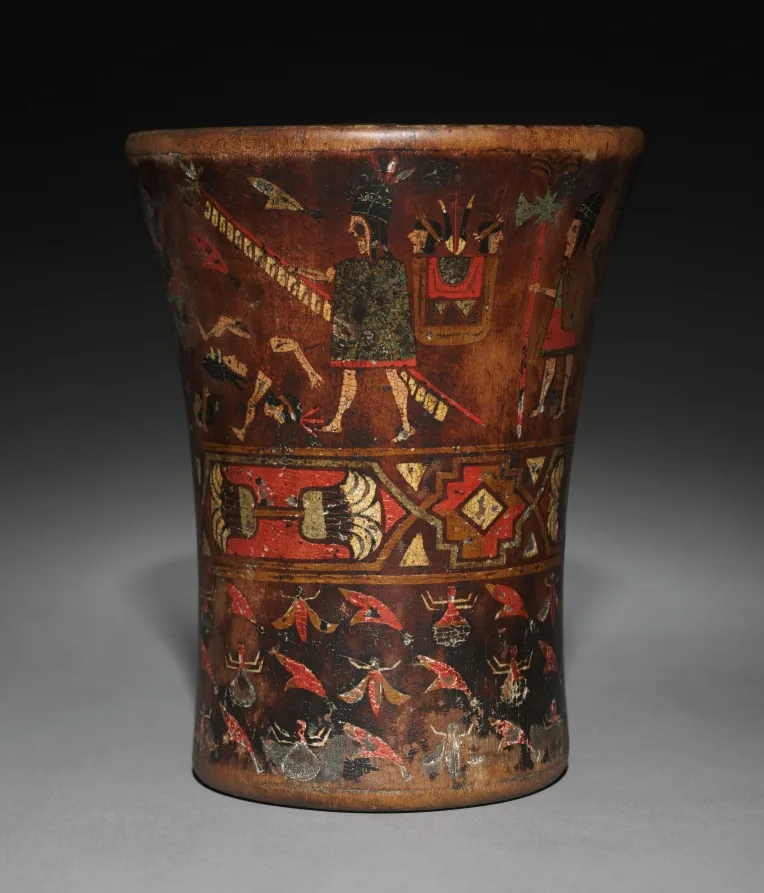
 Peru, Colonial Inka style, 16th century · after 1550
Kero (Waisted Cup)
Maker unrecorded
wood, inlaid pigments
A vessel’s image changes as the vessel is turned, lifted or set down. Compare the narrative zones around the wooden kero with the head modeled in hammered gold. The museum provides different social and iconographic contexts, while leaving both the kero’s opponents and the beaker’s precise identity unresolved.
Peru, Colonial Inka style, 16th century · after 1550Maker unrecorded
wood, inlaid pigments
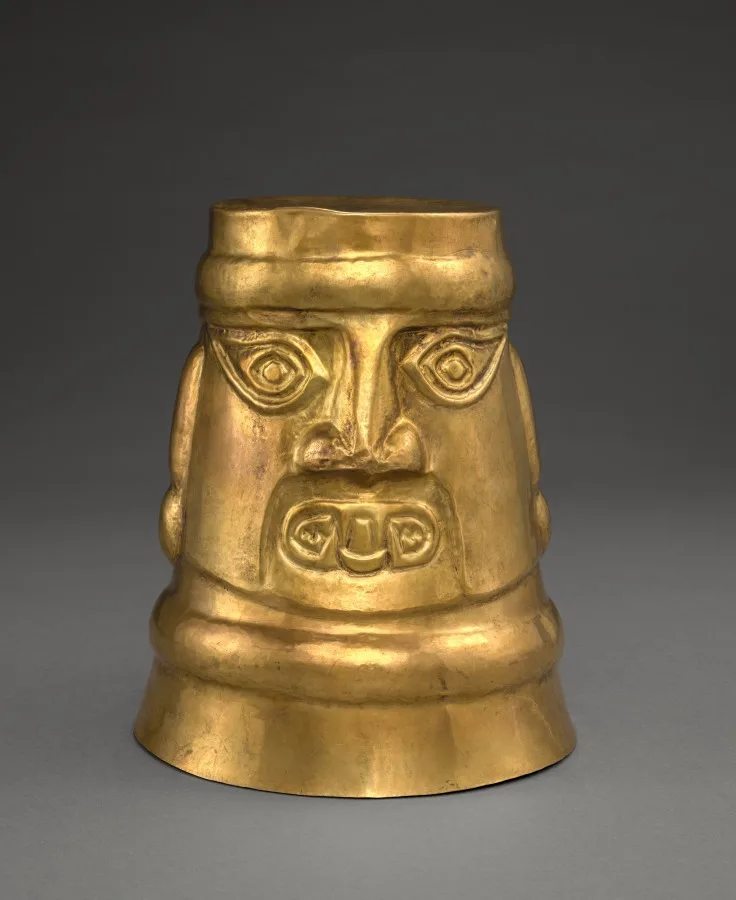 Central Andes (Peru), Lambayeque (Sicán) people, 10th century-12th century · 900–1100
Maker unrecorded
gold, hammered
Armed figures extend around the kero, so one view withholds part of the narrative. The beaker’s face appears upright when it rests on its rim and would be inverted in drinking orientation. The shape of each container controls how its imagery can be encountered.
A geometric band crosses the kero’s narrow waist, separating figured zones. On the beaker, prominent fangs occupy the mouth below its nose. One feature structures a narrative surface; the other contributes to a supernatural identification without settling the figure’s exact name.
The kero's flaring upper rim marks its drinking mouth. The beaker's flaring edge and uneven reflections reveal a shaped metal surface. The museum identifies inlaid pigments in wood for the first and hammered gold for the second: distinct processes behind two usable vessel forms.
The works come from different Andean cultures and periods. The colonial kero’s reciprocity traditions should not be assigned automatically to the earlier Lambayeque gold vessel.
The comparison of visible choices is our own reading. Follow either artwork page for its full context, uncertainty note and image-rights record.
Carving, casting, hammering and painting transform bodies into images.
Four American works ask us to separate evidence from reconstruction.