Reading what survives
A fragment, a rejoined carving, a complex stone silhouette and a colonial-period drinking vessel all preserve information unevenly. This route follows what can still be seen, then asks what additional research supplies. Avoid treating absence as a licence to invent: missing figures, debated narratives and uncertain uses are part of an honest encounter with the surviving work.
Begin the journey ↓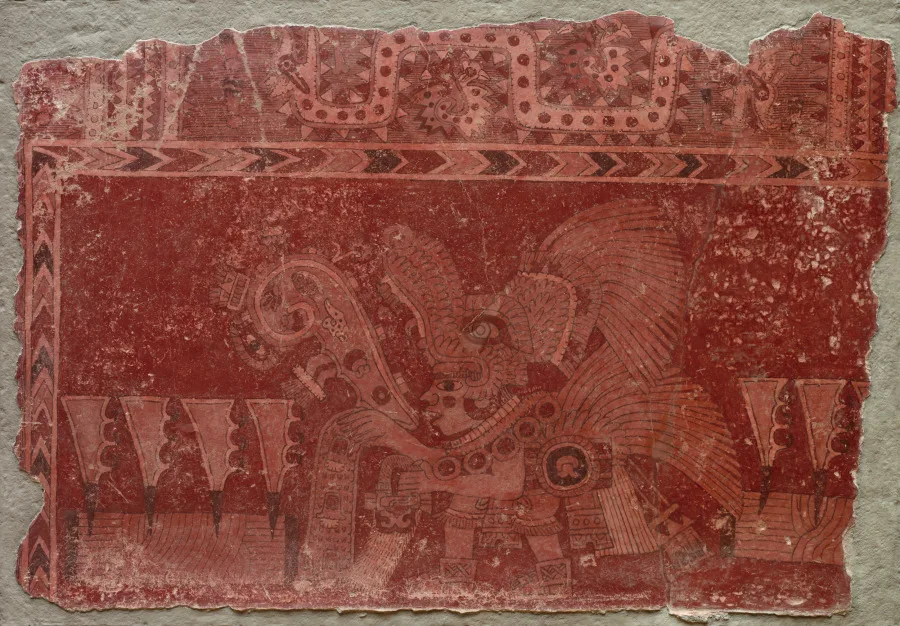
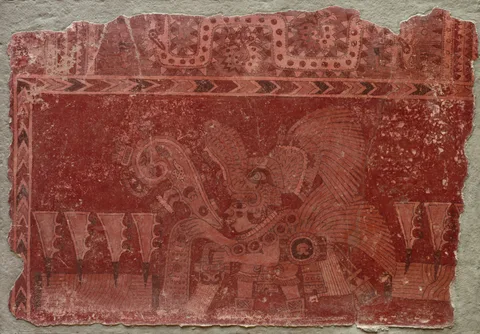
A scroll makes an unseen action visible
A curling form extends near the figure’s mouth. The museum reads it as a chant or vocalization, beside an offering action and plants. The mural fragment comes from a larger repeated architectural programme; this surviving section cannot show its entire original setting.
Carry this question: How does the painted scroll give a visible form to something you could normally hear?
Open the artwork ↗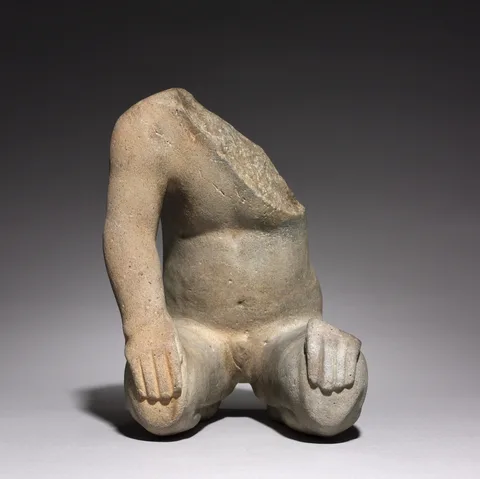
A hand recovered and rejoined
One knee and hand were recovered as a fragment and rejoined, according to the museum. The head and upper chest remain missing. Looking at the rejoined area shows how a sculpture can become more legible through material recovery while still withholding its original complete appearance.
Carry this question: What can the surviving hands and knees establish even without the head?
Open the artwork ↗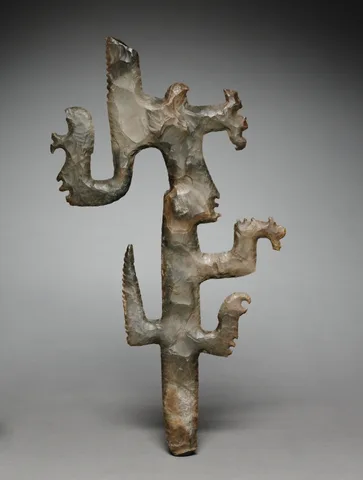
Profiles shaped by removing stone
Small profiles branch around a larger central figure. The museum identifies K’awil through the principal head’s features, including the forehead projection. Comparable eccentric flints had several uses, but their variety does not establish the precise occasion or placement of this example.
Carry this question: How do the same chipped edges define both a stone surface and a sequence of faces?
Open the artwork ↗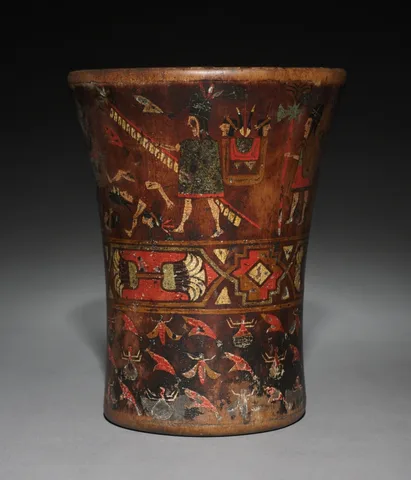
An image without a fully settled opponent
Armed figures occupy the upper zone of this wooden drinking vessel. The museum discusses an Inka battle narrative while leaving the opposing group uncertain. Made after Spanish conquest, the vessel combines a continuing drinking tradition with a narrative whose exact historical identification remains open.
Carry this question: Which details identify armed action without identifying every participant?
Open the artwork ↗Look at a pair more closely
- Silhouettes within silhouettes
A serpent headdress and a Maya eccentric flint demand attention to the edge.
- Giving in two images
A Teotihuacan mural and an Egyptian stele represent provision differently.
- Cups and changing orientation
A colonial Inka kero and a Lambayeque beaker connect images with use.
Read with the sources
Historical context follows the individual museum records linked on each artwork page. These routes make original comparisons of visible form; resemblance alone is not evidence of shared meaning or direct influence.