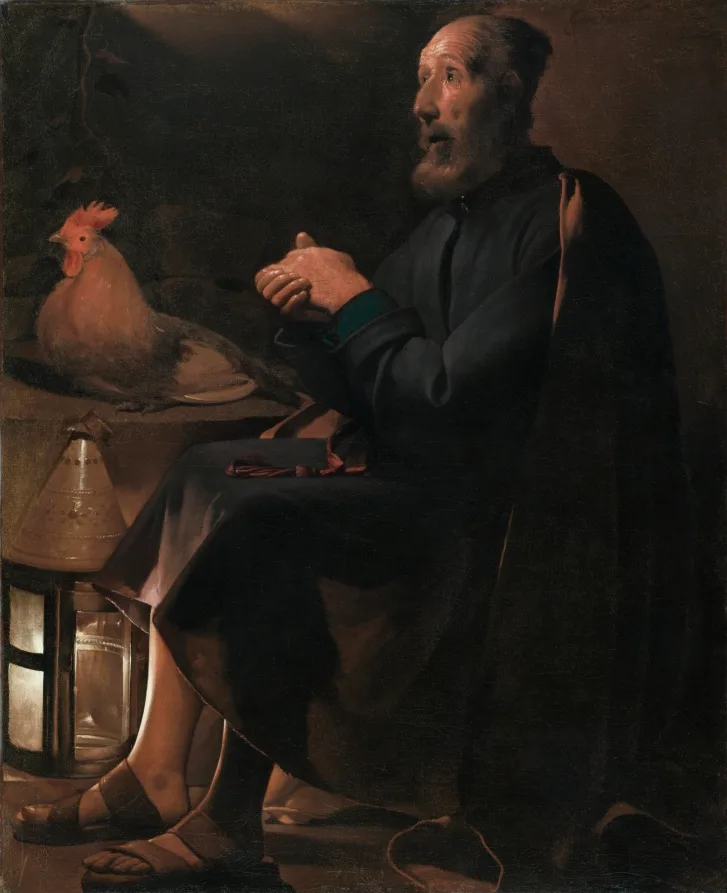
 France · 1645
Saint Peter Repentant
Georges de La Tour (French, 1593–1652)
oil on canvas
Darkness can isolate a reflective figure or make an entire crowd difficult to distinguish. Compare two Christian subjects through the placement of light, while separating a lantern inside a painted scene from the tonal effects of a printed plate.
France · 1645Georges de La Tour (French, 1593–1652)
oil on canvas
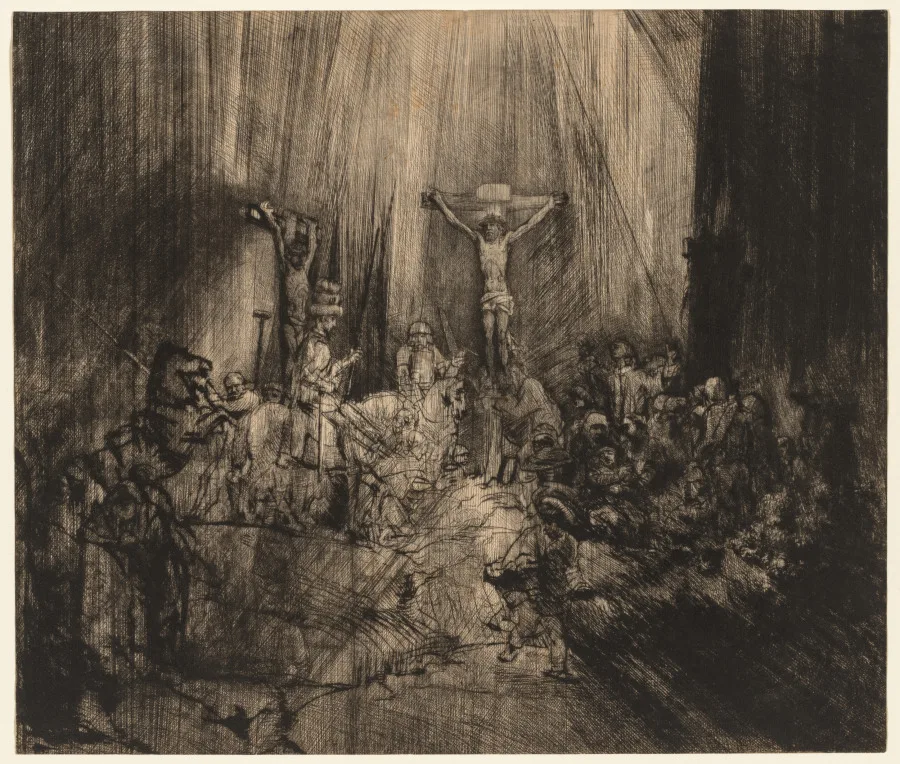 Rembrandt, 17th century · 1653-c.1660
Rembrandt van Rijn (Dutch, 1606–1669)
drypoint
Peter’s clasped hands emerge clearly against his cloak. In the drypoint, Christ’s body occupies a bright central opening above the crowd. Selective visibility directs attention toward reflection in one work and toward the crucified figure in the other.
The rooster beside Peter recalls the prediction associated with his denial. Rembrandt’s heavy lines partly conceal spectators, shifting attention through reduced clarity. Narrative information can therefore arrive through one identifiable attribute or through the deliberate suppression of surrounding detail.
La Tour includes a lantern near Peter’s feet as a light source within the scene. Rembrandt retained ink on the plate’s sides when producing this impression. Both create tone, but one represents an object and the other involves a documented choice in making a particular print.
The subjects depict different moments and the materials work differently. Shared darkness does not establish direct influence or make an individual print’s ink effects equivalent to a represented lantern.
The comparison of visible choices is our own reading. Follow either artwork page for its full context, uncertainty note and image-rights record.
Holding, crowning, sewing and waiting connect bodies to larger narratives.
Printed cotton, woven wool, glass in paint, and ink ask for different kinds of looking.