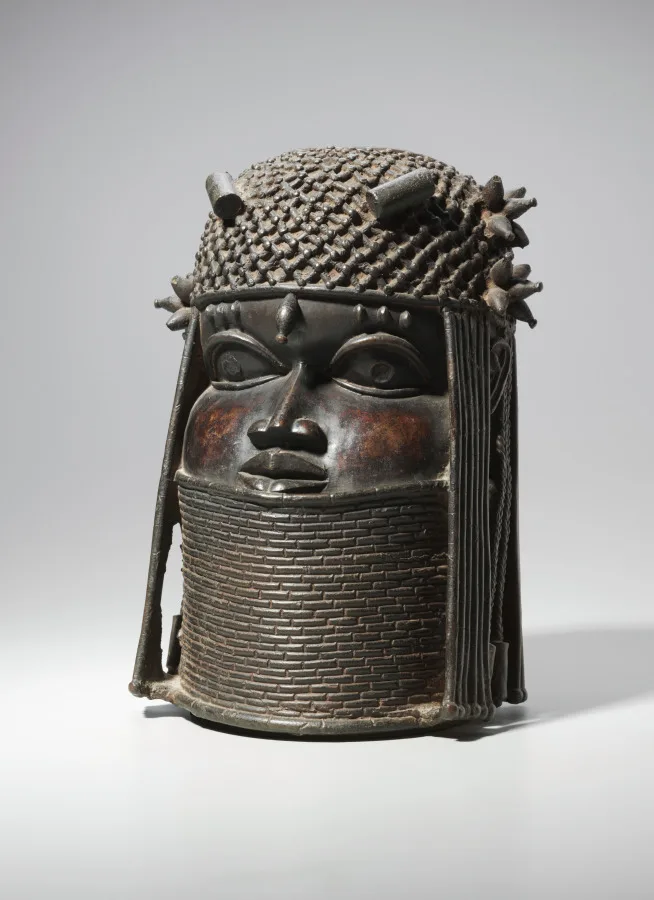
 Nigeria, Benin Kingdom, Ẹdo peoples, members of the Igun Eronmwon (royal brasscasters) guild · possibly mid-1500s or early 1600s
Ancestral Commemorative Head (uhunmwun-elao)
Maker unrecorded
Copper alloy and iron
Two metal heads invite us to look for identity, but the kinds of identity differ. The Benin head represents an ideal royal ancestor within an altar setting; the Roman portrait gives an individual-looking face whose sitter remains unknown. Compare what regalia, skin and hair can actually establish.
Nigeria, Benin Kingdom, Ẹdo peoples, members of the Igun Eronmwon (royal brasscasters) guild · possibly mid-1500s or early 1600sMaker unrecorded
Copper alloy and iron
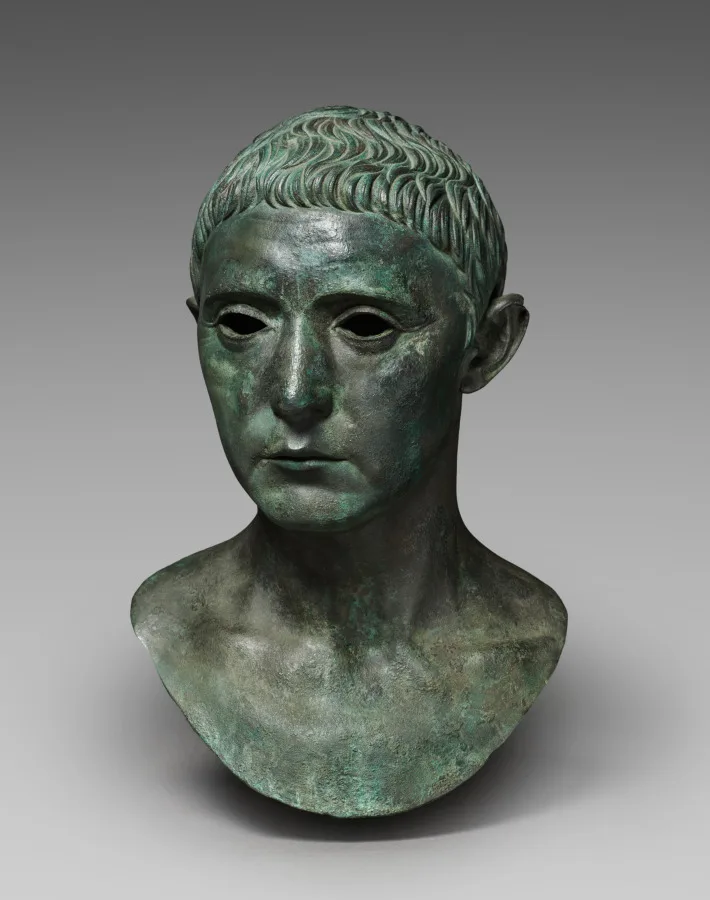 Italy, Roman, Augustan period · 27 BCE–14 CE
Maker unrecorded
bronze
The Benin face is framed by a large collar and royal cap. Its ideal form participates in an ancestral royal image. The Roman forehead carries individualized furrows, yet those features do not recover the sitter’s name. A particular-looking face is not the same as a securely identified person.
The Benin cap translates coral-bead regalia into a dense cast surface. The Roman hair is organized into short, carefully modeled locks. Both give the upper silhouette a distinct texture, while only the former represents a separate worn emblem of office.
The Benin collar supports a compact royal image once combined with an elephant tusk above. The Roman eye sockets have lost their original inlays. One work lacks a major associated component; the other has lost details central to the appearance of the face.
The works should not be reduced to a contrast between “symbolic” and “realistic” cultures. Both are selective constructions, and their original settings and purposes differ.
The comparison of visible choices is our own reading. Follow either artwork page for its full context, uncertainty note and image-rights record.
Five distinct ways to make authority visible.
Six Mediterranean figures offer different strengths of identification.