Ancient bodies and names
An attribute can name a god, a gesture can signal childhood, and a hairstyle can suggest a historical person. None of these clues works in isolation from its setting. Compare six ancient Mediterranean bodies, including secure mythological readings and cautious portrait identifications. Look also for missing parts and modern restoration, which can alter what a figure seems to tell us.
Begin the journey ↓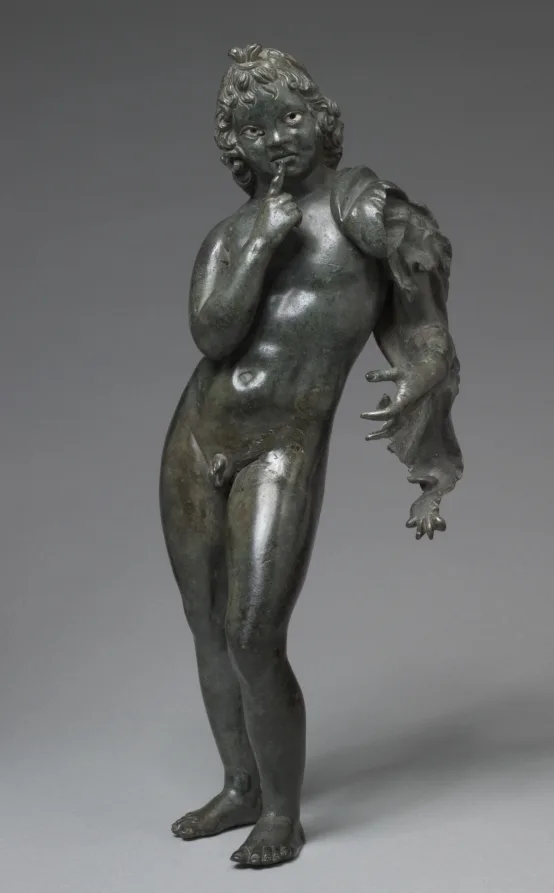
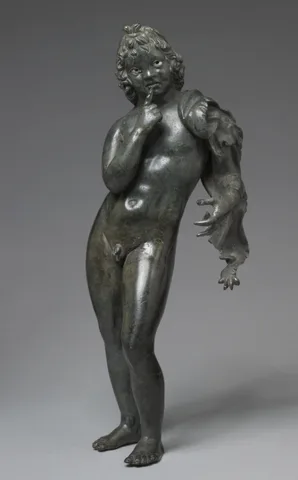
A finger associated with childhood
The raised finger touches the mouth. In this Egyptian-derived image of Harpocrates, the gesture refers to childhood; it should not automatically become a request for silence. The modeled body and materials also show how the figure participates in a wider Hellenistic visual setting.
Carry this question: What is the actual position of the finger before you assign it a meaning?
Open the artwork ↗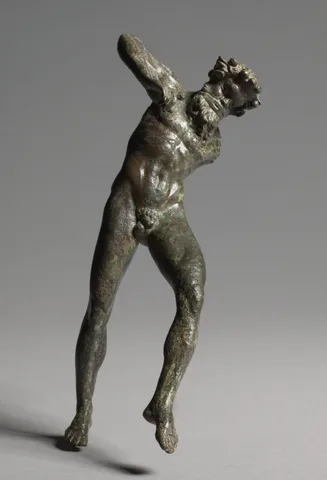
A dance with missing equipment
The satyr twists through the torso, rising on active legs. His left arm is missing; the museum infers probable pipes from the surviving hand and mouth strap. The remaining pose can still suggest movement without allowing a precise reconstruction of the lost instrument.
Carry this question: Which change of direction between torso and legs makes the body feel active?
Open the artwork ↗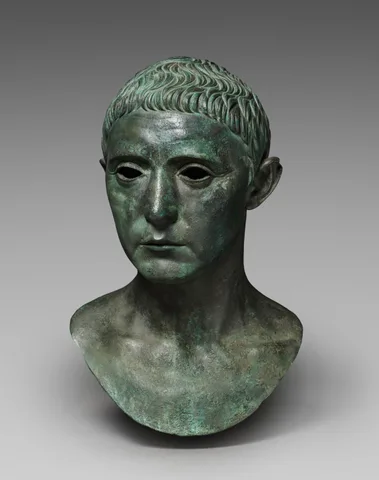
A face without a secure name
The furrowed forehead and carefully shaped hair produce a particular face, but the sitter is unknown. The museum discusses alternative dating within late Republican or early imperial Rome. Individual-looking features do not automatically supply a recoverable biography.
Carry this question: Which features seem personal, and which remain insufficient to identify a person?
Open the artwork ↗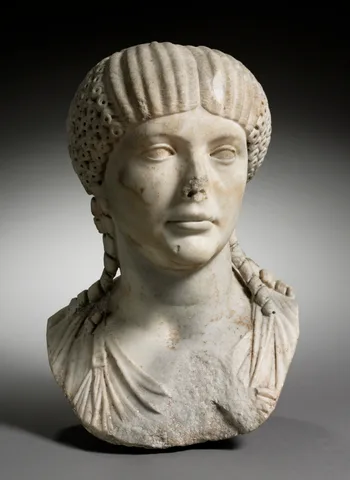
A hairstyle supports a proposal
Deep waves across the crown of the head contrast with small curls and long ringlets. The museum proposes Claudia Octavia as a possible identity. The hairstyle contributes to that discussion, but the word “possibly” remains essential when presenting the portrait.
Carry this question: How many different treatments of hair can you distinguish?
Open the artwork ↗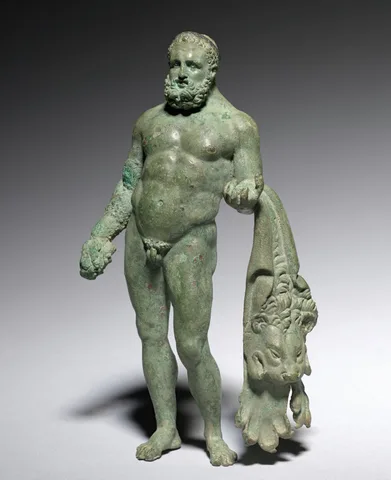
A hero recognized by a skin
The lion skin hangs beside the body, with the animal’s head clearly modeled. It supports the identification of Hercules even though most of his club is lost. Here a surviving attribute provides firmer evidence than an attempt to read heroism from musculature alone.
Carry this question: Which features make the hanging form recognizable as an animal skin?
Open the artwork ↗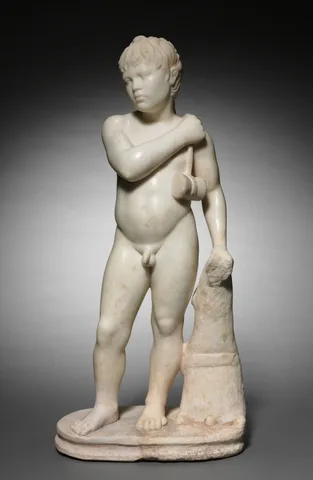
A complete-looking body includes restoration
The youth’s pose combines an athletic weight, a supporting structure and carefully balanced legs. The museum identifies the lower right leg and foot as reconstructed. Looking at that area introduces another kind of history: modern work contributes to the continuity of the figure now on view.
Carry this question: How does knowing about restoration change your reading of an apparently continuous pose?
Open the artwork ↗Look at a pair more closely
- Gestures need context
A finger at the mouth and a downward palm require different readings.
- Faces, office and person
A Benin ancestral head and an unnamed Roman portrait make different claims.
Read with the sources
Historical context follows the individual museum records linked on each artwork page. These routes make original comparisons of visible form; resemblance alone is not evidence of shared meaning or direct influence.
- Statuette of Harpocrates — museum collection record
- Piping and Dancing Satyr — museum collection record
- Portrait Bust of a Man — museum collection record
- Portrait Bust of the Empress Claudia Octavia — museum collection record
- Hercules — museum collection record
- Youth with Jumping Weights — museum collection record