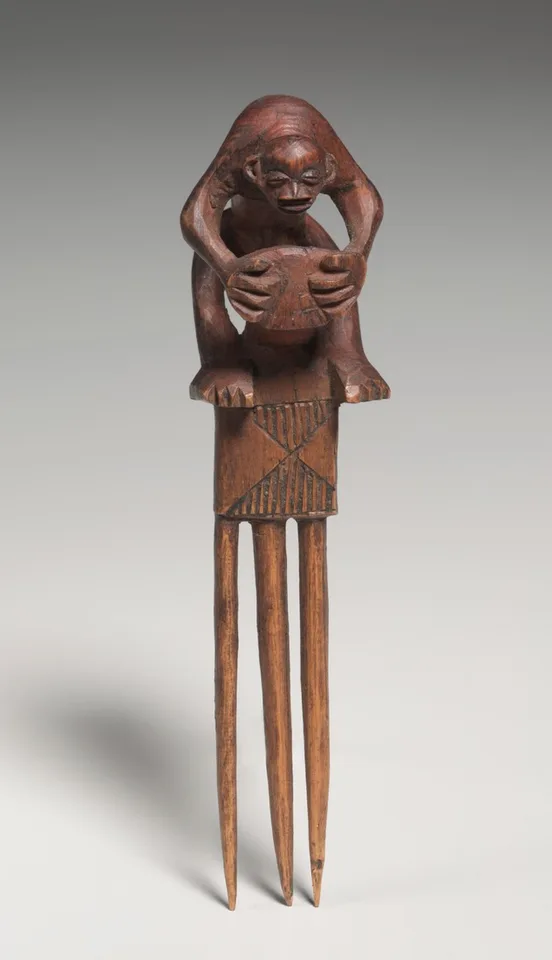
 Central Africa, Democratic Republic of the Congo or Angola, Chokwe, 20th century · c. 1910
Comb
Maker unrecorded
Wood
Two combs reserve their upper portions for sculpture while keeping recognizable teeth below. Compare the compact poses, transitions and working edges. The figures belong to different times and cultural settings, so the shared practical form offers a formal connection rather than evidence of a common story.
Central Africa, Democratic Republic of the Congo or Angola, Chokwe, 20th century · c. 1910Maker unrecorded
Wood
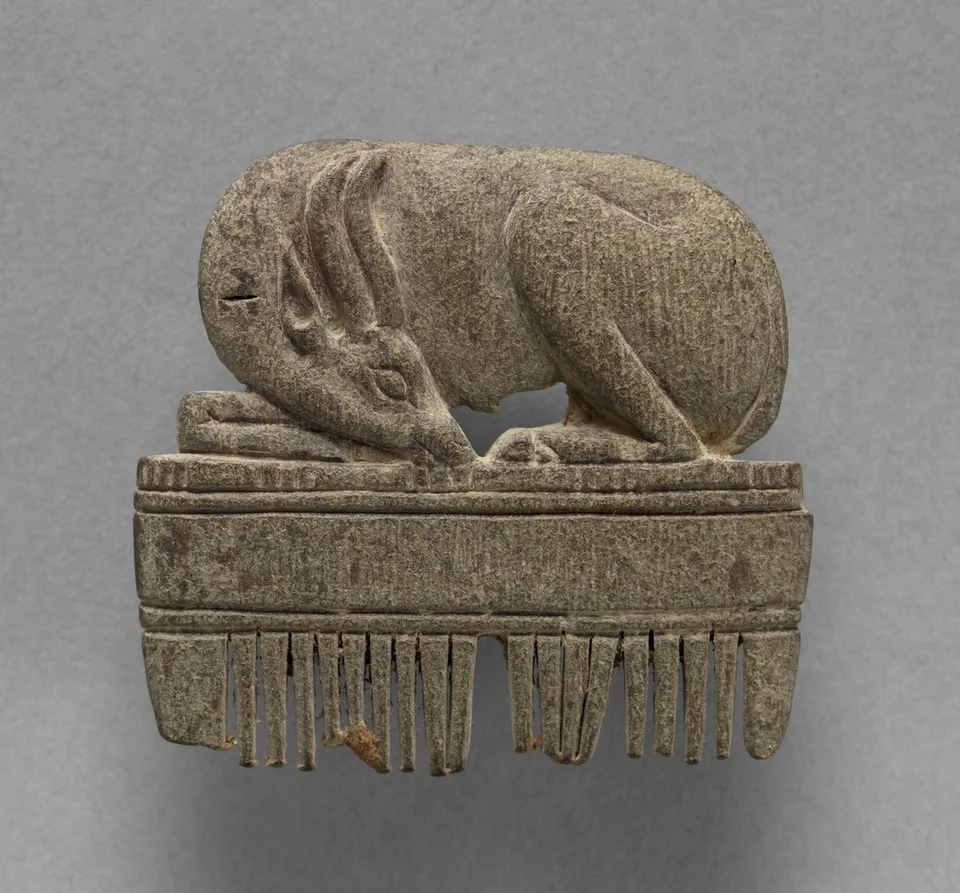 Egypt, New Kingdom (1540–1069 BCE), Dynasty 18, reign of Amenhotep III (1390–1352 BCE) · c. 1391–1353 BCE
Maker unrecorded
wood
The drummer bends over an instrument with both hands drawn inward; the gazelle folds its head toward its forelegs. Each pose compresses a recognizable subject into the limited space above the comb’s crossbar.
Diagonal cuts decorate the Chokwe comb’s rectangular junction. The Egyptian gazelle’s horns curve close to its neck above a firm horizontal bar. Both move from lively modeled forms toward a more regular structure without making the transitions identical.
Three long Chokwe teeth leave broad spaces between them; the Egyptian comb has many closely spaced teeth, now interrupted by breaks. Their different spacing and survival conditions remain visible even when the sculpture above first attracts attention.
The comparison concerns compact carving and comb structure. It does not establish shared symbolism, equivalent grooming practices or historical contact between the makers.
The comparison of visible choices is our own reading. Follow either artwork page for its full context, uncertainty note and image-rights record.
From a model boat and comb to divination and ancestral images.
Five ways to divide a modest object between image and practical use.