Read the
Picture
An open collection
Egypt, New Kingdom (1540–1069 BCE), Dynasty 18, reign of Amenhotep III (1390–1352 BCE) · Other

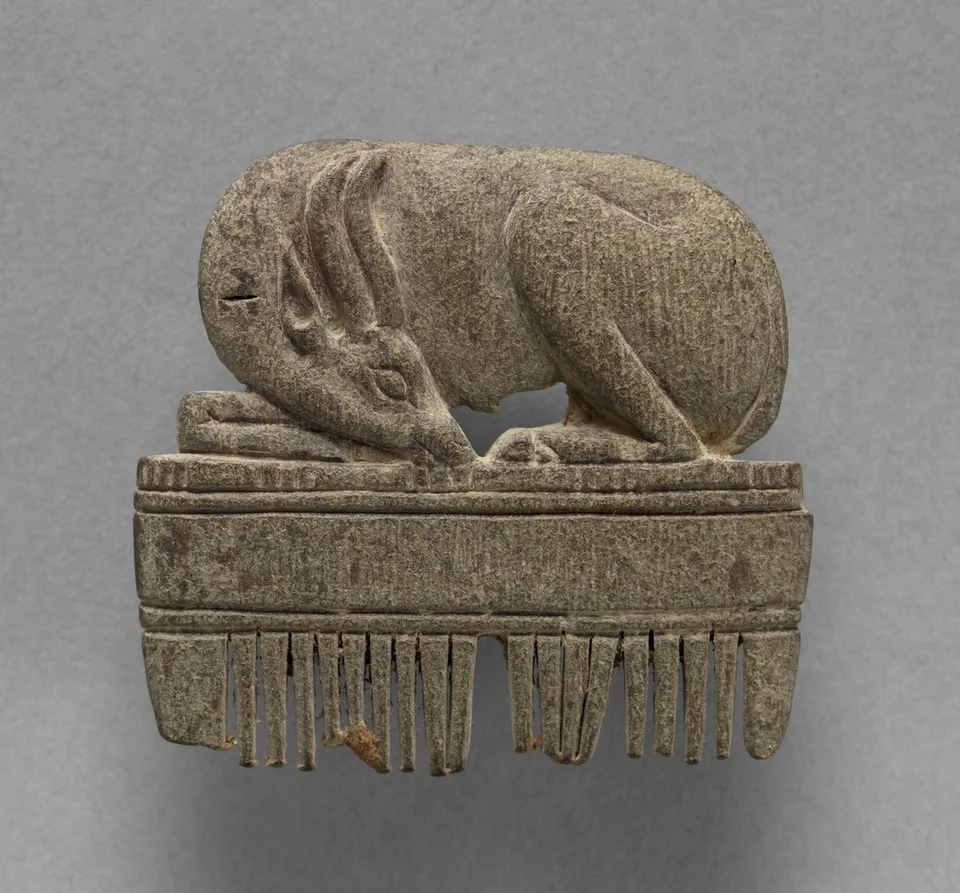
Comb with Gazelle

Maker unrecorded · c. 1391–1353 BCE

A weathered wooden comb has a broad rectangular crossbar and a row of closely spaced teeth, several broken. Above the bar, a crouching gazelle bends its head downward toward folded forelegs. Long horns curve backward beside the neck, and the rounded hindquarters fill the upper right corner. Fine parallel lines border the crossbar.
100%

Drag to move · Pinch or +/− to zoom · Arrow keys to pan · 0 to reset

The Cleveland Museum of Art · 1995.90 · Image: CC0Museum image ↗
A little context

A gazelle folds its head toward its legs above a row of narrow teeth, making a compact animal fit an everyday object.

The museum identifies the animal above this wooden comb as a gazelle and places the object among elaborate Egyptian implements of personal care. Its collection discussion describes the attention given to cosmetics and their associated containers and tools. Here the represented animal occupies the upper portion, leaving the narrow teeth below to perform the comb’s practical work. The ornament and function remain distinct while sharing the same piece of wood.

The folded posture is crucial to the design. A standing gazelle would require a much taller and more fragile silhouette, but the lowered head, curved horns and bent legs compress the animal into a rounded block. Small openings keep its anatomy legible without entirely separating the limbs. Below, the straight crossbar provides a firm visual boundary before the long parallel teeth begin. Some teeth are broken, so the rhythm is interrupted. Those losses are part of the present object, not evidence that the maker planned an irregular grooming edge.

A careful reading

The catalogue lists wood, while the museum’s short note calls this ivory; this guide follows the catalogue material. The broader cosmetic-object description establishes no owner or exact use setting. Missing teeth change the original outline.
Try your eye

How does the animal fit within the comb’s compact upper area?

Where this reading begins

  • Comb with Gazelle: collection record — The Cleveland Museum of Art. Identification, qualified cultural and maker attribution, materials, object-specific historical context, provenance and stated uncertainties; photograph independently inspected for visual observations. Museum record updated 2026-05-29; accessed 2026-11-14.

Our observations describe the supplied museum photograph. Historical identifications and context follow the cited collection record; interpretive limits are stated above. This is an independent guide, not a museum endorsement.

Image rights & attribution

Comb with Gazelle, c. 1391–1353 BCE. Egypt, New Kingdom (1540–1069 BCE), Dynasty 18, reign of Amenhotep III (1390–1352 BCE). Wood; overall: 5.4 x 5.7 x 0.4 cm (2 1/8 x 2 1/4 x 3/16 in.). The Cleveland Museum of Art, Gift of Jean-Luc and Véronique Chalmin, 1995.90

Individual API record marked CC0; checked 2026-11-14. CC0 1.0 dedication. Record date: 2026-05-29 08:15:35.556000. Museum print JPEG preserved unchanged in local originals; overview JPEG resized and recompressed from that same full frame; responsive WebP and zoom derivatives resized and recompressed; numbered annotation overlay separate from image.