Working a small surface
A broken practice stone, a palette, a comb and two vessels each make different demands on their surfaces. Some areas need to remain usable; others can carry figures or a compressed landscape. Follow the boundary between an object’s shape and its decoration, keeping unknown functions and broader cultural comparisons separate from what the photograph actually shows.
Begin the journey ↓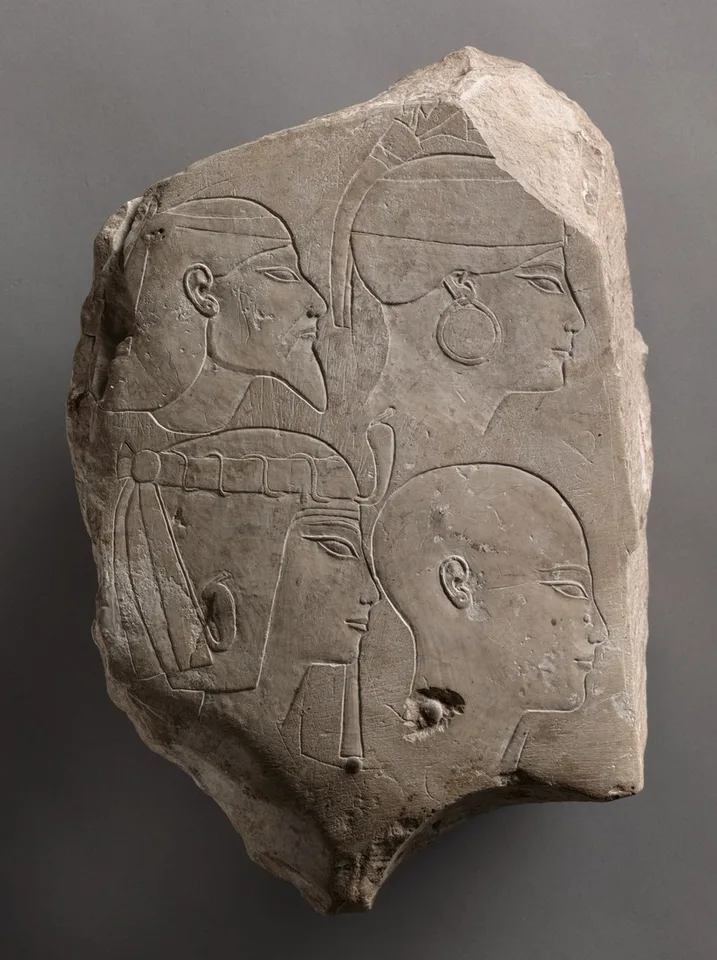
Profiles as working exercises
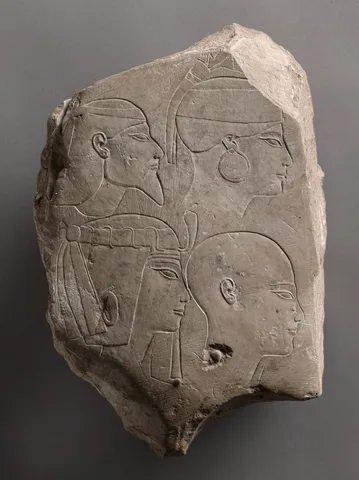
The pointed beard belongs to one of several profiles on a trial piece. The museum’s cultural identifications describe Egyptian artistic conventions, not objective definitions of the people represented, and the reverse is outside this view.
Carry this question: What makes this profile distinct within a repeated format?
Open the artwork ↗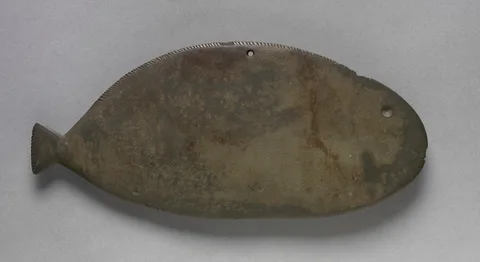
A plain centre inside a fish
The broad centre remains available for grinding pigment while the outline supplies the animal’s identity. This is a useful contrast with the trial piece: not every available surface needs detailed figurative work.
Carry this question: Where is the fish recognizable without carved scales?
Open the artwork ↗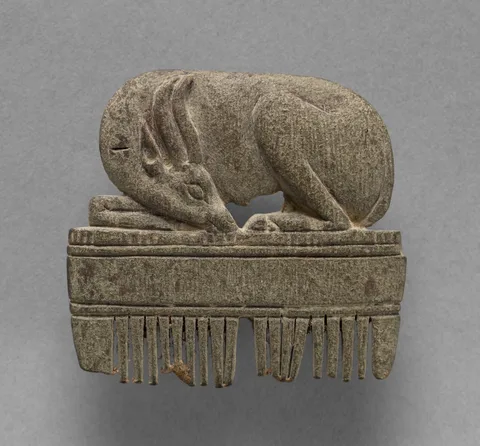
Teeth beneath a folded animal
The surviving teeth establish the object as a comb even where breakage interrupts them. Above, the folded gazelle fits its limited space. Ornament and working structure meet within one compact outline.
Carry this question: Which parts establish the object’s function despite the breaks?
Open the artwork ↗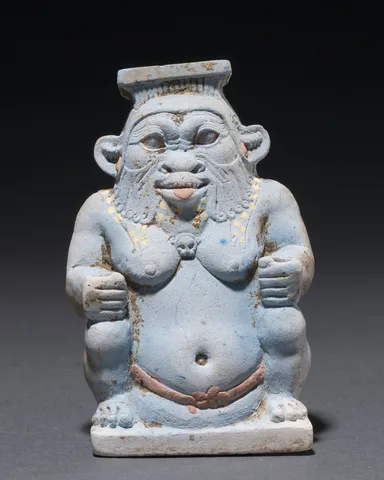
An opening above a divine face
The short vessel neck rises directly above Bes. It preserves access to the container while the figure gives it a religious association; the record does not identify the particular substance once held inside.
Carry this question: How is the container opening separated from the head?
Open the artwork ↗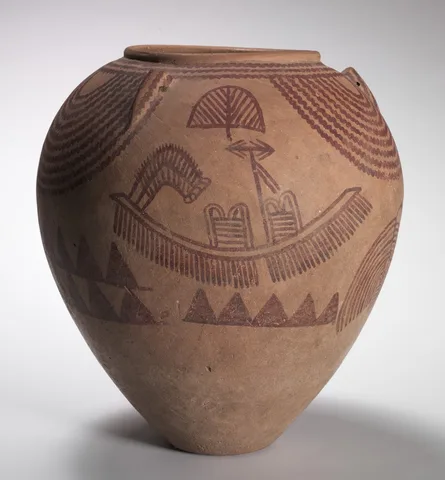
A river compressed into a pot
The many short oars make the long curved hull legible. The museum connects this imagery with Nile movement and communication, but does not identify a specific voyage or justify importing later boat rituals into the scene.
Carry this question: How do repeated short strokes suggest many oars?
Open the artwork ↗Look at a pair more closely
- Figures above the teeth
A Chokwe drummer and an Egyptian gazelle animate two carved combs.
- Faces that pour
Bes and a Roman bear turn anatomy into container structure.
- Plain centres, speaking edges
A fish palette and an Ifá tray reserve open space for work.
Read with the sources
Historical context follows the individual museum records linked on each artwork page. These routes make original comparisons of visible form; resemblance alone is not evidence of shared meaning or direct influence.