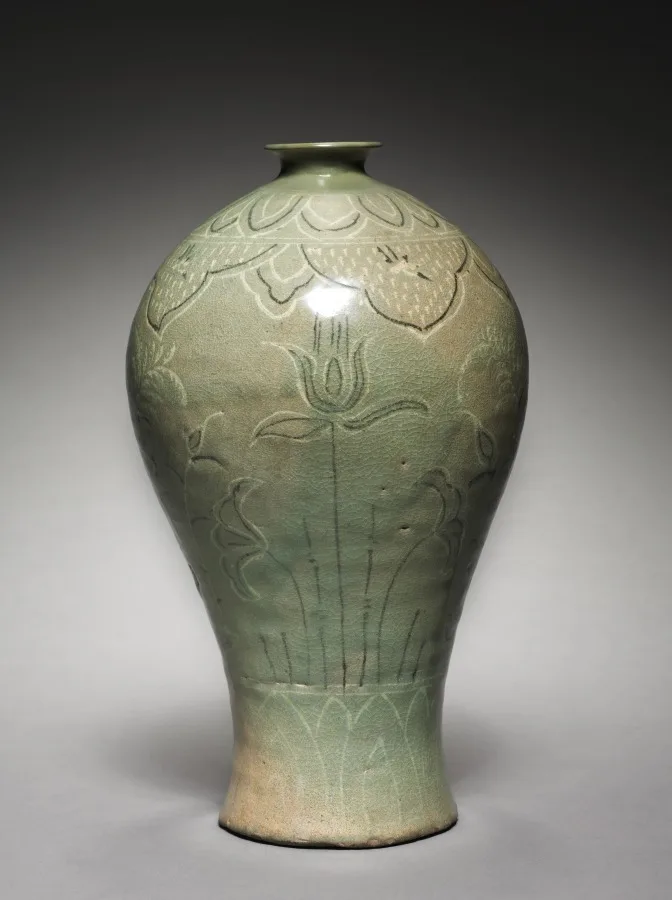
 Korea, Goryeo dynasty (918–1392) · 1300s
Prunus Vase with Inlaid Lotus and Reed Design
Maker unrecorded
Celadon ware with inlaid white and black slip decoration
Flowers move across a rounded vessel and an architectural tile panel in different ways. Compare the relationship between decoration and support rather than assuming that floral motifs carry the same symbolic message.
Korea, Goryeo dynasty (918–1392) · 1300sMaker unrecorded
Celadon ware with inlaid white and black slip decoration
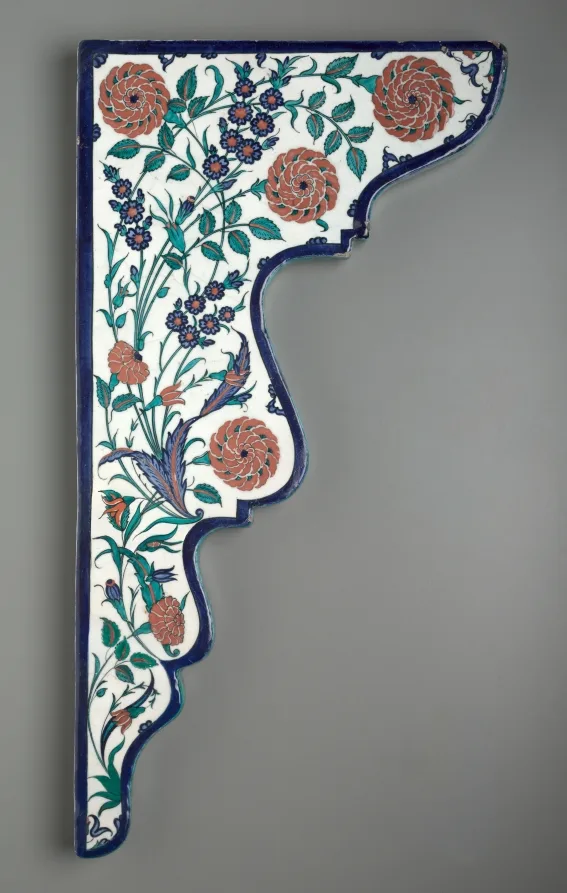 Turkey, Iznik, Ottoman period (1299–1922) · c. 1570–75
Maker unrecorded
Fritware with red slip and underglaze design
Lotus and reed stems spread over the Korean vase’s curved body; its type-name “prunus vase” does not identify the depicted plant. Interlacing stems link flowers across the Iznik panel. Each support directs how the plant lines continue and where they meet a boundary.
The vase uses pale and dark slip inlay beneath a celadon glaze. The Iznik panel combines underglaze design with strong red slip. Compare how flowers separate from their grounds while keeping these techniques distinct; they are not simply two examples of paint applied to finished ceramics.
The vase’s small mouth belongs to a container associated with storing liquids. The spandrel’s inward curve belonged to the surround of an architectural opening, completed by a missing section. Their forms make sense through use: one contains, while the other frames.
The pairing demonstrates adaptation to surfaces. It does not establish a direct line of transmission between these two particular objects.
The comparison of visible choices is our own reading. Follow either artwork page for its full context, uncertainty note and image-rights record.
Flowers, birds and animals change meaning with context.
Let the material change the questions you ask.