Nature without a dictionary
A flower is not a password with one fixed translation. It can be a seasonal observation, a decorative form, an attribute or part of a story. In this journey, keep two questions separate: what is represented, and what evidence supports its interpretation here? The answers may involve the object’s use, its place of making or the artist’s way of handling a surface.
Begin the journey ↓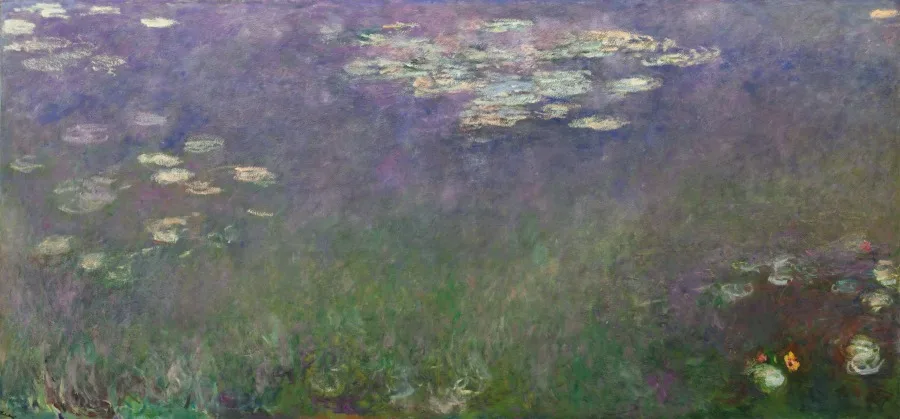
A surface that becomes a space
Follow the lily pads across reflections and open water. A garden subject lets Monet explore painting’s surface as much as the identity of a plant. Look for the relationship between distinct shapes and loose marks.
Carry this question: Where can you tell water from reflection, and where does that distinction blur?
Open the artwork ↗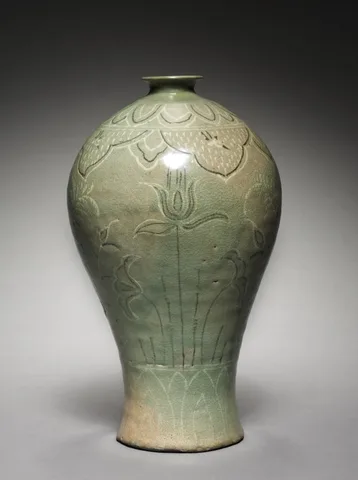
Lotus and reeds wrap around a vessel
Despite the type-name “prunus vase,” this Korean vessel carries an inlaid lotus and reed design. Follow its pale and dark plant lines beneath the celadon glaze. The photograph offers one view of decoration that continues around a curved body.
Carry this question: How do the inlaid stems echo the vessel’s tall, rounded form?
Open the artwork ↗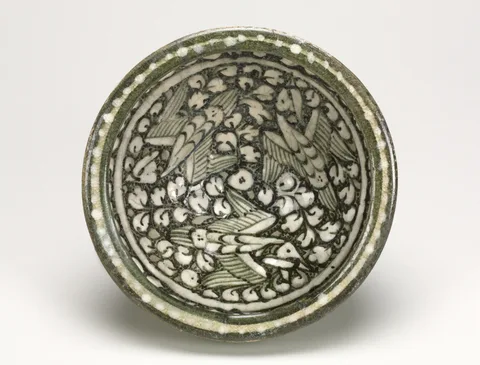
Birds become a rhythm
Look at the pale birds and lotus forms against the darker bowl. The museum connects this Ilkhanid decoration with motifs adapted from China and with the Persian simurgh. A repeated bird can organise a pattern while also participating in a specific history of exchange; neither role makes every bird carry the same story.
Carry this question: What repeats, and what varies?
Open the artwork ↗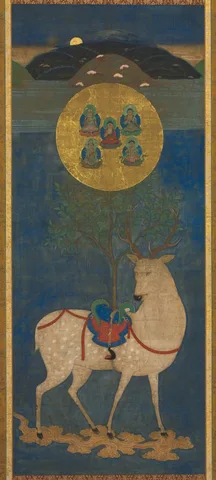
An animal within a sacred setting
The title and museum account establish a particular Japanese religious context. Read the deer together with the objects and setting around it. Isolating the animal would remove evidence essential to interpretation.
Carry this question: Which surrounding details make this more than a study of wildlife?
Open the artwork ↗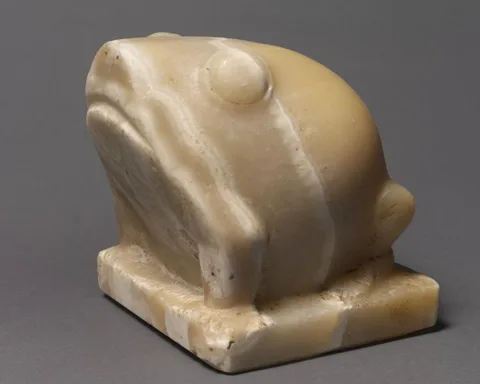
A stone pattern gives shape
Follow the natural bands in the travertine across the rounded animal. They help describe volume without being painted outlines. The later association with the goddess Heqat is documented, but the precise religious meaning at this early date remains unknown.
Carry this question: How do the stone’s bands reinforce the rounded body?
Open the artwork ↗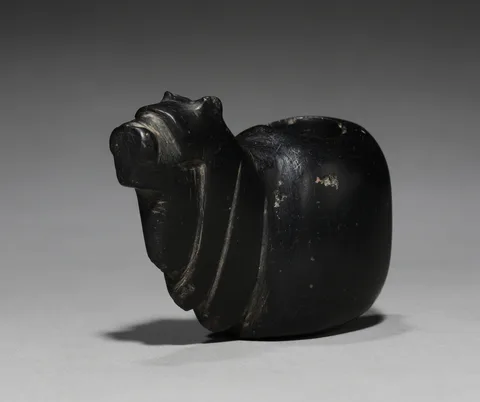
Animal and object at once
The alpaca form and the cavity belong to the same object. The museum identifies a ritual context; the visible structure helps explain why this is more than a miniature animal sculpture.
Carry this question: What does the hollow change about the way you understand the form?
Open the artwork ↗Look at a pair more closely
- When an animal becomes an object
A Moche bat vessel and an Inka alpaca canopa
- Flowers find a surface
A prunus vase and an Iznik floral spandrel
- Two ways to organise attention
A Nairatma mandala and Monet’s Water Lilies
Read with the sources
Historical context follows the individual museum records linked on each artwork page. These routes make original comparisons of visible form; resemblance alone is not evidence of shared meaning or direct influence.
- Water Lilies (Agapanthus) — museum collection record
- Prunus Vase with Inlaid Lotus and Reed Design — museum collection record
- Bowl with Flying Birds — museum collection record
- Kasuga Deer Mandala — museum collection record
- Statue of Heqat, the Frog Goddess — museum collection record
- Alpaca Offering Container (Canopa) — museum collection record