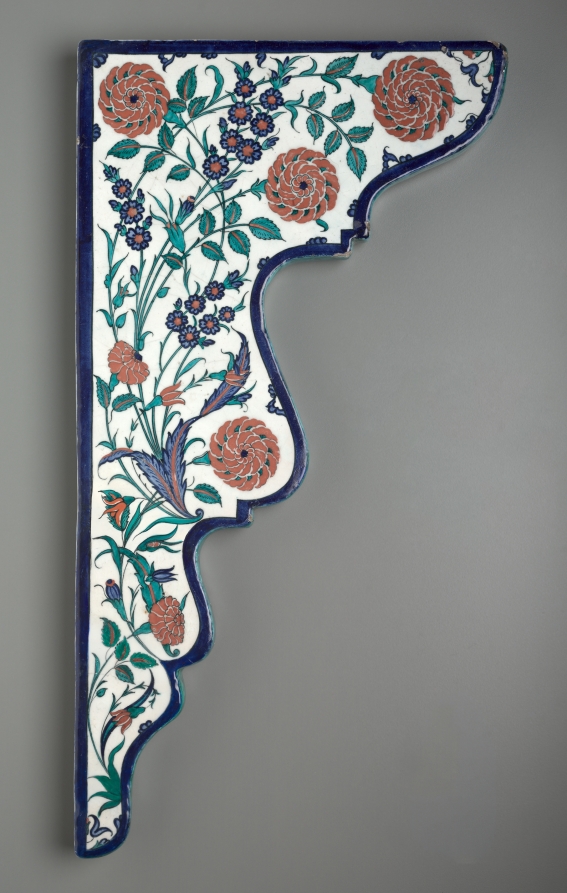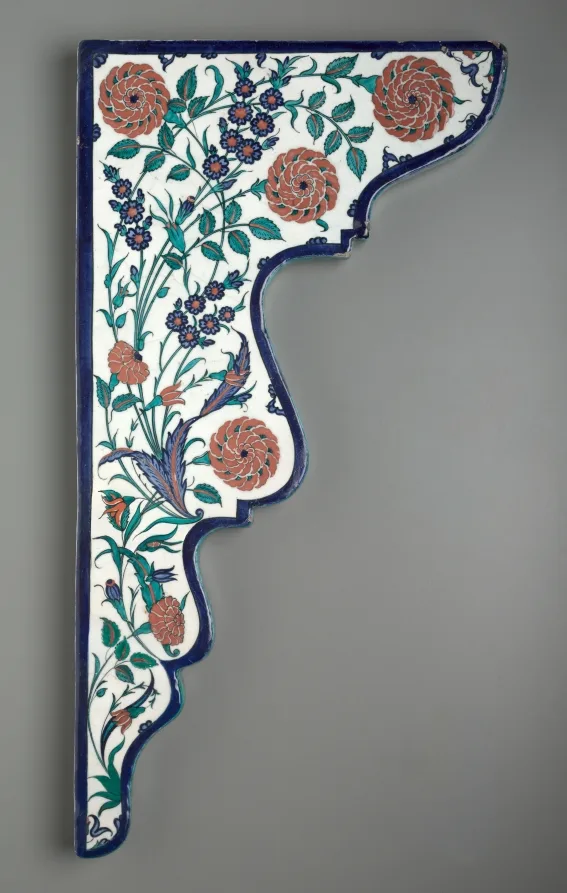
The curved edge reveals an architectural fragment; rich red blossoms reveal a technical achievement in Ottoman ceramic production.
The unusual outline is the first clue to this object’s purpose. It is not a broken rectangular picture: the inward-curving edge belongs to a spandrel, a panel associated with an arch. The museum explains that a missing right half would have completed an architectural frame over a doorway, window, or niche. Imagine the flowers extending around an opening rather than hanging as an isolated image.
The panel was made in Iznik, an Ottoman centre renowned for ceramic vessels and architectural tiles. Its white ground keeps the intertwined blue and green stems clear, while red flowers punctuate the surface. The museum identifies the intense red as a technical accomplishment produced with a thick, iron-rich clay slip. Follow a single stem between blossoms and leaves, and then step back to see the balance of repeated colours. The floral surface can evoke abundance and paradise in its cultural setting, but the original building and exact viewing position are not supplied by this image.
The panel’s architectural role is documented, but its missing partner and original placement are not reconstructed here. The museum’s paradise association is contextual; it does not make every flower an individually coded religious symbol.