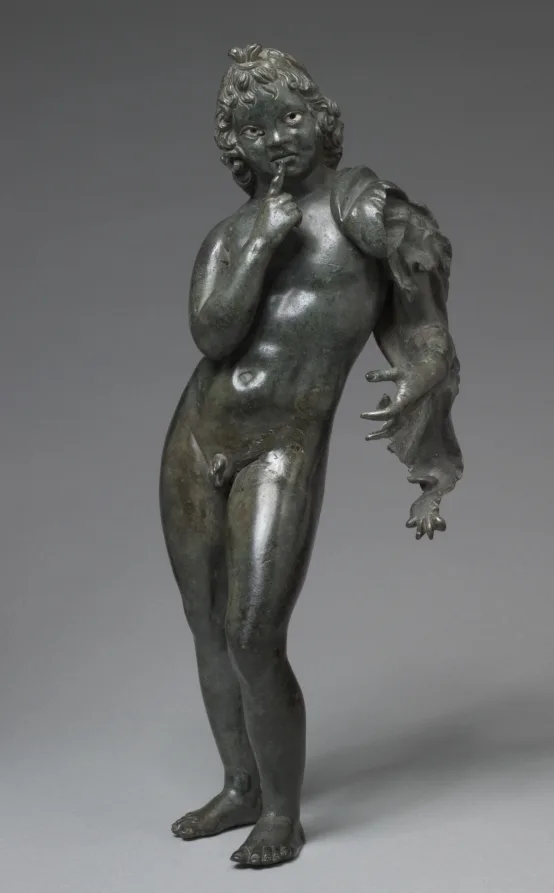
 Greece, Greco-Roman Period, late Ptolemaic Dynasty · c. 50 BCE
Statuette of Harpocrates
Maker unrecorded
bronze, hollow cast, with silver inlays
A hand position becomes meaningful through an image’s particular history. Compare Harpocrates with the Standing Buddha from Myanmar, first describing each visible action. The museum supplies distinct narratives and traditions; visual resemblance to familiar modern gestures should not replace that contextual evidence.
Greece, Greco-Roman Period, late Ptolemaic Dynasty · c. 50 BCEMaker unrecorded
bronze, hollow cast, with silver inlays
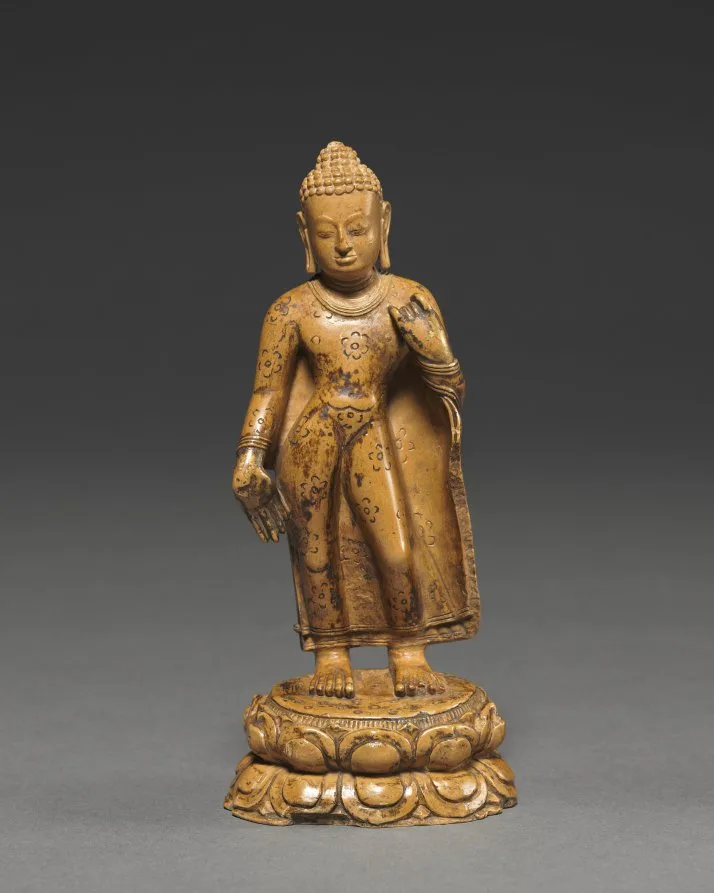 Burma (Myanmar) · c. 800s
Maker unrecorded
Kaolin
Harpocrates touches his mouth with a finger, an Egyptian-derived sign of childhood. The Buddha lowers an open palm, which the museum connects with his return from heaven. Neither gesture becomes a universal instruction simply because a modern viewer recognizes the hand position.
Harpocrates has silver eye inlays within the bronze face. Small flowers mark the Buddha’s robe, with a possible link to falling blossoms in the descent narrative. One detail changes the material presence of the eyes; the other may reinforce a particular story.
Harpocrates shifts through bent and straighter legs, giving the small body a relaxed imbalance. The Buddha’s feet rest above a two-layer petalled base. Compare bodily movement with an emphasized support, without assuming that posture alone measures either image’s sacred importance.
These figures belong to different periods and religious settings. The comparison concerns how visible evidence supports a contextual reading, not a shared code of gestures or belief.
The comparison of visible choices is our own reading. Follow either artwork page for its full context, uncertainty note and image-rights record.
A gesture is a clue, not a universal language.
Six Mediterranean figures offer different strengths of identification.