Read the
Picture
An open collection
Greece, Greco-Roman Period, late Ptolemaic Dynasty · Metalwork

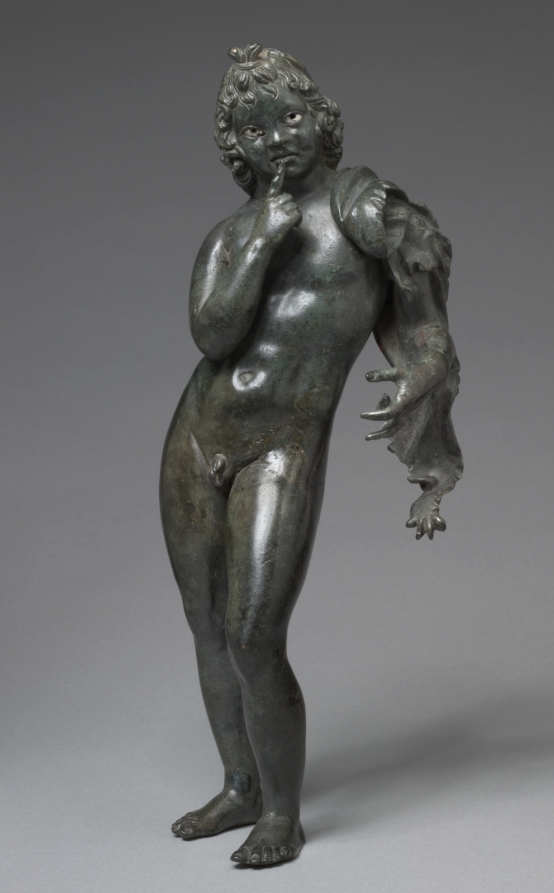
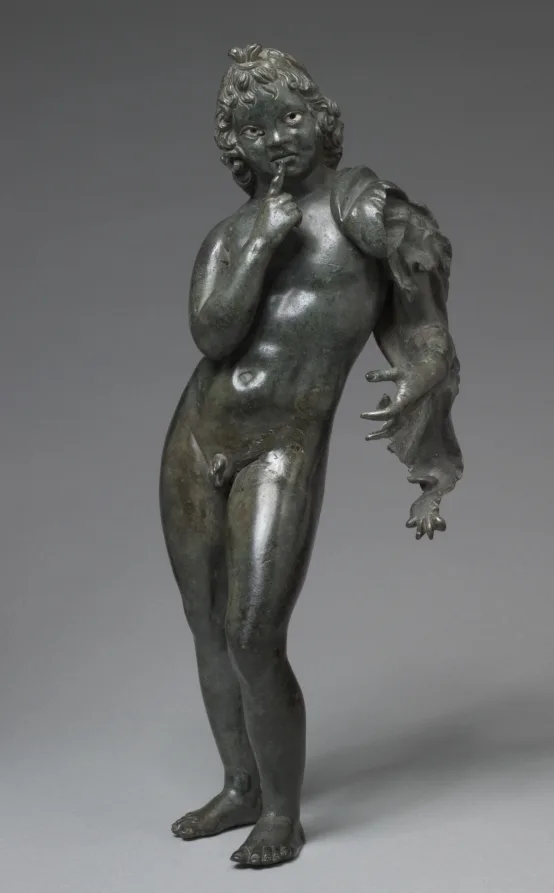
Statuette of Harpocrates

Maker unrecorded · c. 50 BCE

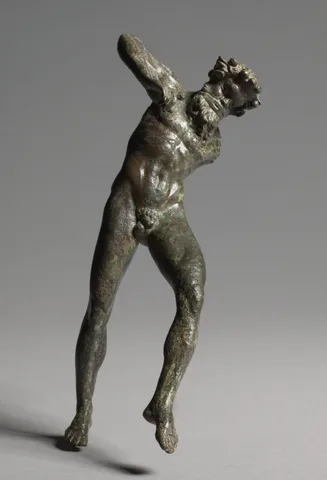
A small bronze boy stands with weight shifted to one leg and a finger raised to his mouth. Curly hair frames a rounded face with pale inlaid eyes. An animal skin hangs over one shoulder and arm, while the other arm bends upward. The dark metal catches bright highlights across the torso and limbs.
100%

Drag to move · Pinch or +/− to zoom · Arrow keys to pan · 0 to reset

The Cleveland Museum of Art · 1972.6 · Image: CC0Museum image ↗
A little context

A finger at the mouth looks familiar, but this figure uses an Egyptian sign of childhood rather than a universal instruction.

The raised finger reaches the mouth, a gesture modern viewers may read as a request for silence. Begin instead with the museum's identification. This is Harpocrates, the Greek form of the Egyptian child god Horus, and the gesture relates to an Egyptian sign for a child. A familiar movement can carry a meaning different from our first association.

The body is modeled with soft volumes, a shifted stance and curling hair, combining conventions of Hellenistic naturalism with the Egyptian gesture. Pale eye inlays sharpen the face's presence against the dark bronze. The museum notes a hole at the top of the head that probably held an Egyptian double crown, now missing. These features make the figure a useful case of cultural adaptation rather than a choice between purely Greek and purely Egyptian identities. Looking and historical context work together, while the missing crown remains a reconstruction rather than something visible in full.

A careful reading

The original double crown is inferred from a hole and related images. A finger-to-mouth gesture should be read within this Egyptian-derived childhood convention, not automatically translated as a modern command for silence.
Try your eye

What does the museum associate with the finger-to-mouth gesture?

Where this reading begins

  • Statuette of Harpocrates: collection record — The Cleveland Museum of Art. Object identification, attribution, materials, historical context and stated uncertainties; observations independently checked against the museum photograph. Museum record updated 2026-05-29; accessed 2026-11-13.

Our observations describe the supplied museum photograph. Historical identifications and context follow the cited collection record; interpretive limits are stated above. This is an independent guide, not a museum endorsement.

Image rights & attribution

Statuette of Harpocrates, c. 50 BCE. Greece, Greco-Roman Period, late Ptolemaic Dynasty. Bronze, hollow cast, with silver inlays; overall: 27 x 10.2 x 8.6 cm (10 5/8 x 4 x 3 3/8 in.). The Cleveland Museum of Art, Purchase from the J. H. Wade Fund, 1972.6

Individual API record marked CC0; checked 2026-11-13. CC0 1.0 dedication. Record date: 2026-05-29 07:32:26.871000. Web JPEG downloaded unchanged; responsive WebP and zoom derivatives resized and recompressed; numbered annotation overlay separate from image.