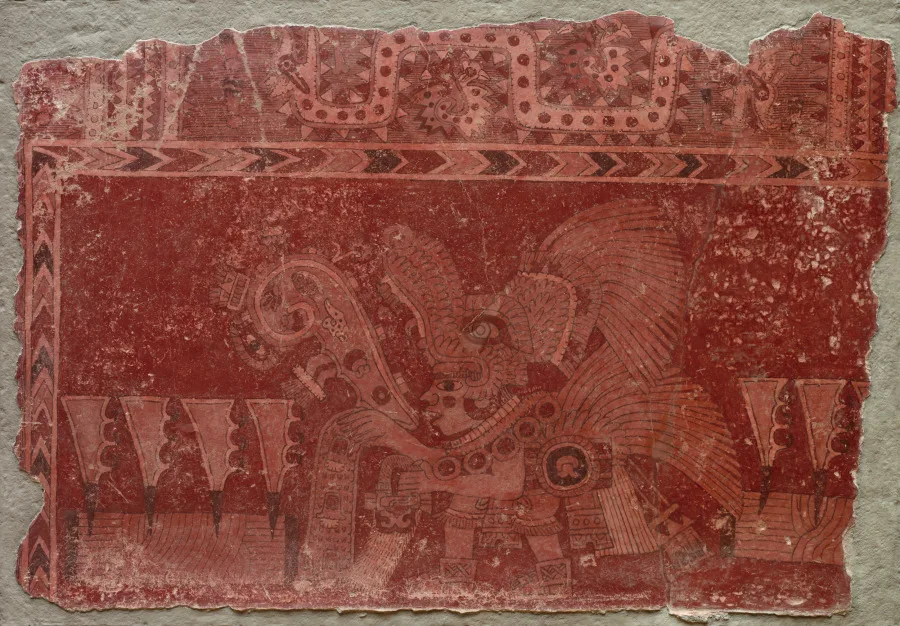
 Central Mexico, Tlacuilapaxco apartment compound(?), Teotihuacán style, Classic Period · 500–550
Mural Fragment with Elite Male and Maguey Cactus Leaves
Maker unrecorded
fresco on wall fragment
Both images direct attention toward an offering, but they organize action and recipients differently. Compare the represented things, the figures’ relationships and the marks that add information beyond bodily form. These are distinct historical settings for provision, not interchangeable illustrations of a universal ritual.
Central Mexico, Tlacuilapaxco apartment compound(?), Teotihuacán style, Classic Period · 500–550Maker unrecorded
fresco on wall fragment
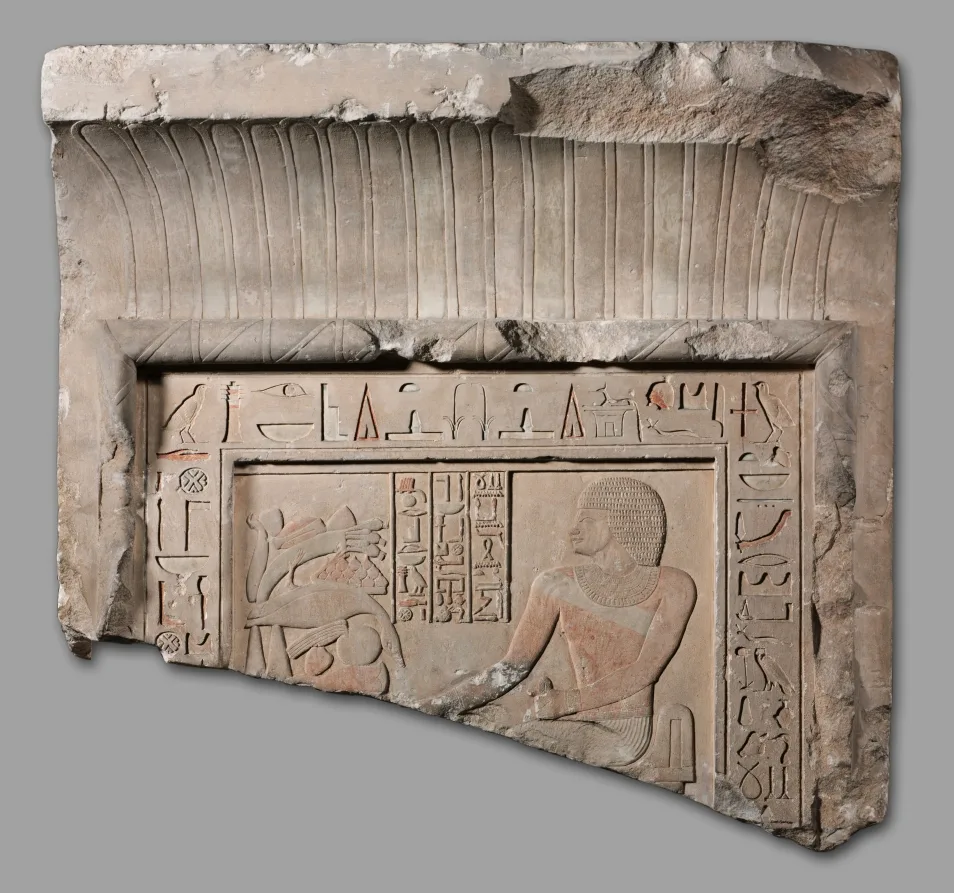 Egypt, Aswan, Qubbet el-Hawa, excavations of Lady William Cecil, 1904, "Cecil Tombs," no. 28, Middle Kingdom (2040–1648 BCE), Dynasty 12, probably reign of Senusret I (1971–1926 BCE) · c. 1960–1916 BCE
Maker unrecorded
painted limestone
The mural shows an outflow below the extended hand, interpreted by the museum as a libation. The stele places an arrangement of offerings before the seated Shemai. One image emphasizes an action in progress; the other presents provisions in a funerary setting.
A curling scroll near the mural figure’s mouth is read as vocalization or chant. The Egyptian frame carries hieroglyphs cut into the stone, distinct from the raised central signs translated by the museum. The scroll is not a literal transcription equivalent to the written signs.
Plants below the mural action support the museum’s discussion of maguey and offerings. The stele’s seated recipient is identified as Shemai, a chief of police. These details locate the acts within particular accounts instead of letting a general idea of “giving” replace historical specificity.
The two works differ in religion, period, place and architectural setting. Their fragmentary survival also limits reconstruction of the complete images and the actions once associated with them.
The comparison of visible choices is our own reading. Follow either artwork page for its full context, uncertainty note and image-rights record.
Four Egyptian objects make colour, reflection, carving and enclosure active.
Four American works ask us to separate evidence from reconstruction.