Read the
Picture
An open collection
Egypt, Aswan, Qubbet el-Hawa, excavations of Lady William Cecil, 1904, "Cecil Tombs," no. 28, Middle Kingdom (2040–1648 BCE), Dynasty 12, probably reign of Senusret I (1971–1926 BCE) · Sculpture

Stele of Shemai

Maker unrecorded · c. 1960–1916 BCE

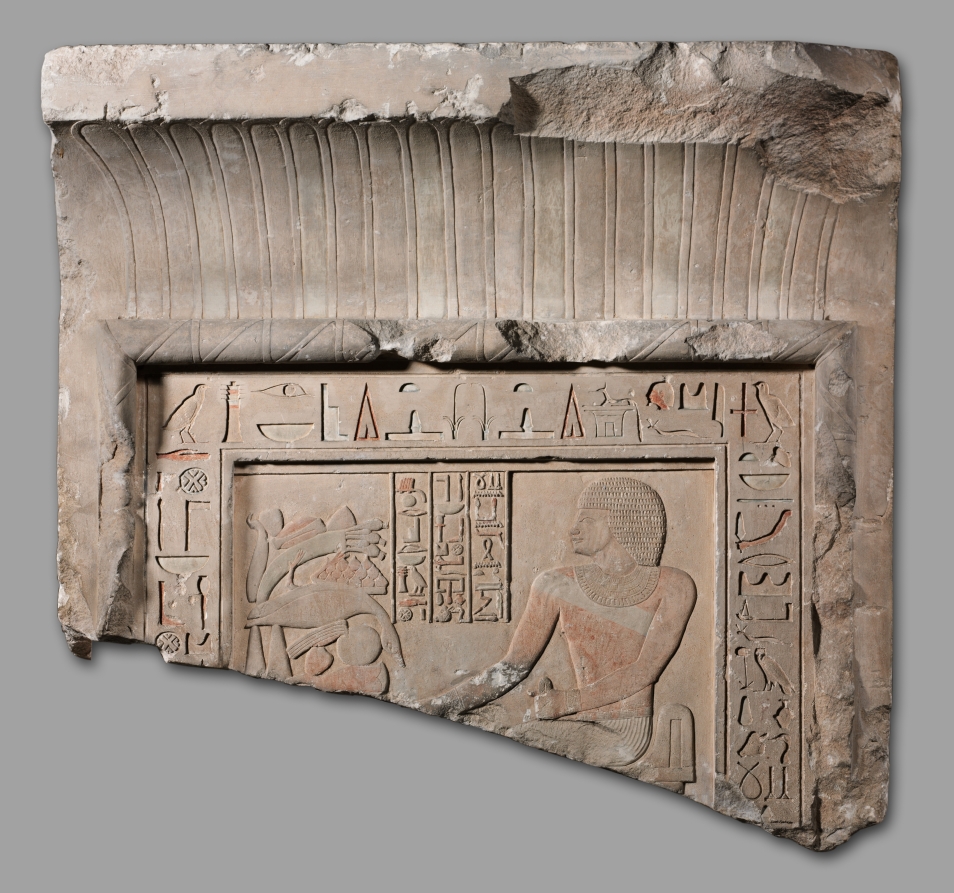
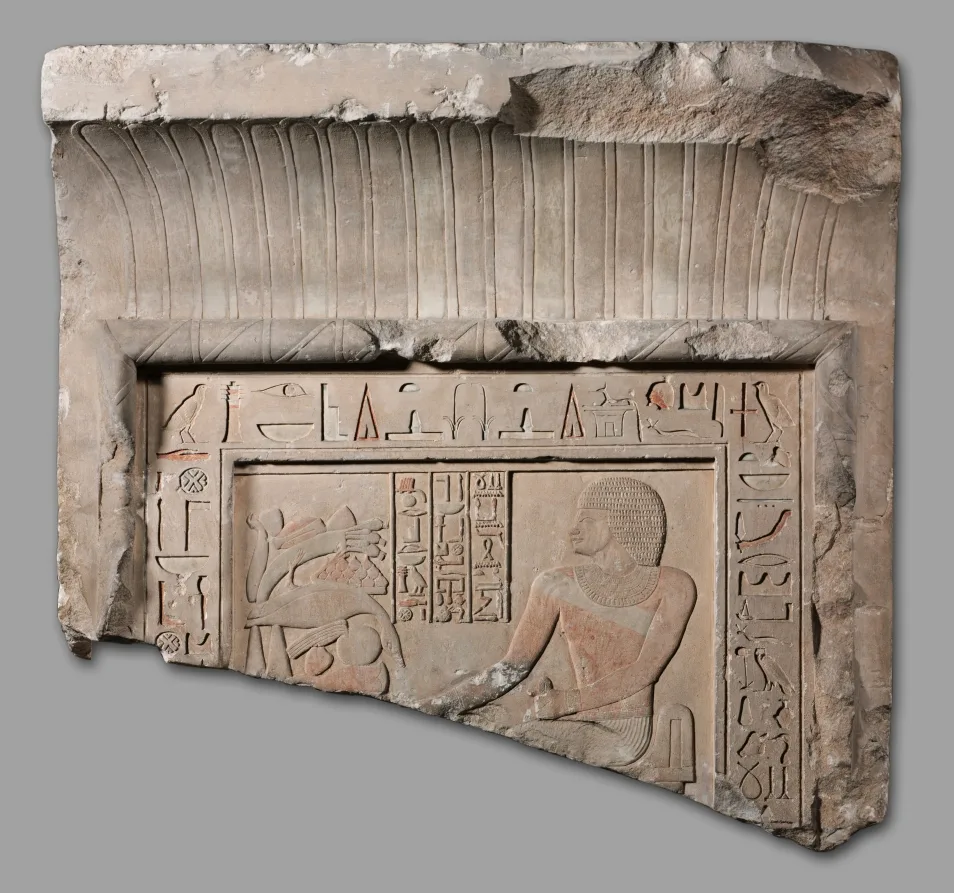
A broken limestone stele resembles a framed doorway beneath a broad grooved cornice. Inside, a seated man faces a table piled with offerings. Columns of hieroglyphs stand between figure and table, while additional signs run around the frame. The lower edge is broken diagonally, and faint reddish paint survives on the figure and signs.
100%

Drag to move · Pinch or +/− to zoom · Arrow keys to pan · 0 to reset

The Cleveland Museum of Art · 1921.1017 · Image: CC0Museum image ↗
A little context

A door-shaped memorial uses two carving techniques to distinguish an offering scene from its surrounding written frame.

Read the stone at two depths. The figure and central signs stand above their background, while the signs around the frame are cut into the surface. The doorway-like outline holds these different techniques together. Even where the lower part is broken, the seated man and offering table remain legible as a relationship across the central field.

The museum identifies the deceased as Shemai, a chief of police. The inscription requests offerings for his ka, or vital spirit, in relation to Osiris. Food and other provisions therefore belong to a funerary purpose rather than merely describing a meal in progress. The work's precise effect depends on both words and relief: without translation we can describe their placement, but not recover the named person or requested gifts fully. Its damaged lower boundary also marks the limit of what survives. A careful reading uses the preserved carving and the museum's translation together.

A careful reading

The lower scene is incomplete. The inscription's meaning comes from translation in the museum record; recognizing individual shapes in the photograph is not the same as independently reading the full Egyptian text.
Try your eye

What differs between the central scene and the border inscriptions?

Where this reading begins

  • Stele of Shemai: collection record — The Cleveland Museum of Art. Object identification, attribution, materials, historical context and stated uncertainties; observations independently checked against the museum photograph. Museum record updated 2026-05-29; accessed 2026-11-13.

Our observations describe the supplied museum photograph. Historical identifications and context follow the cited collection record; interpretive limits are stated above. This is an independent guide, not a museum endorsement.

Image rights & attribution

Stele of Shemai, c. 1960–1916 BCE. Egypt, Aswan, Qubbet el-Hawa, excavations of Lady William Cecil, 1904, "Cecil Tombs," no. 28, Middle Kingdom (2040–1648 BCE), Dynasty 12, probably reign of Senusret I (1971–1926 BCE). Painted limestone; overall: 83.5 x 86 x 23 cm (32 7/8 x 33 7/8 x 9 1/16 in.). The Cleveland Museum of Art, Gift of Edward S. Harkness, 1921.1017

Individual API record marked CC0; checked 2026-11-13. CC0 1.0 dedication. Record date: 2026-05-29 05:31:43.873000. Web JPEG downloaded unchanged; responsive WebP and zoom derivatives resized and recompressed; numbered annotation overlay separate from image.