Read the
Picture
An open collection
Central Mexico, Tlacuilapaxco apartment compound(?), Teotihuacán style, Classic Period · Painting

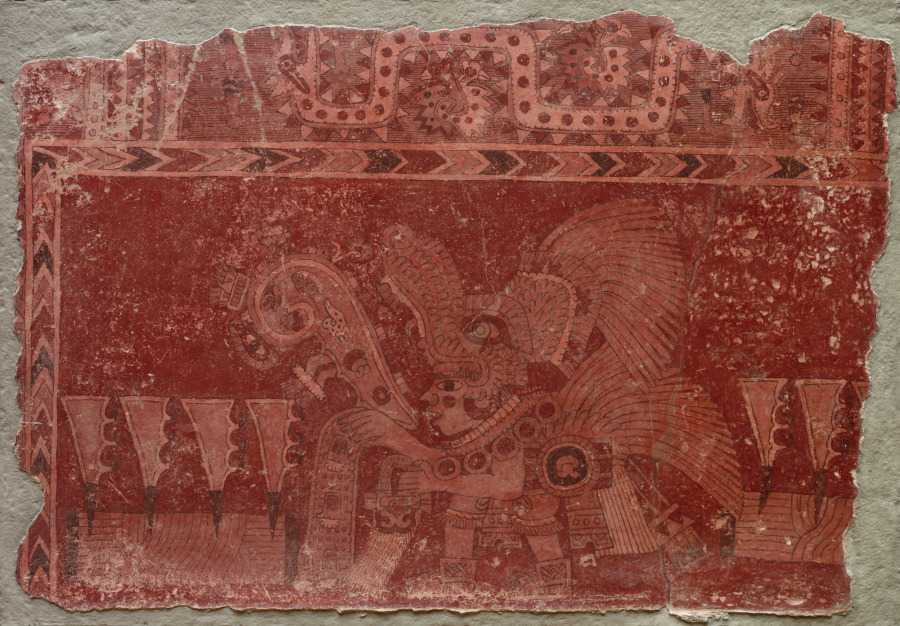
Mural Fragment with Elite Male and Maguey Cactus Leaves

Maker unrecorded · 500–550

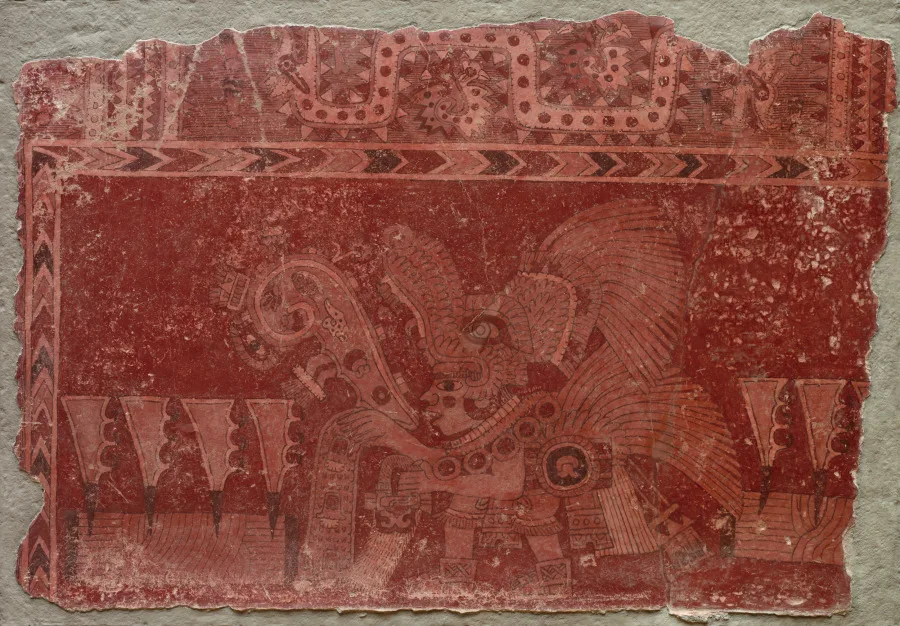
A red-toned wall-painting fragment shows an elaborately dressed profile figure with a large feathered headdress. A curling form extends from the mouth, and decorated streams fall from an outstretched hand. Tall pointed plant-like forms stand on either side. Patterned bands frame the scene, and irregular broken edges interrupt the upper painted register.
100%

Drag to move · Pinch or +/− to zoom · Arrow keys to pan · 0 to reset

The Cleveland Museum of Art · 1963.252 · Image: CC0Museum image ↗
A little context

A curling form turns sound into something visible, while an outstretched hand sends a painted offering downward.

The figure seems to send forms out into the space ahead. A large curl leaves the mouth, and another decorated stream descends from a hand. These are not attempts to reproduce only what a camera could capture: they make chanting and an offered liquid visible through pictorial conventions. Dress and a great feathered headdress establish an elaborate public presence.

The museum describes this elite figure as part of a repeated procession around a patio in a Teotihuacán residential compound. The fragment therefore once participated in an architectural sequence, not an isolated framed picture. It identifies a mouth scroll, a flower-filled libation and an incense bag. The nearby maguey forms may relate to blood offerings and a beverage made from the plant's sap, but that association remains qualified. Reading the fragment means distinguishing visible conventions, reconstructed architectural repetition and proposed ritual significance instead of treating all three as equally certain.

A careful reading

The specific apartment-compound attribution and meanings of the maguey forms are qualified. The fragment does not preserve the complete patio composition; only the surviving figure and surrounding sections are directly visible.

Try your eye

What does the curling mouth scroll make visible according to the museum?

Where this reading begins

Our observations describe the supplied museum photograph. Historical identifications and context follow the cited collection record; interpretive limits are stated above. This is an independent guide, not a museum endorsement.

Image rights & attribution

Mural Fragment with Elite Male and Maguey Cactus Leaves, 500–550. Central Mexico, Tlacuilapaxco apartment compound(?), Teotihuacán style, Classic Period. Fresco on wall fragment; overall: 83.2 x 116.2 cm (32 3/4 x 45 3/4 in.). The Cleveland Museum of Art, Purchase from the J. H. Wade Fund, 1963.252

Individual API record marked CC0; checked 2026-11-13. CC0 1.0 dedication. Record date: 2026-05-29 07:06:46.244000. Web JPEG downloaded unchanged; responsive WebP and zoom derivatives resized and recompressed; numbered annotation overlay separate from image.