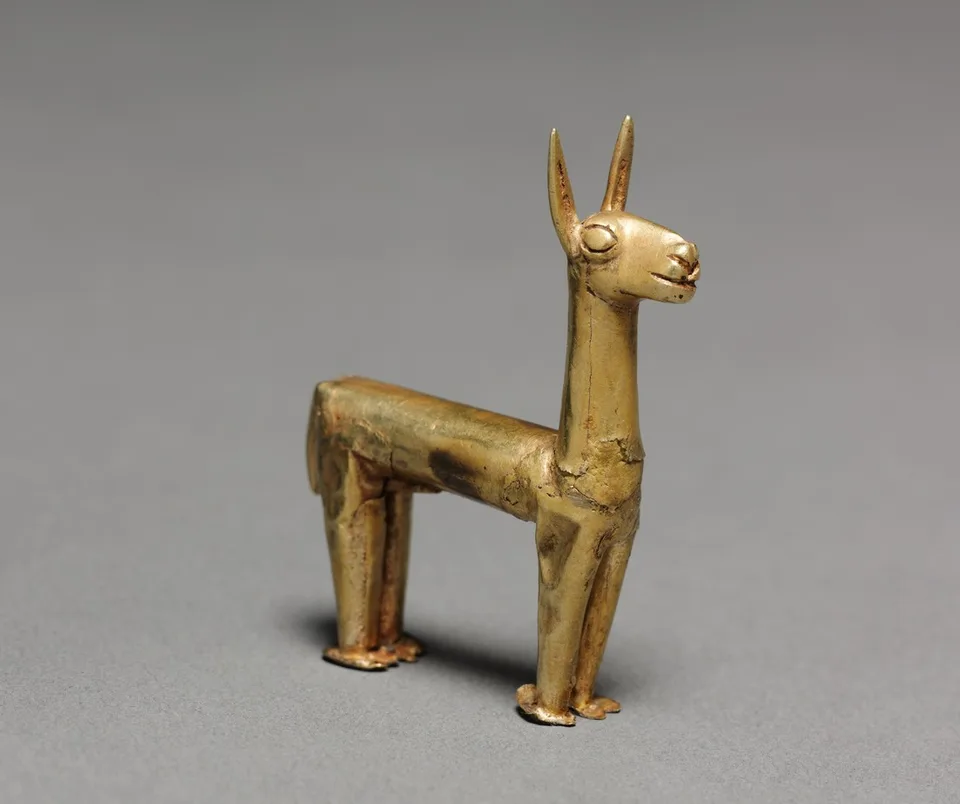
 Peru, Bolivia, Chile or Ecuador, Inka style (1400-1532) · 1400–1532
Llama Figurine
Maker unrecorded
hammered gold
Gold makes both objects visually striking, but their forms and fabrication differ. The llama uses hammered metal and visible joins; the pendant uses intricate casting and openwork. Follow what the material does before assuming that preciousness gave both objects the same social or religious role.
Peru, Bolivia, Chile or Ecuador, Inka style (1400-1532) · 1400–1532Maker unrecorded
hammered gold
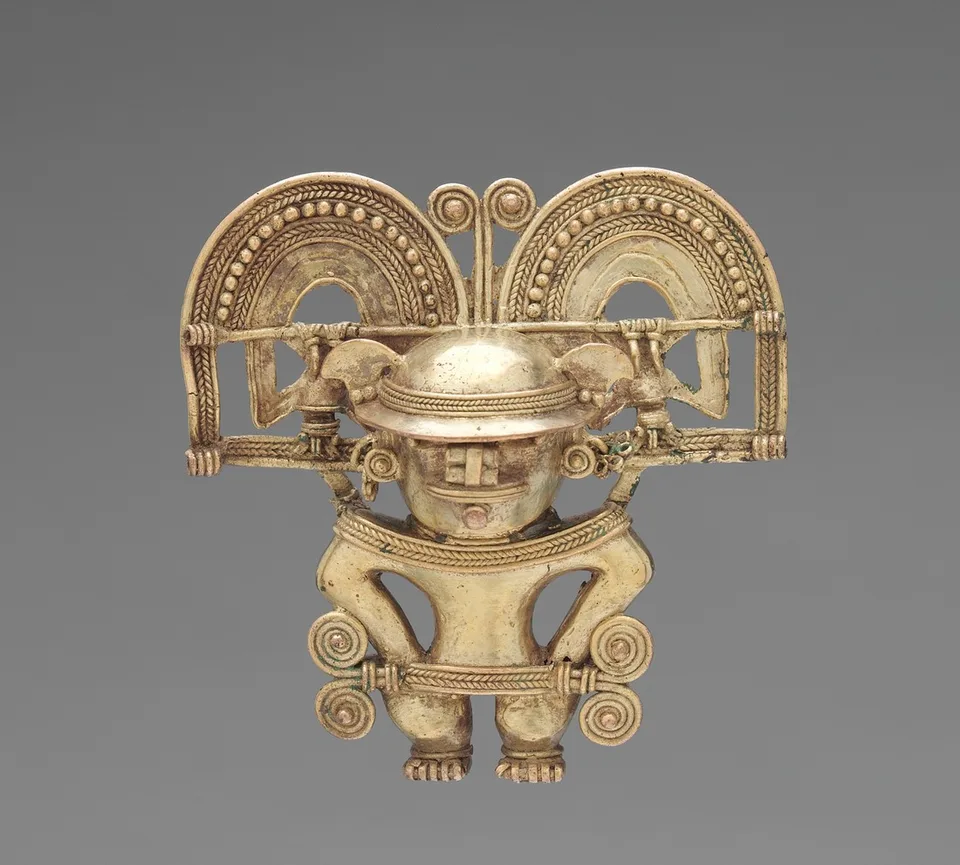 Colombia, Tairona · 900–1550
Maker unrecorded
cast gold
The llama’s tall ears and neck establish an economical animal silhouette. The pendant’s paired arches enlarge a compact human-like figure into a broad symmetrical emblem. Each makes a recognizable outline with different proportions and structural demands.
Uneven joins around the llama’s chest reveal assembly from worked gold. Tiny hanging bats within the pendant’s framework demonstrate the detailed modeling possible with lost-wax casting. Seams and openwork offer different kinds of evidence about fabrication.
The llama’s compact horizontal body is readily identifiable as an animal. The pendant’s lip ornament contributes to an elaborate human-like figure whose meaning remains uncertain. Detailed regalia does not make a ruler’s identity as secure as the llama’s animal form.
Inka offering contexts cannot be transferred to a Tairona pendant, and the pendant’s conventional chieftain label remains uncertain. Shared gold does not imply shared use.
The comparison of visible choices is our own reading. Follow either artwork page for its full context, uncertainty note and image-rights record.
Five objects connect imagery with gripping, wearing and attachment.
Four legible images whose exact settings or meanings remain unresolved.