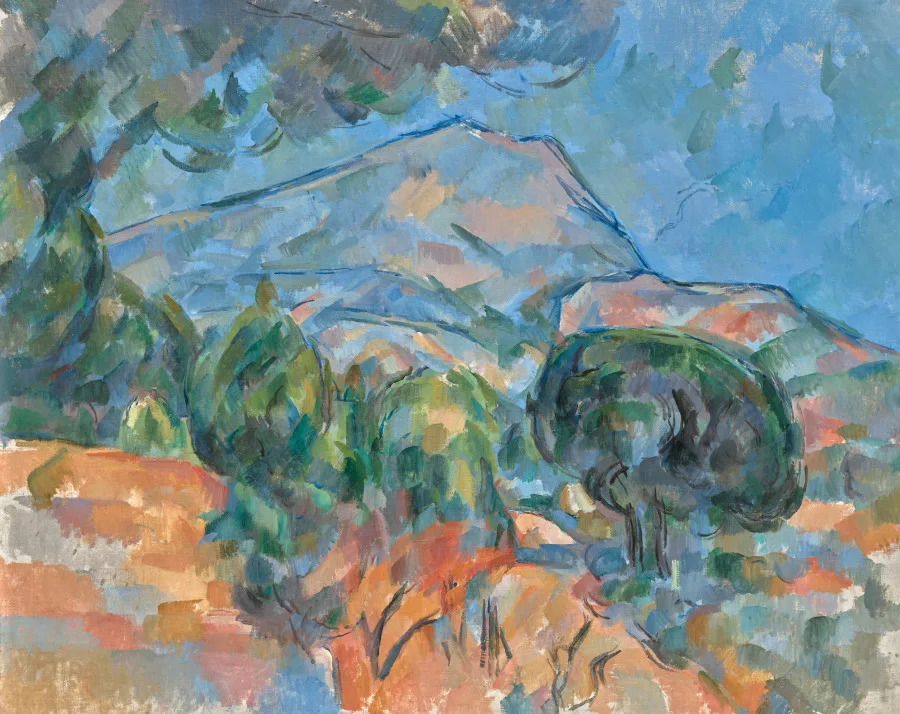
 France, late 19th-early 20th Century · c. 1904
Mount Sainte-Victoire
Paul Cezanne (French, 1839–1906)
oil on fabric
Both landscapes build a distant mountain through visible paint, but one organizes recurring forms while the other preserves documented incompleteness. Compare edges, scale references, and degrees of finish without assuming that every open passage means the same thing.
France, late 19th-early 20th Century · c. 1904Paul Cezanne (French, 1839–1906)
oil on fabric
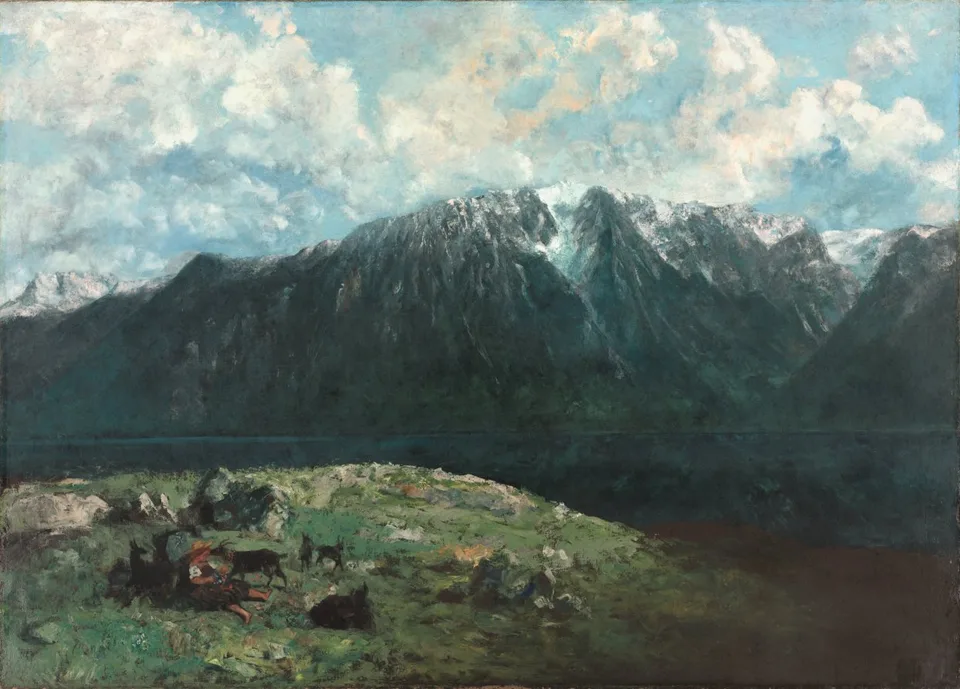 France · 1877
Gustave Courbet (French, 1819–1877)
oil on fabric
Cézanne gives the pale ridge an interrupted blue contour. Courbet distinguishes snowy peaks from softer clouds through contrasting marks and paint densities. Each makes a distant form legible through handling, rather than treating the mountain as an untouched fact transferred onto the canvas.
Cézanne’s rounded umbrella pine stands before the angular ridge. Courbet places small animals on the near slope beneath a long mountain wall. Both provide recognizable nearer forms, but they establish depth and immensity through different scales and shapes.
The branch in Cézanne’s painting echoes the mountain and links distances through direction. Courbet’s sparsely worked lower corner is documented as unfinished at his death. Visible openness can be part of an organized surface or an interrupted process; context prevents a simplistic equation.
The comparison concerns pictorial construction, not a claim that the mountains or working methods are identical. Courbet’s unfinished status is documented; it should not be generalized to every loosely worked landscape.
The comparison of visible choices is our own reading. Follow either artwork page for its full context, uncertainty note and image-rights record.
Distance emerges through marks, scale, edges and degrees of finish.
A stag, a jungle, a mountain and a textile take different routes from nature into art.