Building a landscape
A landscape is constructed from decisions about what to clarify and what to leave less definite. Follow five different approaches to water, mountains and trees. The route compares visible organisation rather than ranking accuracy, and distinguishes source-supported site identifications or unfinished passages from meanings we might be tempted to invent for them.
Begin the journey ↓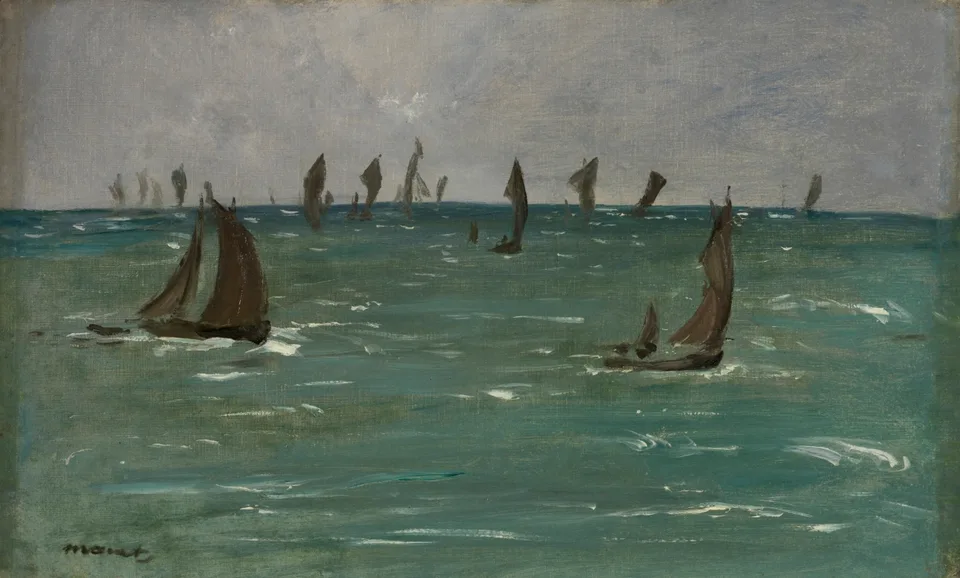
Boats diminish into marks
Small sails near the waterline answer larger vessels closer to us. Their reduced scale creates distance without detailed descriptions of every boat. Look for how spacing and definition carry the sea outward beyond the most legible foreground forms.
Carry this question: How little information is needed for a distant boat to remain recognisable?
Open the artwork ↗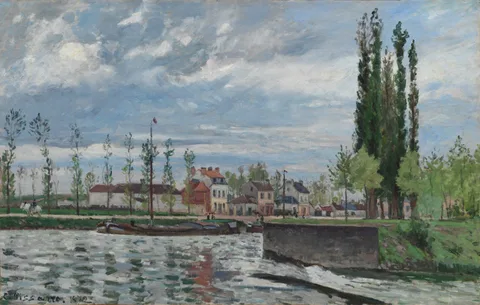
Masonry steadies moving water
The lock creates a firm geometric shape among broken strokes of water and foliage. This is a worked landscape, with infrastructure shaping the river. Rapid-looking marks alone do not establish the museum’s proposed single-session execution as a certainty.
Carry this question: Which edges feel most stable against the moving water?
Open the artwork ↗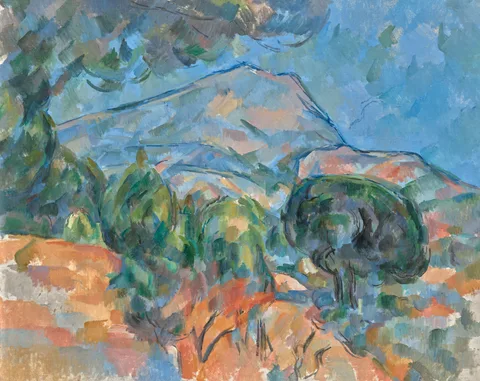
Near and far share a direction
The foreground branch echoes the mountain’s slope, connecting separate depths through related angles. Compare this with Manet’s changes of scale. A landscape can hold together through repeated directions as well as through a gradual reduction in detail.
Carry this question: Where does the branch repeat or depart from the ridge behind it?
Open the artwork ↗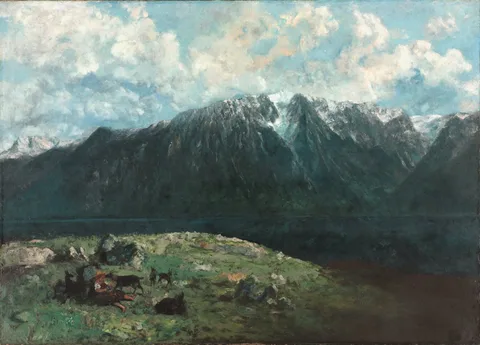
An interrupted process remains visible
The sparsely described corner differs sharply from the worked mountain and sky. The museum documents the painting as unfinished at Courbet’s death. This evidence supports a discussion of process without assuming that every open passage was intended as a final effect.
Carry this question: How does the unfinished corner change your attention to the worked areas?
Open the artwork ↗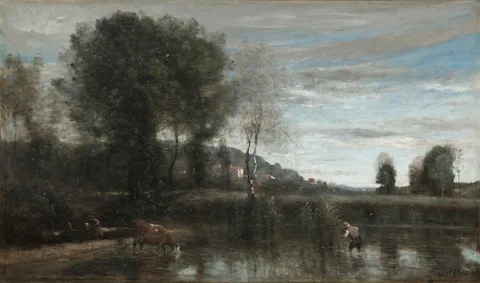
The shore softens into atmosphere
Distant buildings lose contrast across the pond. The museum relates Corot’s late manner to observation and memory, but a specific private recollection cannot be recovered from the paint. Follow the visible softening before naming an emotional response.
Carry this question: Which boundaries dissolve first as your eye travels across the pond?
Open the artwork ↗Look at a pair more closely
- A mountain and the work of painting
Cézanne’s Sainte-Victoire and Courbet’s Alpine panorama
- Water with and without boats
Manet at Berck and Homer at Prouts Neck
Read with the sources
Historical context follows the individual museum records linked on each artwork page. These routes make original comparisons of visible form; resemblance alone is not evidence of shared meaning or direct influence.