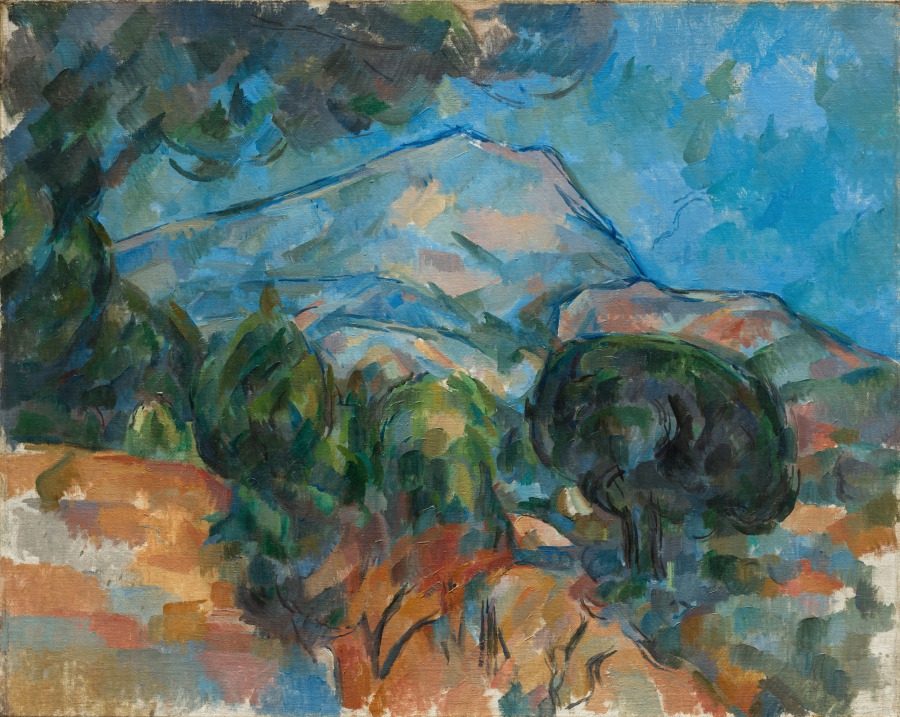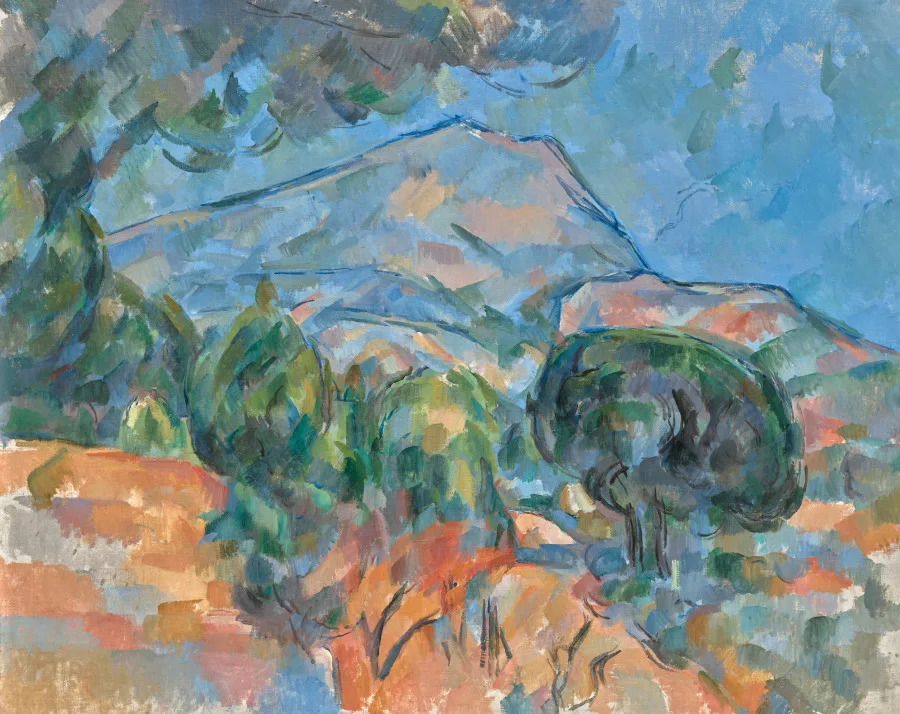
A nearby branch echoes a distant mountain, joining different depths through a shared direction on the canvas.
The mountain is recognizable, but its surface is built from patches rather than a continuous wash of shading. Pale blue, pink, and cream meet beneath an emphatic blue contour. In front, green trees and orange ground break into similarly distinct strokes. Cézanne makes near and far belong to the same visible system of painted decisions without flattening them into identical shapes.
The museum identifies this as a view from a road east of Aix-en-Provence, where the artist could see two umbrella pines and Mount Sainte-Victoire. He returned to the mountain repeatedly during his final decades. This particular view gains coherence from the branch entering at the upper left: its slope echoes the mountain behind. Trace that correspondence, then compare the rounded pine at the right with the angular ridge. Repetition does not mean sameness; the landscape holds together through related directions, contrasting shapes, and colors that recur across different distances.
The museum identifies the site and the relationship of branch and mountain. A painted patch should not automatically be assigned a fixed symbolic meaning, and repeated visits do not make this one canvas a complete record of the changing place.