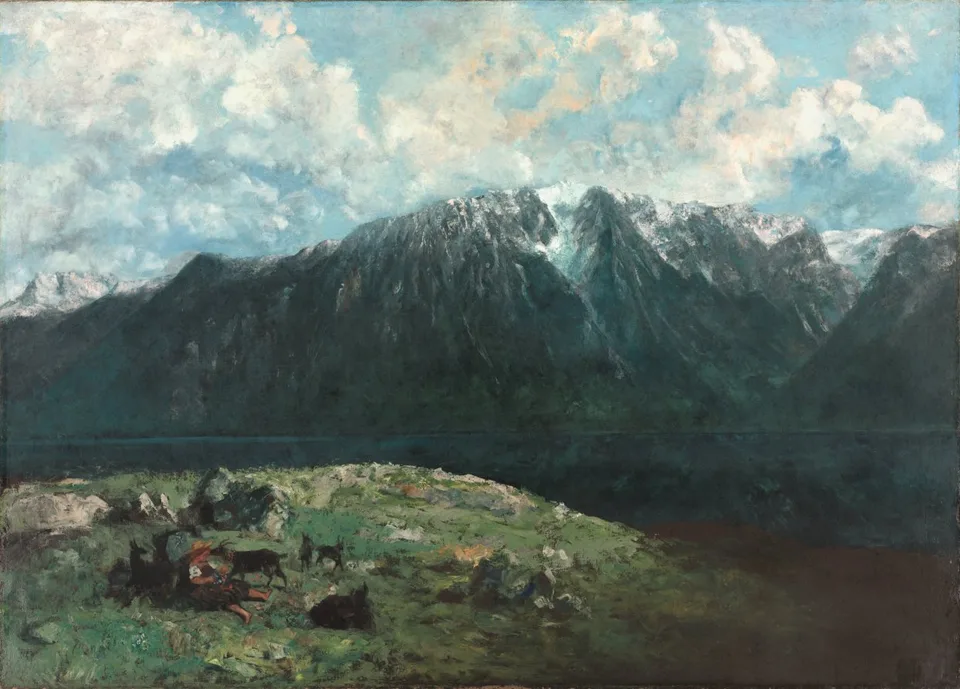
The mountain panorama holds two kinds of evidence: a view across Lake Geneva and the unfinished work of making it.
The mountains create a formidable dark wall beneath a shifting bank of clouds. Pale snow catches along their upper ridges, while a narrow band of water separates them from the nearer grassy slope. Small grazing animals help establish the foreground’s scale. The contrast between tiny bodies and the long range gives the scene its breadth without placing a large human figure at its center.
Courbet painted this view toward Les Dents du Midi while living in exile in Switzerland after the Paris Commune. The museum records that it remained unfinished when he died in 1877. That history helps explain the broadly unresolved lower right, but it should not make us dismiss the finished-looking passages. Compare the worked mountain and cloud surfaces with the exposed, simplified foreground: the picture offers an unusually direct opportunity to distinguish different stages and densities of paint. It is both a landscape and a material record of an interrupted process.
The unfinished lower right is documented by the museum. Its present appearance should not be treated as a deliberate abstract statement, and the landscape’s emotional tone cannot establish exactly what Courbet felt during exile.
What supports calling the lower right unfinished?
Practise looking at Panoramic View of the Alps, Les Dents du Midi →