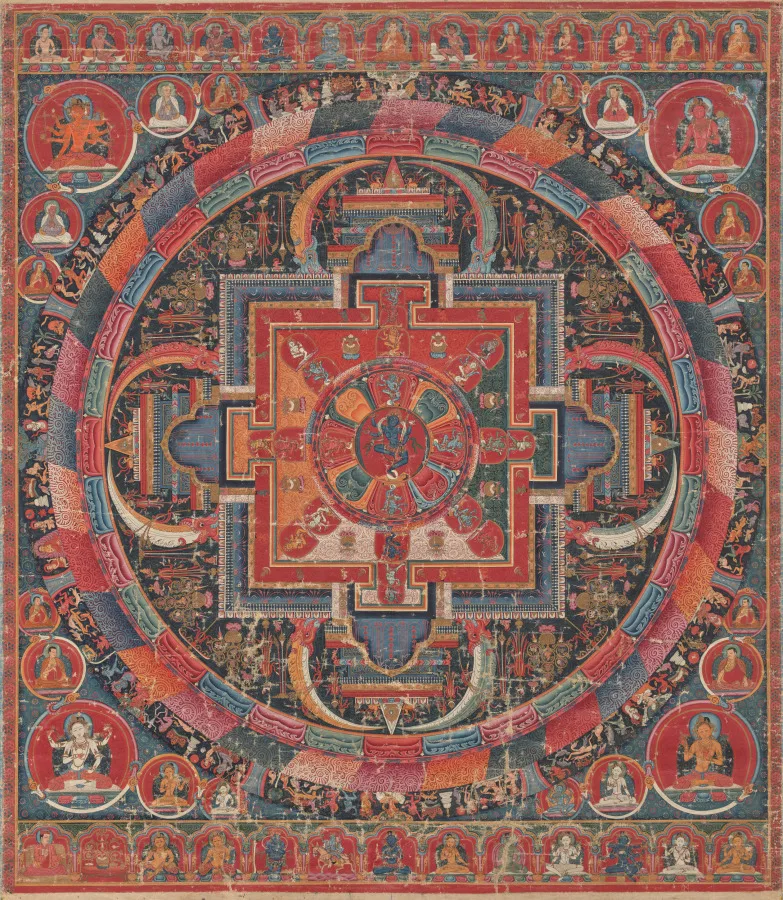
 Central Tibet · c. 1375
Twenty-three Deity Nairatma Mandala
Maker unrecorded
Gum tempera, ink, and gold on cloth
One image presents a strongly organised sacred structure; the other disperses attention across water, plants and reflections. Compare routes of looking while respecting the very different purposes of a Tibetan Buddhist painting and Monet’s garden subject.
Central Tibet · c. 1375Maker unrecorded
Gum tempera, ink, and gold on cloth
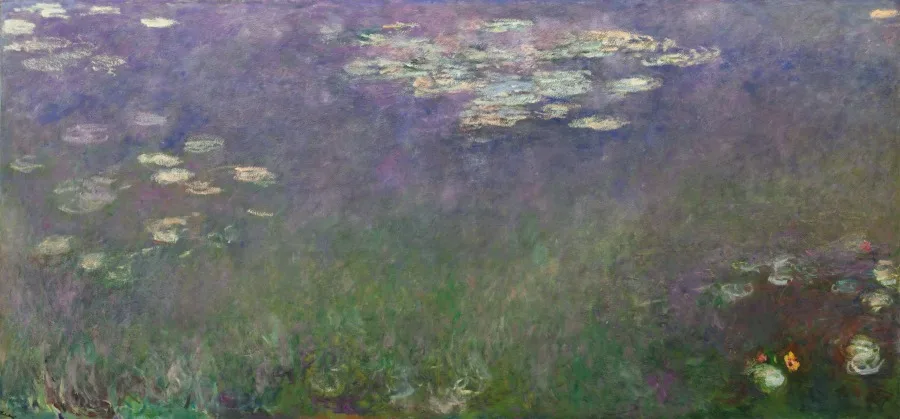 France, late 19th century-early 20th century · c. 1915–26
Claude Monet (French, 1840–1926)
oil on canvas
The mandala establishes a centre through surrounding forms. In Water Lilies, attention can move among patches and reflections without settling on a single figure. Notice how your route differs.
The mandala’s enclosing structures organise relationships. Monet’s transitions often soften boundaries between water, reflection and painted mark. Each approach gives a different role to the edge of a shape.
Lineage teachers occupy the mandala’s upper border, locating its diagram within traditions of instruction. Monet’s water and colour continue to the canvas edge without a visible shore. Compare those boundaries while preserving their different purposes: the museum stresses teachers’ guidance in understanding the mandala.
A resemblance in pattern does not make these works spiritually equivalent. The mandala is not simply decorative geometry, and the comparison makes no claim about Monet adopting its ritual structure.
The comparison of visible choices is our own reading. Follow either artwork page for its full context, uncertainty note and image-rights record.
Flowers, birds and animals change meaning with context.
A view is constructed, not simply copied.