Ways of making space
A deep landscape, a shallow surface and a patterned sacred diagram organise attention differently. None needs to be judged against one model of realistic space. In these works, follow the route your eye takes: through overlapping shapes, across bands of colour, around a centre or toward a distant landmark.
Begin the journey ↓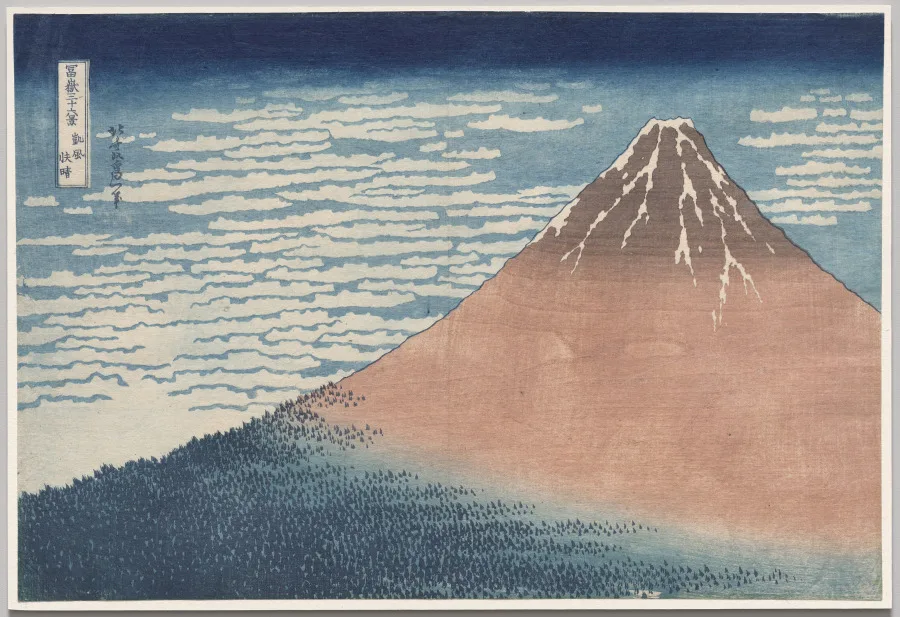
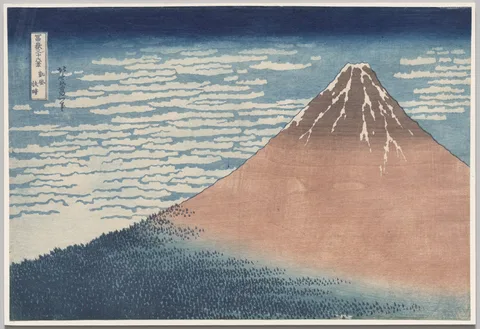
A mountain and a few bands of colour
The mountain’s silhouette separates areas of sky and land with striking economy. Attend to the contrast between the large slope and small patterned details; scale does not require crowded description.
Carry this question: Which boundary makes the mountain feel largest?
Open the artwork ↗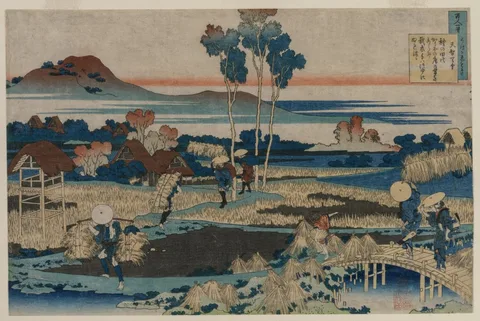
Work distributed across a landscape
Follow the fields and figures through the composition. A landscape can organise different activities rather than merely offer a scenic view. The arrangement encourages patient movement from one part to another.
Carry this question: How does the image lead you from foreground activity toward distance?
Open the artwork ↗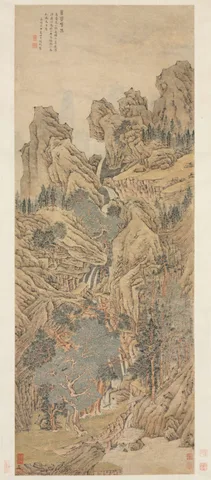
Small figures, extensive setting
Locate the tiny qin player beneath the trees, then follow the rocks and waterfall upward. The contrast in scale makes the musician part of a much larger setting. The record attributes the painting to an imitator of Wen Zhengming; a suggested connection to Lu Zhi remains a scholarly proposal, not a settled maker’s name.
Carry this question: Where does the composition give you room to pause?
Open the artwork ↗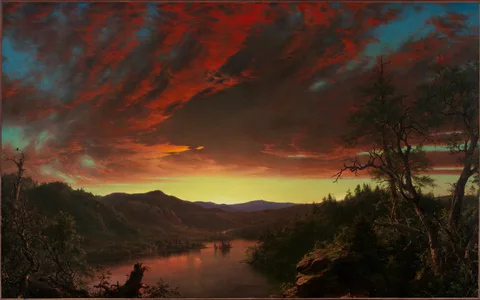
Distance through light
Follow the layers from near forms to the illuminated sky. Church’s landscape is constructed through colour and contrast as well as descriptive detail. The emotional effect is a reading to discuss, not a measurable fact.
Carry this question: Which layer feels farthest away, and what creates that effect?
Open the artwork ↗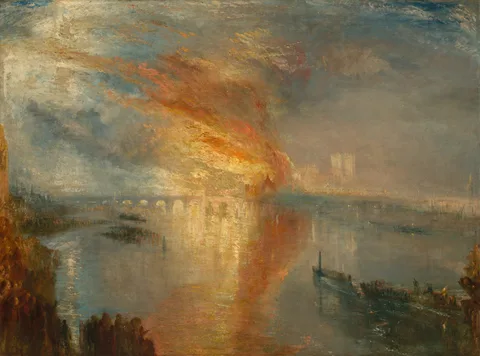
Architecture inside atmosphere
The building and bridge give structure to a scene dominated by light and smoke. Look for recognisable forms that keep the event legible as paint dissolves clear boundaries.
Carry this question: Where does solid structure give way to reflection or flame?
Open the artwork ↗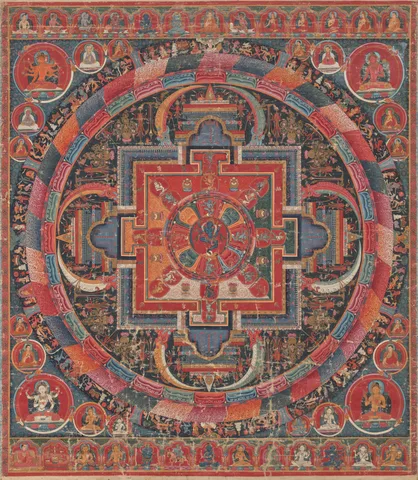
A space organised around a centre
A mandala’s ordered arrangement differs from a landscape view. Read the centre, surrounding figures and boundaries as a designed religious structure, using the record for specific identifications.
Carry this question: How do repeated forms direct attention toward the centre?
Open the artwork ↗Look at a pair more closely
- Making atmosphere visible
Hiroshige’s rain and Turner’s fire-lit atmosphere
- Two ways to organise attention
A Nairatma mandala and Monet’s Water Lilies
Read with the sources
Historical context follows the individual museum records linked on each artwork page. These routes make original comparisons of visible form; resemblance alone is not evidence of shared meaning or direct influence.
- South Wind, Clear Sky, from Thirty-Six Views of Mount Fuji — museum collection record
- Poem by Emperor Tenchi, from the series One Hundred Poems by One Hundred Poets Explained by the Nurse — museum collection record
- Playing the Qin in a Secluded Valley — museum collection record
- Twilight in the Wilderness — museum collection record
- The Burning of the Houses of Lords and Commons, 16 October 1834 — museum collection record
- Twenty-three Deity Nairatma Mandala — museum collection record