Read the
Picture
An open collection
France, late 19th century-early 20th century · Painting

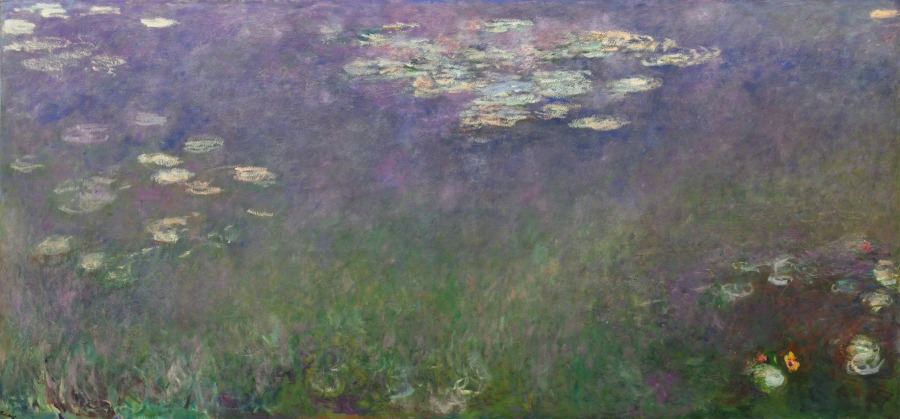
Water Lilies (Agapanthus)

Claude Monet (French, 1840–1926) · c. 1915–26

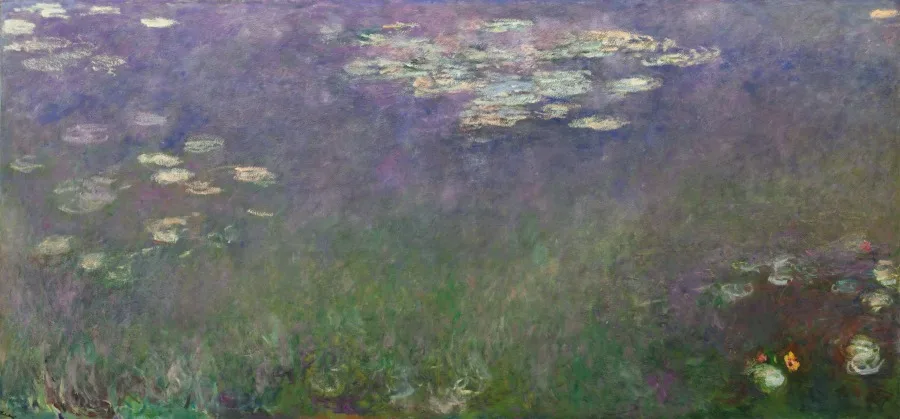
A very wide painting shows a pond in soft violet, blue, and green. Pale lily pads and flowers cluster toward the upper left and middle. Long green strokes descend through the lower water, with several pink and yellow accents at the lower right. No bank, horizon, or sky is directly visible.
100%

Drag to move · Pinch or +/− to zoom · Arrow keys to pan · 0 to reset

The Cleveland Museum of Art · 1960.81 · Image: CC0Museum image ↗
A little context

Start with a lily pad, then let your eye slip between the surface of the pond and its reflections.

Where does the water end and the reflected world begin? Monet makes that a rewarding question rather than a puzzle with one answer. Small, pale clusters give us recognizable water lilies, while broader passages of blue, violet, and green make the pond harder to measure. There is no horizon to fix our viewpoint. Follow one long stroke and it may seem to belong to vegetation, reflected light, or paint itself.

This large canvas grew out of Monet’s sustained study of the garden he developed at Giverny in France. The museum connects it with his attention to light both entering the water and reflecting from its surface. At more than four metres wide, the original can occupy much of a viewer’s field of vision. A screen cannot recreate that scale, but zooming out and in lets you experience the shift between a coherent watery atmosphere and the individual marks that produce it.

A careful reading

The image records a painted interpretation of a cultivated pond, not a botanical survey. A colored mark need not correspond to a separately identifiable plant or carry a fixed symbolic meaning.
Try your eye

Which visible choice makes the pond feel difficult to measure?

Where this reading begins

  • Water Lilies (Agapanthus) — collection record — The Cleveland Museum of Art. Documents Monet’s Giverny garden, reflected and penetrating light, the omitted horizon and banks, and the canvas’s 425.6 cm width. The reading of individual paint marks comes from this image. 2026-11-11; accessed 2026-11-16.

Our observations describe the supplied museum photograph. Historical identifications and context follow the cited collection record; interpretive limits are stated above. This is an independent guide, not a museum endorsement.

Image rights & attribution

Water Lilies (Agapanthus), c. 1915–26. Claude Monet (French, 1840–1926). Oil on canvas; framed: 204.9 x 430.3 x 6 cm (80 11/16 x 169 7/16 x 2 3/8 in.); unframed: 201.3 x 425.6 cm (79 1/4 x 167 9/16 in.). The Cleveland Museum of Art, John L. Severance Fund and an anonymous gift, 1960.81

Individual API record marked CC0; checked 2026-11-13. CC0 1.0 dedication. Record date: 2026-11-11 12:58:23.339000. Web JPEG downloaded unchanged; responsive WebP and zoom derivatives resized and recompressed; numbered annotation overlay separate from image.